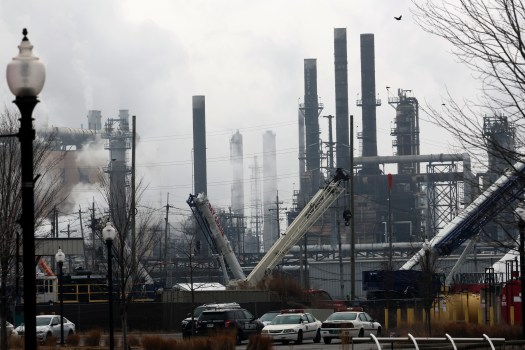

Flares went off at BP’s Whiting refinery Sunday night after a “brief loss of electric power disrupted operations,” according to a company statement.
“Power has been restored and operations are stable,” the BP statement said. “The power interruption was system-related and not the result of operator actions. We have experienced and highly qualified operations teams and established safety and communications protocols in place to engage stakeholders.”
The Whiting refinery “continuously monitors” air emissions, including during flaring. Officials report results to regulators “in compliance with its operating permit,” according to BP.
Lisa Vallee, a Whiting resident, said in a text message that she did not receive a company alert about the flares, even though she’s signed up for text and email alerts. Alarms went off for hours Sunday night, Vallee said.
A company spokesperson was unable to immediately comment on whether community members and United Steelworkers Local 7-1 members picketing outside the refinery were made aware.
USW 7-1 President Eric Schultz told the Post-Tribune Wednesday that the union wasn’t notified about the flares, and picketers outside the refinery weren’t notified. Schultz said workers inside the refinery were told the shelter-in-place Sunday night.
Picketers evacuated Sunday night and returned Monday morning, Schultz said.
“They were smelling sulfur and hydrogen sulfide,” he added. “Who knows what else (they smelled), but those are the two that you could pick up on. We’re pretty well accustomed to what those smell like inside the refinery.”
Schultz believes the issue is a corporate issue, and the union doesn’t blame replacement workers for the response to the flaring. He’s worried that replacement workers are more at risk in situations like Sunday night.
“My concern is (replacement workers) haven’t had to go through training courses,” Schultz said. “They might have done some computer-based trainings and some walk-throughs, but they don’t have the real-world experience for what happens (in situations) like that.”
The Indiana Department of Environmental Management was notified by refinery officials Monday morning about the flaring event Sunday.
“IDEM Emergency Response personnel responded to the site and began assessing any potential environmental impacts,” the IDEM statement said. “As part of this assessment, a nearby outfall to Lake Michigan was inspected, and no evidence of petroleum entering the lake was found.”
As part of its IDEM permit, BP is required to report any emissions that deviate from the standards in the Clean Air Act, according to the agency statement.
“IDEM will review BP’s incident reports and take appropriate action if any violations are identified,” the statement said. “IDEM will continue to monitor the situation and work with BP to ensure the refinery remains in compliance with all state and federal environmental regulations.”
mwilkins@chicagotribune.com