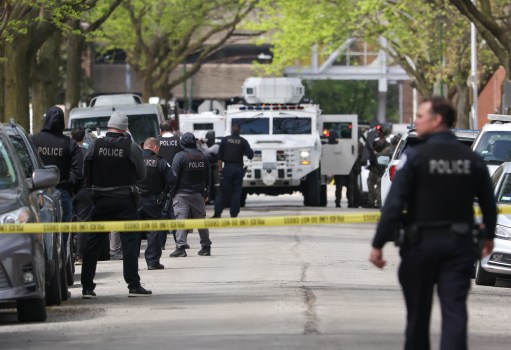

Chicago police Officer John Bartholomew, shot to death on Saturday by a suspect while he was in custody, should be alive today.
The alleged shooter, 26-year-old Alphanso Talley, was ordered detained Monday by Cook County Circuit Court Judge Luciano Panici. Talley is accused of murder and attempted murder, among numerous other charges, in the death of Bartholomew, 38, and the grave wounding of his 57-year-old partner, who hasn’t been identified.
As Assistant State’s Attorney Mike Pekara described the scene in court Monday, Talley, who’d been captured and arrested early Saturday in the suspected armed robbery of a Family Dollar store in Albany Park, was taken by police at his request to Endeavor Health Swedish Hospital in the Lincoln Square neighborhood. At the hospital, while in custody and guarded by the two officers, Talley was uncuffed to prepare for a CT scan after which he reached under a blanket, pulled out a handgun and shot Bartholomew in the head and his partner in the face, the prosecutor said.
Talley then fled naked from the hospital and soon was recaptured. But a Chicago police officer was dead and another was critically wounded.
How Talley had access to the gun after being in the custody of officers and subject to a metal-detecting search by hospital personnel remains mysterious. Clearly, he shouldn’t have possessed a weapon in those circumstances. Those questions will need to be answered in due course.
But we wish to address another, broader concern underscored by this tragedy.
There clearly are far too many like Talley who are subject to arrest and wandering our streets freely for weeks, if not months after warrants are issued. We’ve raised alarms before about Cook County’s apparent systemic issue with enforcing conditions of release for those charged with violent crimes. Recent horrific tragedies have demonstrated the urgent need to improve Cook County’s process for enforcing warrants, too.
In Talley’s case, there were three outstanding warrants for his arrest when he allegedly robbed the Family Dollar store with an accomplice, who remains at large. Cook County Circuit Court Judge John Lyke Jr. had issued a warrant for Talley’s arrest on March 11 after Talley failed to appear in his courtroom on charges of carjacking and armed robbery, according to the public-safety reporting outlet, CWBChicago.
That was six weeks before Saturday. We don’t know what attempts were made in that intervening period to enforce the warrant for Talley’s arrest, but we do know they weren’t sufficient.
We really can’t think of any decent reasons for Talley to be roaming the city on Saturday. His arrest should have been a high priority. Carjacking and armed robbery aren’t minor offenses, and Talley had a lengthy criminal record. Additionally, the Illinois Department of Corrections had labeled Talley an absconder for failing to abide by parole conditions. By virtually any reasonable definition, Talley posed a danger to the community.
Bartholomew isn’t the first recent high-profile victim to lose his life to someone with an outstanding warrant. On March 19, Loyola University freshman Sheridan Gorman was shot dead while at the lakefront in the early-morning hours with friends. The man charged with the killing, Venezuelan migrant José Medina, was subject at the time to an outstanding warrant issued in September 2023 for a shoplifting charge.
Both of these killings are brutal tragedies for the families and friends of those lost.
For Chicago, the shocking crimes are noteworthy contributors to its tattered national reputation — fair or not — for being unsafe and for criminal-justice policies perceived as being concerned more with the rights of those accused than the interests of those victimized.
Cook County Chief Judge Charles Beach II, who took over that office late last year, in late January instituted reforms of the county’s electronic monitoring system, which had become a source of intense controversy after a series of violent crimes committed by those awaiting trial on charges of committing other violent crimes but who were permitted to be confined at home.
Electronic monitoring has become a flashpoint since Illinois’ enactment of the 2021 SAFE-T Act, which made us the nation’s first state to eliminate cash bail. As it pertains to violent crime, the law made judges’ opinions the only real safeguard against the commission of additional crimes while the justice system runs its course after charges are filed. Those who judges deem not to pose a threat to public safety generally are allowed certain times during the week to attend to personal business and otherwise are ordered confined at home, with those conditions enforced via electronic monitors.
The jury is out on Beach’s reforms, which is understandable since they’ve been in effect for not quite three months and he still is hiring more personnel to strengthen electronic-monitoring enforcement.
But what seems absolutely clear in both the Talley and Medina cases is that Cook County’s system for enforcing warrants isn’t working.
A Chicago police officer is dead and another is fighting for his life as we write. The system failed them, just as surely as it failed Sheridan Gorman.
It’s not too much to ask that those who don’t show up for court hearings — particularly those like Talley who are accused of violent crimes — face timely consequences for failing to do the bare minimum while the system permits them to walk free among us.
Much as last year’s crisis around electronic monitoring called for Beach’s rapid intervention, so too must county officials immediately overhaul our process for enforcing court warrants.
Submit a letter, of no more than 400 words, to the editor here or email letters@chicagotribune.com.