To inform voters and to help the Chicago Tribune Editorial Board make endorsements, the board posed a series of questions to the candidates running for alderman. See their answers below. See how other candidates answered here.
Name: Mueze Bawany
Ward: 50th
Current job: Teacher, Chicago Public Schools
Previous political experience: N/A
Education: BA Northeastern Illinois University
Spouse’s occupation: N/A
Sources of outside income: N/A
The rise in violent crime remains a top priority for City Hall. Homicides, shootings and carjackings are all unacceptably high. Tell us how city government can be innovative in combating crime, and explain what measures you would propose if elected.
Everyone deserves to feel safe in the neighborhoods they call home and it’s become abundantly clear that addressing the problem of crime requires both immediate and long-term solutions. Most immediately, we need to relieve the burden on police by expanding the existing mental health first responder pilot program so that crisis workers and paramedics respond to non-violent 911 complaints in every Chicago neighborhood. As reported by the Tribune recently, there is a disconcerting lag in the immediacy of police response to 911 calls that call for “immediate” responses. The CPD remains plagued by staffing shortages with the latest reports stating that there are at least 1,600 open positions within the CPD that are not being filled leading to officer burnout. The aforementioned pilot program would help relieve police officers of duties that they are tasked with but have not been trained for.
In the longer term, we need to address the root causes of violence which requires a multi-pronged approach. This includes creating re-entry programs that focus on supporting those leaving jail with connections to work, housing, and additional life-line programs that ensure that people are not returning to jail and finding support as they re-enter society. We need to open a dedicated Office of Gun Violence Prevention as it’s undeniable that the relative accessibility to guns in the US makes violent crime all the more deadly and carjackings all the more possible. I will continue to champion the Treatment not Trauma campaign to support the reopening of Chicago’s public mental health clinics closed under Rahm Emanuel’s tenure.
The CTA, one of the nation’s largest transit systems, remains a troubled agency grappling with issues ranging from violent crime and ghost buses and trains, to flagging ridership. Give us your thoughts on what specific measures CTA should take to make train and bus service safer, more reliable and more equitable for Chicagoans.
Incentivizing ridership Perhaps somewhat paradoxically, taking measures to increase and restore ridership helps to address issues of flagging ridership and crime on CTA buses and trains as it provides security by way of passive monitoring which in turn deters crime. One measure that we can take to do that would benefit the common good in multiple respects is to make the CTA free for CPS students. Given the success of the “First Day, Free Rides” campaign, making the CTA free for all students can culturally inform mass transit use as well as encourage school attendance. In addition to CTA students, I would extend this offer for free ridership to seniors as well.
Reinstating unarmed conductors on CTA trains The position of unarmed conductors was eliminated in 1998 as a cost-cutting move by the CTA and should be reinstated. In other metropolitan areas of the country, unarmed conductors have been proven to be very effective in increasing not just rider and driver safety but also their sense of safety.
Passing the Bring Chicago Home ordinance The rise of the number of people experiencing homelessness in the city has seen an increased number of unhoused Chicagoans turning to trains and buses for shelter. The Bring Chicago Home ordinance’s proposal to restructure the Real Estate Transfer Tax on properties over $1 million as a means of providing affordable housing for the unhoused should be passed in City Council, and if elected, I promise to make every effort to advance this in City Council.
Ten years ago, enrollment at Chicago Public Schools was 403,000 students. In September, enrollment stood at 322,000 students. Enrollment at CPS has dropped for 11 consecutive years. What specific measures should CPS undertake to reverse the trend of ever-dwindling enrollment?
We need to work to eliminate the current system of student-based budgeting (SBB) program in CPS that does not take into account the welfare, socioeconomic needs, language acquisition barriers and literacy gaps amongst other measures that prevent students from thriving in schools and thus leads them to drop out of school. Moving towards a transformative equity-based model that takes these metrics of student welfare (or lack thereof) into account is crucial. Such a model requires generating sustainable community school status to schools that need extra support; we must increase funding and staffing as it has been well-proven that smaller class sizes increase the quality of education received by students, especially those that require extra support and/or attention. A disproportionate number of students who drop out also have special education needs and we need to bolster our funding for special needs education which is often among the first departments at the mercy of cost-cutting measures with every school budget cut.
Disinvestment on the South and West sides is a decades-long problem with myriad causes. Give us at least one innovative idea that you believe could play a role in reversing South and West side disinvestment, and explain why the idea is realistic and feasible.
Interestingly, addressing disinvestment on the South and West sides (the most blighted areas of our city as the question indicates) was the ostensible purpose of the creation of TIF districts but the misuse of this program has prevented TIFs from fulfilling this purpose. We need more oversight into TIFs and I believe that this is best done by democratizing how TIF money is utilized and mobilized. Of course, this requires a degree amount of public education around the intricacies of TIFs but at this in itself is not an unworthy endeavour as the Civic Illumination Project has demonstrated. In a similar manner as participatory budgeting efforts across wards have undertaken, and undertaken well, and we should implement a similar system for TIFs. Residents need an opportunity to provide input on TIF proposals and weigh in with the council. These meetings must be scheduled at a variety of dates and times, to ensure equal opportunity to participate, regardless of race, ethnicity, socioeconomic status, or zip code. Moreover, participatory budgeting and TIF input can even be integrated together, in order to make the process more efficient.
Do you support giving Chicagoans property tax relief? If yes, please explain how you would accomplish it. If no, please explain why not.
I do support property tax relief. Local government is funded mostly through property taxes and this places undue burden on homeowners and especially among the economically disadvantaged. The State could take a significant portion of the burden borne by the property tax off of local governments simply by abiding by its responsibility under Article X, Section 1 of the Illinois Constitution, which states, “The State has the primary responsibility for financing the system of public education.” We need to adopt progressive revenue solutions (such as a Financial Transaction Tax (the LaSalle Street Tax) and Chicago Corporate Head Tax) which would provide a fairer way to spread the burden of providing adequate funding for quality public education without the burden of taxation falling disproportionately on working families. There is hope too that changes in leadership at the Board of Review, which has been notoriously corrupt for many years, will finally allow new technologies promoted by the Cook County Assessor’s Office to be implemented at the Board of Review that would help increase the accuracy of property tax assessments.
Give us your take on the city’s use of tax increment financing districts. Do you feel they have been useful, or do you feel that the problems associated with them outweigh their usefulness? What if any reforms would you want to apply to the city’s usage of TIFs?
Apart from the aforementioned idea elaborated in the question before last–created as a tool to restore blighted areas, TIFs have become tools for the creation of slush funds that politicians can earmark for pet projects or to enrich developers who likely have the means to build the project without an injection of TIF financing. Moreover, TIF funds raised in one community ends up supporting projects in another–if elected, I am committed to ensure that money raised by our Devon/Western TIF is reinvested into our ward. By returning TIF to its roots as a means to improve neighborhoods that would not improve “but for” a taxpayer subsidy, substantial revenues that are taken out of the property tax revenue stream could be restored, allowing those revenues to be used for education.
Lead in drinking water is a major health concern for the city. It is estimated that in Chicago there are roughly 400,000 homes and small apartment buildings with lead service lines. So far, the city has replaced less than 300 lead service lines. Do you feel the pace of lead service line replacement should be expedited, and if yes, what is the best, most feasible way to accomplish that?
Yes, the pace of lead service line replacement is genuinely appalling and the goal set to replace lead service lines by 2040 should certainly be expedited. The lack of political will to address this issue is seriously troubling given that multiple reports have flagged that “lead service lines connect more Chicago homes to water mains than in any other American city”. Moreover, most of these lead service lines connect many single family homes leaving our citizens vulnerable to the proven neurological problems associated with lead poisoning. Not only are we amongst the most affluent of American cities, and indeed global cities but there are funds allocated to address this issue that simply have not been invested. Despite the $15 billion allocated to fund lead service line replacement efforts as part of the bipartisan infrastructure bill approved in November 2021, we have only seen 74 of the 400,000 lead service lines replaced at least as of April 2022. Lori Lightfoot’s declaration of the urgency of replacing lead service lines has proven to be mouth service, and it is clear that we have the resources to execute this very basic of public services–providing clean and safe water to Chicagoans–but there is a dearth of political will and action in this respect, and we must change this.
If you are an incumbent, please explain what is it about your service on the City Council that makes you most qualified for the job. If you have never served on the council, please explain what is it about your background that makes you most qualified.
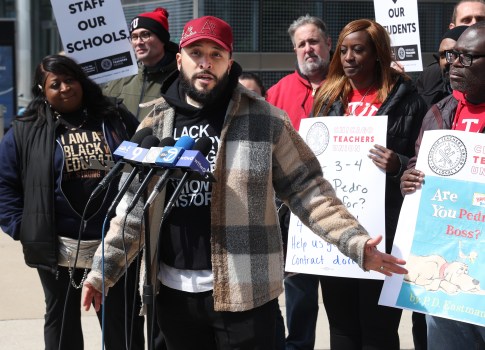
I believe my track record demonstrates an unrelenting commitment to public service and ability time and time again to deliver solutions to problems faced by students and the community alike makes me uniquely qualified for the role of alderman. My parents instilled in me the ethic and value of service that has guided all my life’s undertakings. This is exemplified most notably perhaps through conducting voter registration efforts at our mosque with my father when I was just a child, organizing food justice efforts through the Inner-City Muslim Action network while in college, and most recently through my work organizing with CTU to create sanctuary schools in CPS and to create legislative blueprints in my role as Chair of the CTU Housing Committee to protect unhoused students and their families.
The pandemic added a particular impetus to the scale and direction of my organizing, given the vacancy of leadership in our ward during that time. In this period, I raised $50,000 to support students under threat of homelessness and mobilized alongside the community to provide essential PPE to those in need. Nevertheless, it was also during the pandemic that I recognized the frustrating limits of my remit to tackle structural issues as a community organizer and it was this that ultimately spurred my decision to run for alderman.
What is the most pressing issue facing the people of your ward, and how would you address it?
The most pressing issue facing the people of the 50th Ward is the lack of ward democracy. There is no participatory budgeting process of any kind and we are one of the few wards in the city without a zoning council or indeed any form of zoning process that incorporates community input. The complete lack of transparency around the governance of the ward coupled with story upon story of ward constituents’ difficulty in reaching the alderman and getting basic 311 requests for speed bumps, for example, fulfilled is deeply troubling. If elected, I will certainly implement a community-zoning process to solicit input and buy-in from community members on all development that occurs in our ward as well as organizing quarterly meetings where residents decide how $1.32 million of our menu money is spent on capital improvements in our ward.
Sum up why should voters elect you and not your opponent(s)? (Please limit this to policy and approach, not a biography recitation.)
An important aspect of the answer to this question is addressed in the previous question but it is just an example of Alderman Silverstein’s persistent failure to provide timely and indiscriminate constituent services: the first of the two key responsibilities of being an alderman. As we know, inaction is action in and of itself, and her inaction became especially insidious when the pandemic first hit and she did the bare minimum to support the most vulnerable in our community. As a result, we had tragically the highest death rate of nursing home residents in our ward. COVID-19 was an unprecedented phenomenon but failure to ameliorate the scale of its tragedy only reinforced how important it is that we elect responsive leadership as an alderman’s actions (and inaction) affects the day-to-day welfare in the ward. During the pandemic, day-to-day welfare became a highly unfortunate matter of life and death. Alderman Silverstein has also consistently failed to spend the entirety of the menu money allocated to our ward throughout her three terms which has left (notably the less affluent) areas of our ward in disrepair.
Alderman Silverstein has also done the bare minimum legislatively: the second responsibility of an alderman. She served as a rubber stamp alderman for both Rahm Emanuel and Lori Lightfoot, voting with them on average 91% of the time on divided roll call votes. During her 12 years in office, she has not sponsored any “major legislation” and has notably voted for the closure of mental health clinics, and most recently against the Anjanette Ordinance.
If elected, I will raise the bar for what our constituents should expect of our alderman and expand the imaginary for what our ward could look like, and what people deserve. My commitment to implementing these much-needed co-governance structures and delivering responsive service to all our constituents without discrimination is central to why I am running. 40+ years of divisive machine leadership in our ward has manufactured structural problems that need addressing more than ever, and I would not be running if I did not believe I could provide such leadership.