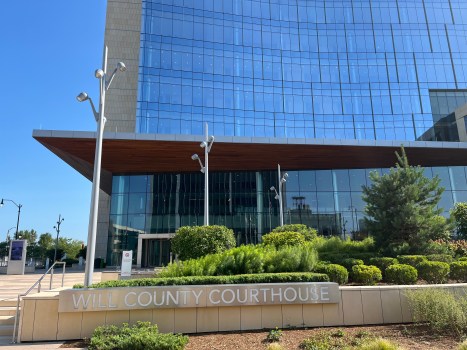


State officials filed a consent order Thursday to end the Aqua Illinois lawsuit, which alleged the company failed to provide safe drinking water to certain residents in University Park, saying the company consecutively met the state lead action levels.
Village officials expressed their concern with the filing and said they do not trust that Aqua Illinois properly addressed the lead levels.
“Hell no. I was shocked,” said Trustee Theo Brooks. “We just don’t trust the water. None of us trust Aqua.”
Attorney General Kwame Raoul and Will County State’s Attorney James Glasgow asked a judge to approve the consent order Thursday after finding Aqua Illinois met the state lead action level over several six-month compliance sampling periods and developed an effective corrosion control treatment for the public water system, according to a news release from the Illinois attorney general’s office.
“Throughout this lawsuit, my office has prioritized making sure University Park residents have access to water that meets state requirements,” Raoul said in the release.
In a statement, Aqua Illinois President Dave Carter said the company has met state and federal drinking water benchmarks for more than two years.
“Our agreement with the Attorney General’s Office and the State’s Attorney for Will County reflects our commitment to improving the community and our dedication to providing safe and reliable drinking water to our customers. We’ve conducted unprecedented testing of the system and these ongoing compliance checks confirm that the system is meeting and has met the regulatory benchmarks for lead and copper,” Carter said in the statement.
Village Trustee Gina Williams, who said she followed the Aqua lawsuit closely before she was elected in April, said she does not trust the claims in the consent order.
“Me, myself and I will never trust the water. We have had numerous people with illness and we have no way of knowing if Aqua played a role in that,” Williams said. “I will always use bottled water and filters. I do not trust it.”
University Park Mayor Joseph Roudez and Village Manager Elizabeth Scott did not respond to requests for comment.
The lawsuit, filed in 2019, accused Aqua of failing to provide safe drinking water, failing to comply with monitoring and sampling requirements, violating construction and operating permit requirements and creating a public nuisance.
Aqua switched its water source to the Kankakee River and began adding a blended phosphate mix to the public water system to improve taste, according to the lawsuit. The change, the lawsuit alleges, is believed to have caused a chemical reaction that removed a protective layer in residential plumbing.
Resident Chandra DeVance, who has previously addressed her concerns to the Village Board, said it has been a difficult four years navigating the water in her home. She and her neighbors have had to be mindful of how they use water for personal hygiene, preparing food and other uses.
“It’s been challenging. A lot of uncertainty and a lot of anxiety,” DeVance said. “You have to remember not to rinse your mouth out with water. I can’t soak in the bathtub like a regular person.”
DeVance, who has lived in the village since 1987, said she does not trust the claims in the consent order.
“I don’t believe that,” DeVance said. “It’s been four years now. That’s insane.”
In the consent order, prosecutors wrote Aqua exceeded lead action levels in sampling periods July 1 to Dec. 31, 2019, and Jan. 1 to June 30, 2020. In April 2020, Aqua changed its corrosion control treatment for its public water system to a phosphoric acid corrosion control chemical, and in the July 1 to Dec. 31, 2020 testing period the water did not find high levels of lead, according to the consent order.
But in March 2021, the water samples showed an upward trend in lead levels.
By July 2021, Aqua received an Illinois EPA approval to change the corrosion control treatment for its public water system to zinc orthophosphate, according to the consent order. With that change, Aqua did not hit lead levels that would require minimizing exposure for three sampling periods between July 2021, and December 2022, according to the consent order.
The Illinois EPA continued to evaluate the effectiveness of the corrosion control treatment, the consent order states, and the agency issued a special exception permit to Aqua June 14, 2023, stating there was annual compliance sampling of the public water system.
The sampling period then shifted to Jan. 1 to Sept. 30, 2023, and all the sampling in that period found the water to have been below 15 parts per billion for lead, according to the consent order.
Under the terms of the consent order, Aqua has the option to stop providing bottled water and filter devices, but has to ensure that customers within the most impacted area of the village have access to bottled water and filter devices if sampling exceeds 15 parts per billion. Residents will still be able to request free monthly water testing of their kitchen cold water tap, according to the consent order.
“I was shocked to read that,” Brooks said. “But at the same time it doesn’t surprise me.”
The order also establishes a technical assistance program in which residents’ tap water will be tested for lead. If the result of the water is above 15 ppb for lead, the resident will be eligible to receive a free filter device and an inspection of the visible plumbing.
If needed, further testing and inspection will be completed under the technical assistance program, including an Illinois-licensed, third-party plumber inspecting and fixing any issues, according to the consent order. Aqua would pay, up to $2,000, for any work the plumber completes.
Under the program, Aqua will fund an escrow account with up to $300,000 for the remediation of lead solder and any lead-containing fixtures found in kitchen faucets. Aqua will also pay an additional $200,000 in civil penalties.
The technical assistance program will continue for one year from the entry of the consent order. Aqua will send out information to residents about how to register for the program, according to the order.
Illinois EPA Director John Kim said in the news release the technical assistance program “goes above and beyond the requirements of applicable state drinking water regulations.”
“For more than four years, residents of University Park have endured significant concerns with their drinking water as numerous steps were taken to ensure they had access to water that complies with state drinking water standards,” Kim said in the release. “This Consent Order represents a new beginning for the University Park residents, as Aqua Illinois has now consistently demonstrated compliance with the regulatory lead action level.”
Brooks disagreed with the notion.
“The residents don’t trust the water. The residents are using bottled water to prepare their food and brush their teeth,” Brooks said. “They have not made us feel safe about the water.”