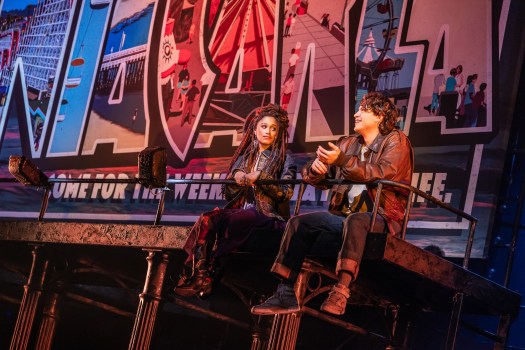


“How Blood Go,” “What to Send Up When It Goes Down,” “Welcome to Matteson” — each is the title of a recent work that Congo Square Theatre produced, centered on the Black experience in America on a national or local level — productions that were created with Charlique Rolle as the executive director of the theater company. It’s a role she holds in conjunction with being the local and national associate director of the August Wilson New Voices Competition.
Now, the arts administrator, artist, choreographer, director, curator, writer and producer is the new board president of the Black Arts & Culture Alliance of Chicago (formerly the African American Arts Alliance). Founded in 1997 by a group of Black creatives and Black arts organizations, the nonprofit is dedicated to supporting Black artists working in the performing, visual, literary, technical and design art forms. The Alliance also highlights their accomplishments by way of its annual Black Excellence Awards.
Rolle takes over the leadership role from Black Ensemble Theater founder and Alliance co-founder Jackie Taylor. Red Clay Dance Company founding artistic director and CEO Vershawn Sanders-Ward joins Rolle as vice president.
We spoke with Rolle about her plans for the 26-year-old service organization. The following conversation has been edited for length and clarity.

Q: What will your new role with the Alliance entail?
A: Really helping to guide the vision of where we go next. We don’t have an executive director. So that’s definitely something that we are looking to do, really trying to cultivate more community. Our founders have been incredible in creating the space and now we have a new generation of artists and storytellers that is so broad … me and Vershawn are excited about what it looks like for us to build the Alliance as a hub where Black artists, Black arts organizations, can come and find home, space, community, but also find resources that they need to thrive as an artist in Chicago. Think about what it takes for Black artists to thrive in Chicago, but also to help support the development of the economy. … The Alliance is very Chicago-centric. We want to see more individual and independent artists, yes, but also more artists who feel empowered to create things, to create businesses, to create partnerships that are continuously viable. Also that artists have autonomy and flexibility to flex wherever they want, wherever they are in the spectrum they’re able to have the resources they need to feel supported, and that it continues to expand.
Q: Is that the reason for rebranding the name?
A: It’s an Alliance for the next generation and “African American” is a very specific term. We want to ensure that the group encompasses the diasporic representation in Chicago. For example, I don’t identify as African American because I wasn’t born in America, but I am a Black woman, and just being able to have a space where people can identify more specifically without feeling like “maybe, I guess I fit here,” but knowing that this is a space for us.
Q: Jackie Taylor is an institution unto herself, is stepping into a role she cofounded intimidating?
A: It is very exciting. It is intimidating to take over something that has been an institution built by an institution herself, and built by these founders who carry these profound legacies, but it also is very humbling and honoring to say that they felt strongly enough to pass this on to us and to say that we were the right people for this moment. … I really am excited, I think as evidenced in my work with Congo Square, I’m really passionate about how we continue to tell Black stories, even outside of theater across all art genres and being able to do that and also to help focus on specific genres but also to bridge more gaps across genres as well.
Q: What can we do as laypeople to help Black arts thrive in the long term?
A: We’re building partnerships … thinking about resources that we can offer to our artists, whether that is legal support, financial support, medical support, insurance — those big picture long-term things that we have to strategize around. Creating more opportunities and finding connections for artists, our goal and intention is that we want to be around the city, but also we want to support Black-owned businesses — even the culture part. How we can build, thrive, and help society. The power of the arts in society is such a vital thing.
Q: What does the programming look like going forward?
A: We do a lot of professional development, whether that is mentorship programs, workshops for arts organizations, leadership development, and professional development resources. Another type of programming that we have been doing, we call our Black United series, which goes throughout the year and we started back in 2020. What it does is it helps to bring specificity and focus on Black theaters or Black dance companies, giving artists an opportunity to connect with them. We had one full day of workshops and panels for the artists of that genre. On another day, artists got the opportunity to audition for all of the Black theaters, all of the Black dance companies, whomever opted in, all in one space. Bringing people together to say “here are people that you want to work with.” There’s a lot of artists that are working in other places who don’t know what other theaters or directors are out there. Being able to create that space for them … we did theater and dance thus far. Our goal moving forward is to do a similar Black United program for each of the genres represented that is specific to some of the things that they need. What does that look like for visual artists, for musicians, for writers? To give them access, opportunities to connect, and help expand their portfolio, they may need additional resources. For actors and dancers, that’s an audition to get a gig but for visual artists that might be opportunity to present in a gallery.
Q: How will the new role impact your creative schedule as an artist?
A: Every season has its ebbs and flows, so sometimes there’s a lot happening at once. I try to help build the schedule around that. Making space to continue to make art … for me, what I’m really exploring and leaning into right now is what leading and working and living from a place of rest looks like. And what that means. “Rest is Resistance,” that book has been a powerful moment in my own ethos, and how I can find support within that to take care of myself as I’m supporting everyone else.
The Black Arts & Culture Alliance of Chicago’s Black Excellence Awards takes place 7 p.m. Nov. 6 at Black Ensemble Theater, 4450 N. Clark St. This year, the event will honor inaugural Black Arts Hall of Fame inductees; more information at www.bacachi.org