



Time has run out for a clock business that’s been part of the Naperville community for more than 25 years.
Elgin Clock Repair closed Saturday and has moved all repairs to its South Elgin headquarters.
Whereas most businesses close because of lack of work, co-owner James LaChapelle says their story is quite the opposite. There are so few repair shops in the area that they simply cannot keep up with demand.
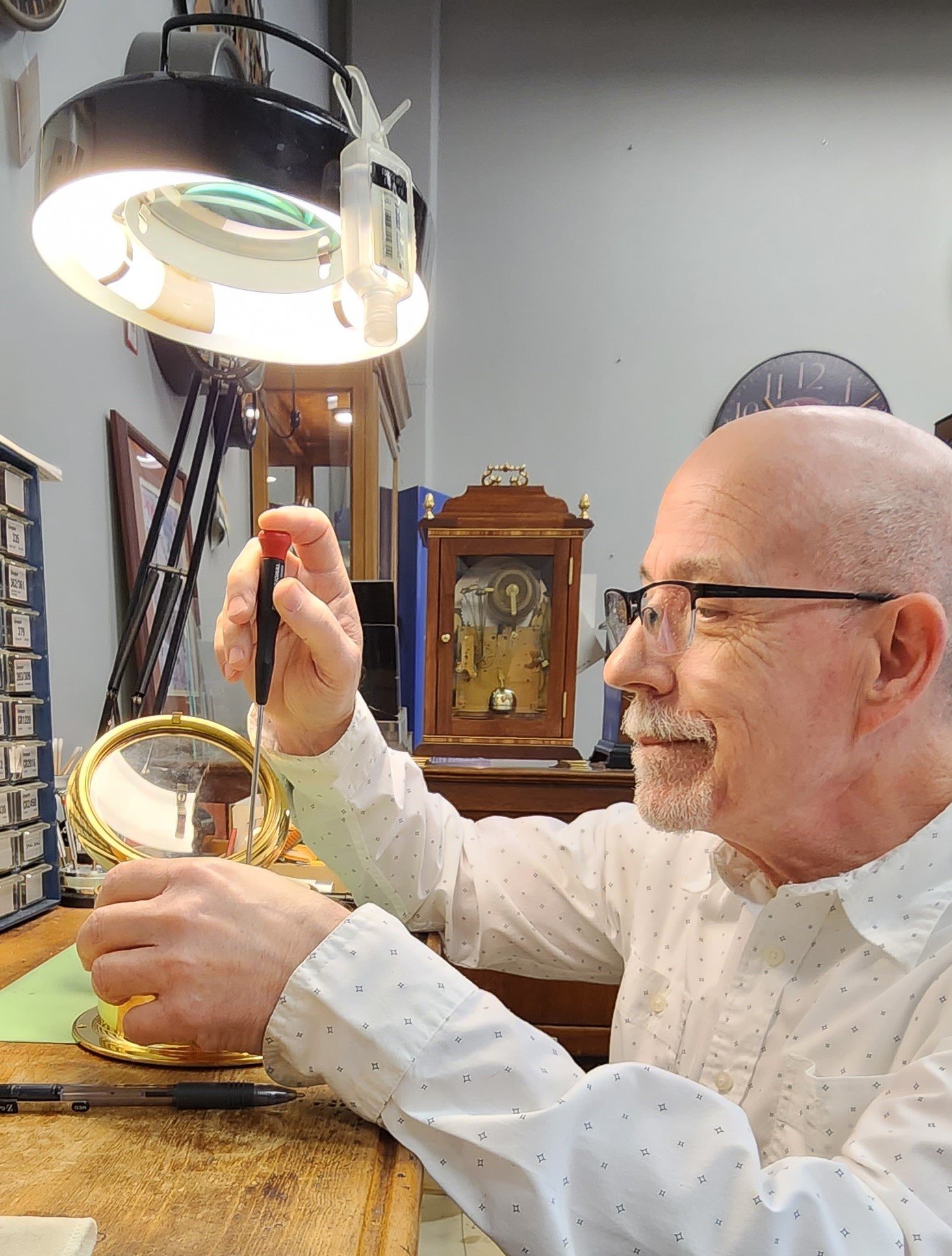
“I picked Naperville (25 years ago) because there was a void of repair shops in this area at the time,” he said.
“Now (most repair shops are) gone. I’m one of the youngest repairmen around and at 67 I think that says something. We are closing because we can’t keep up with the amount of work here. We’re working more hours than we were 20 years ago. I used to do 10 service calls a month, now it’s 50.”
LaChapelle and his partner Ron Iverson have had three different locations in downtown Naperville but moved to 402 W. Fifth Ave. because the parking was easier. In the ’90s, selling used clocks was 50% to 60% of their business, but today it’s more like 5%.
“There was a big clock boom in the ’60s, ’70s and ’80s,” LaChapelle said. “It was something of a status symbol to have big clocks. When we were downtown (and didn’t have a parking lot), people would double park, rush in and pay $4,000 for a clock and run back to their cars. We sold 20 to 30 grandfather clocks a week.”
Today those clocks are being inherited by second and third generations. While there’s a lot of sentimentality attached to them, sometimes repairs can cost more than they are worth. LaChapelle said those clocks need regular care to keep running.
“Every five years they need 40 little drops of oil in different spots,” he said. “They must be serviced and oiled regularly.”
Their Naperville workroom has shelves full of old clocks. While some are being worked on, many others have been abandoned by owners who thought the repair cost too high. LaChapelle says the work can be painstaking and time consuming, which makes it expensive.
One of his most memorable timepieces was a grandfather clock made in the 17th century.
“It was brought in by a man in his 90s. It was in horrendous condition,” he recalled.
“It would have been about $10,000 to fix. He told me it was his grandmother’s and the last time he saw it run was when he was a 3-year-old child in Austria. I agreed to do it for half the price. Really old stuff like this can take one to three years to repair because we had to send out the dial to be restored. It had been covered in gold metallic paint. He was thrilled and wanted it for his daughter. He has since passed on but it’s a family legacy.”
LaChapelle calls himself a “history nut” when it comes to timepieces.
“Clocks were the high tech of their day,” he said. “Being able to tell the time goes back to sundials. Mechanized clocks and navigation equipment were the super computers of their day. You can still see influences from 800 years ago. The mechanisms are very similar to those in the 1600s. I’ve always been fascinated by how things connected.”
LaChapelle and Iverson met as apprentices.
“In the early ’80s I joined up with other apprentices and worked for a master clockmaker,” he said. “In fall 1982 I did my master’s exam with Ron. We had to make gears and screws from metal. Only after I took the exam did I find out there was a 93% failure rate but Ron and I both passed in the high 90s. To this day there are only 15 of us left alive, five active.”
When they completed their apprenticeships at Craft Clocks in Elmhurst in 1982, they became certified master clockmakers with the American Watchmakers-Clockmakers Institute.
LaChapelle originally had dreams of becoming a firefighter, but a year of fire science study at the College of DuPage made him realize he would prefer to work with his hands.
“My father could barely use a hammer. He used to use my mom’s although his father was a carpenter,” he said. “I helped dad assemble a bicycle just by looking at the picture instructions when I was 5 years old. Later I got a car and took engines apart. I liked doing woodwork and mechanics but had not thought of it as a profession because who wants to be cold and dirty?”
But no one is taking up the profession these days, maybe because younger generations are more likely to buy clocks online and get new ones when they break than they are to want to keep larger timepieces around and in working order.
So, it’s the end of an era — at least in the Naperville area. But for older folks, there will always be something special about those old clocks and telling the time by looking at a face that’s watched you and your family for so many years.
Hilary Decent is a freelance journalist who moved to Naperville from England in 2007.


