

Some of the most brutal winter weather in Chicago history has happened in January.
The winters of 1976-77, 1977-78 and 1978-79 were three of the five coldest ever here, according to the National Weather Service.
“In Chicago, the winters of the 1970s were collectively our coldest and snowiest on record — and we have records that go back to 1871 and the Great Chicago Fire,” WGN-TV chief meteorologist Tom Skilling told the Tribune last year.
How frigid and snowy was it? Here are some statistics:
The winter of 1976-1977 had 54.1 inches of snow and was the third coldest winter ever.
January 1977 was the coldest January on record with an average temperature of 10.1 degrees. There were also 12 days below zero that month.
The winter of 1977-1978 had 82.3 inches of snow — the second highest seasonal total — and the fifth coldest.
There would be no relief from the cold and snow during the winter of 1978-79. It would become the second-coldest winter with an average temperature of 18.4 degrees. (The worst was 1903-04, one-tenth of a degree colder.) It would also see almost 90 inches of snow — the all-time season record.
Forty five years ago this week, Chicagoans were already weary from winter’s weather — and didn’t know a crippling blizzard was on its way.
The 20.3 inches of snow that fell on Chicago from Jan. 12-14, 1979, was not only the worst storm of that winter, it would also be a major factor in the city’s mayoral election.
Chicago history | More newsletters | Puzzles & Games | Today’s eNewspaper edition
Jan. 1, 1979: ‘I can take one — either snow or cold — but not both’

The year 1978 ended much as it had begun — under a blanket of white. A New Year’s Eve snowstorm dumped 8-11 inches of snow around the area, “giving New Year’s holiday travelers hangover-like headaches,” the Tribune reported.
Mayor Michael Bilandic said 410 pieces of snow removal equipment, including 13 new snowblowers, were working to clear streets. Winter officially began just 10 days prior, but crews had been busy. They had limited rest since freezing rain made roads slick on Dec. 30.
More than three total feet of snow — or, the amount of snow the city could expect to receive during a normal season — had fallen in November and December combined at Chicago’s Midway International Airport, which was the official recording site at the time.
Bitter cold had hovered over the area since Christmas.
Nerves were frayed.
“I can take one — either snow or cold — but not both,” National Weather Service meteorologist Greg Dickey said.
No one knew it at the time, but the city was on its way to accumulating 89.7 inches — the most ever recorded here in a season — and the second-coldest, tallying 21 days with temperatures below zero.
Jan. 10, 1979: ‘It’s like an all-out war’

A forecasted snowfall of 2-4 inches frizzled out, but the city was still digging out from the New Year’s Eve storm 10 days earlier.
Crews consisting of two police cars, five tow trucks, at least two loaders to scoop up snow and at least three dump trucks to haul it away focused on primary streets.
“It’s like an all-out war,” Pete Schivarelli, then deputy commissioner of Chicago’s Department of Streets and Sanitation told the Tribune at the time. “Seeing all the machines pulling out, it looks like a scene from ‘The Longest Day.’ ”
Yet progress was slow.
“If there are no cars on a block, we can clear it in 20 minutes,” Streets and Sanitation employee Howard Zusel said as he cleared Broadway north of Irving Park Road. “But if there are wall-to-wall cars, like here, it can take two hours.”
Jan. 12-14, 1979: Big snow clogs roads, shuts O’Hare

The attempt to dig out began at 2 a.m. Jan. 14 when the storm concluded and with more snow expected in the days ahead. The snow depth at Midway airport reached 29 inches.
“The aftermath was a nearly paralyzed city,” the Tribune reported. “And the snow was followed by a plunge in temperature well below zero.”
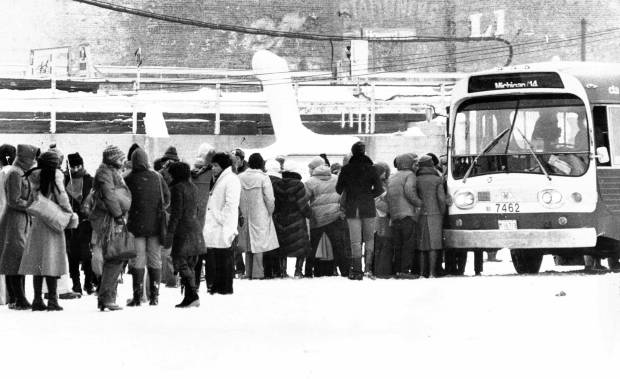
O’Hare and Midway airports remained closed and public transportation service was spotty. Most commuter railroads operated with significant delays.
Those at home couldn’t get to work — unless they, like one Tribune reporter, hitched a ride with a Sun-Times circulation truck — and those at work couldn’t get home — even one meteorologist at the National Weather Service who was contacted by the Tribune during his 16-hour shift.
“My mind is going crazy here. I don’t know how much longer I can handle this,” Richard Ryrholm said. “I’m the only meteorologist on duty now, and I have no idea when my relief will arrive so I can go home.”
Four fishermen whose boat was stuck in ice 1 mile off Oak Street Beach had to be rescued by U.S. Coast Guard helicopters when their boat began taking on water. Loren Drain was born in her family’s home on the North Side, thanks to help from a passerby who was a doctor.
Bilandic attended Mass and called on all Chicagoans to follow his example: “Pray for no more snow.”
Aftermath: City botches plowing of off-street parking lots

After observing the city by helicopter, Chicago Mayor Michael Bilandic ordered city snowplows to clear 250 school and Park District parking lots so residents could move their cars off the roads, but that effort was a failure. Many motorists couldn’t make it past double- and triple-parked cars on the still unplowed side streets.
“These damned politicians will tell you anything,” a motorist said. “They promised us we’re going to get parking. Well, I don’t see anything.”
The Tribune reported that the city’s chaotic snow-removal plan was devised by a City Hall “crony” — a firm owned by Kenneth Sain, a lawyer who opened it after he resigned in 1977 as Chicago’s deputy mayor.
Garbage couldn’t be collected for at least 10 days. Mail was delivered late. The city didn’t even begin plowing residential side streets until Jan. 20. (Though the Tribune noted Jan. 19 that two side streets were “thoroughly plowed” — the block where Bilandic lived and the block where the late Mayor Richard J. Daley had lived.) Schools were closed all week. When they did open Jan. 22, there was no bus service because most of the neighborhood schools were inaccessible anyway.
Instead of taking responsibility for the mishandling of the snow removal, Bilandic lashed out saying police would be ticketing vehicles and ordering them towed if not removed from Chicago’s streets. He also said there would be “no exceptions” for sick, elderly or poor people who couldn’t move their cars. “If there are hardship cases, they can tell that to a judge. That’s what a judge is for,” he told reporters. Bilandic later apologized for his mishandling of the snow removal, but Chicago residents — voters — weren’t satisfied.
Feb. 27, 1979: Jane Byrne wins Democratic nomination

Paralyzing blizzards set up Bilandic for defeat, but it was bright sunshine on Feb. 27 that did him in. The fair weather on the day of the mayoral primary election brought out the voters — the second biggest turnout for a primary election in 40 years — and the memory of the city’s inept handling of record January storms drove them to overturn the Democratic machine. Maverick candidate Jane Byrne won the Democratic nomination.
Byrne’s campaign, launched after she was fired from a City Hall job by Bilandic, was dismissed at first as a bid for retribution. But Bilandic’s handling of the snow buried him.
Byrne easily defeated Republican opponent Wallace Johnson in the general election and was elected Chicago’s first female mayor on April 3, 1979.