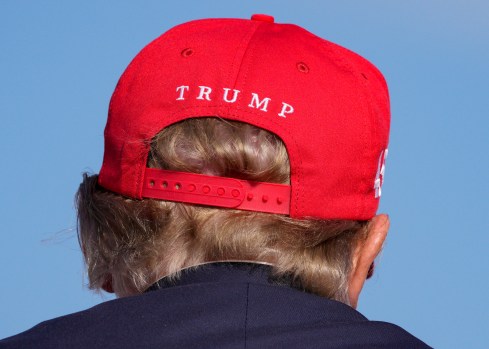

I think it is time for the Tribune to stop treating Donald Trump as if he were just another presidential candidate.
That he is the presumptive nominee of the Republican Party, that he holds rallies, that he spews lies on social media, that he may (or may not) debate President Joe Biden, and so on, is all in the general category of “news.” But should a newspaper as respected as the Tribune blindly report on his words and actions in the same manner as, for example, the Barack Obama and Mitt Romney campaigns? I think that this would be as bad as a boxing referee ignoring that one of the fighters is using brass knuckles.
I am not calling for the Tribune to ignore Trump. But I do think that every story about him that has anything to do with his running for president should be printed in such a way that shows just what kind of a man he is, what kind of a president he was and what his reelection would mean to our democracy.
What I suggest is not an easy task. It requires excellent journalistic skills — and integrity. To print something “just because it happened” is, in this case, not enough to save our country. One of Trump’s weapons, I believe, is that if something is repeated often enough, people regard it as the “truth.” That is how Trump got people to believe the 2020 election was stolen. That is why some people think that immigrants are drug pushers, murderers and sex traffickers.
Granted, there are some editorials that criticize Trump. But that, in my opinion, is too little.
Consider 1974. I was a reader who was electrified by the Tribune printing the transcript of the Richard Nixon tapes. Although I still remember those page-after-page transcriptions, there is still something else the Tribune did that was even more impressive: A week or so later, it printed an editorial that showed the editorial board’s disdain for Nixon. And the board called for his resignation.
In my opinion, that was one of the Tribune’s proudest moments. And I voted for Nixon. Twice!
The 1974 editorial states: “He is humorless to the point of being inhumane. He is devious. He is vacillating. He is profane.”
Likewise, I think that the Tribune Editorial Board should, at the very minimum, have a similar editorial enumerating Trump’s failures to our democracy, our Constitution and our collective sense of decency.
— Thomas Jacobs, Elgin
Lesson for Lincoln assassin
The Apple TV+ series “Manhunt” dramatizing the plot to assassinate President Abraham Lincoln brings a thought to mind. John Wilkes Booth’s mistake was running from the theater. Current events inform us that with the right set of lawyers and a compliant Supreme Court, his case might still be awaiting adjudication.
— Paul Helman, Wilmette
Issues with Injustice Watch
The Tribune Editorial Board’s note preceding Injustice Watch’s guide to judicial races (March 17) refers to Injustice Watch as “a trusted nonprofit.” Many familiar with Injustice Watch’s historical treatment of judicial matters would beg to differ and consider its reporting biased in nature.
Reporting simply on the number of bar associations that have found a candidate either qualified or not recommended places all bar associations on a par with each other, which is often not the case. Certain bar association evaluations are biased due to political, racial and ethnic considerations. Also, smaller bar associations might not have the staffing to adequately evaluate an individual’s background.
If the editorial board continues its practice of no recommendations on judicial races, then it should print a graph that shows every bar association’s rating of each candidate so that the voters may make their own determination as to the weight to given to each decision.
To print a piece from Injustice Watch that equates this important process to simply a numbers game is misleading and does a disservice to voters!
— Marcia Maras, retired Circuit Court judge, Chicago
Practical view on immigrants
The editorial on our immigration system being broken is spot on (“We need immigrants. A bracing message from a titan of corporate America.,” March 15). As mentioned, we need immigrants for many reasons: humanitarian, economic growth, labor force, diversity, etc.
What we also need is an immigration plan. It is shameful and irresponsible for our leadership to allow all these human beings into this country and then abandon them. There are humanitarian organizations helping and some local government agencies assisting, but there is no clear path of assistance for the immigrants, and it all seems like a last-minute scramble.
No country allows in anybody anytime without controls or checks. Our border patrol seems stretched beyond its limits and needs resources.
As people come into our country, count them, know where they will be so they can be reached, and immunize them, and the federal government should have a system in place to provide them with work permits quickly so they can start supporting themselves.
As a country, we need to control our inflow of immigrants, through quotas and a strong immigration policy.
I suspect many politicians also look at these immigrants as future voters, so let’s get them on the path to becoming working, contributing U.S. citizens. Maybe that will incentivize the politicians to vote for reforms.
— Grace Whiting, River Forest
What about liability insurance?
The front-page Sunday article “Migrants buying cars, but lack of licenses a problem” is lengthy and informative. However, it ignores the much bigger problem of these drivers not having liability insurance.
Should responsible automobile owners and drivers really have to pick up the costs of those driving without insurance? I think not.
— Richard A. Arehart, Orland Park
Crumbley’s parents face the law
Whoever coined the phrase “hindsight is 20/20” deserves immense credit. When we look back on things, they appear much clearer than when we try to predict the future. The Ethan Crumbley case is a prime example of this phenomenon.
To the onlooker, it would seem nearly cut and dried that the parents were at least partially to blame for what happened the day their son wreaked havoc at Oxford High School in Michigan. Their parenting didn’t seem exemplary. However, it honestly didn’t seem far removed from my childhood. I grew up in the 1950s and ’60s. Mental health issues such as anxiety and depression in adolescence were accepted as norms that most kids would grow out of. Whether that was true is another conversation.
My folks didn’t buy me a gun, but my dad had guns in the house that weren’t locked up. My brother and I never wanted to use them when our father wasn’t around, but we certainly could have.
So now we have a precedent for charging parents for the crimes of their children. Does this mean that when teenagers in street gangs commit violent acts, their parents will be in legal jeopardy?
— Scott Thompson, Bloomington, Indiana
Submit a letter, of no more than 400 words, to the editor here or email letters@chicagotribune.com.