
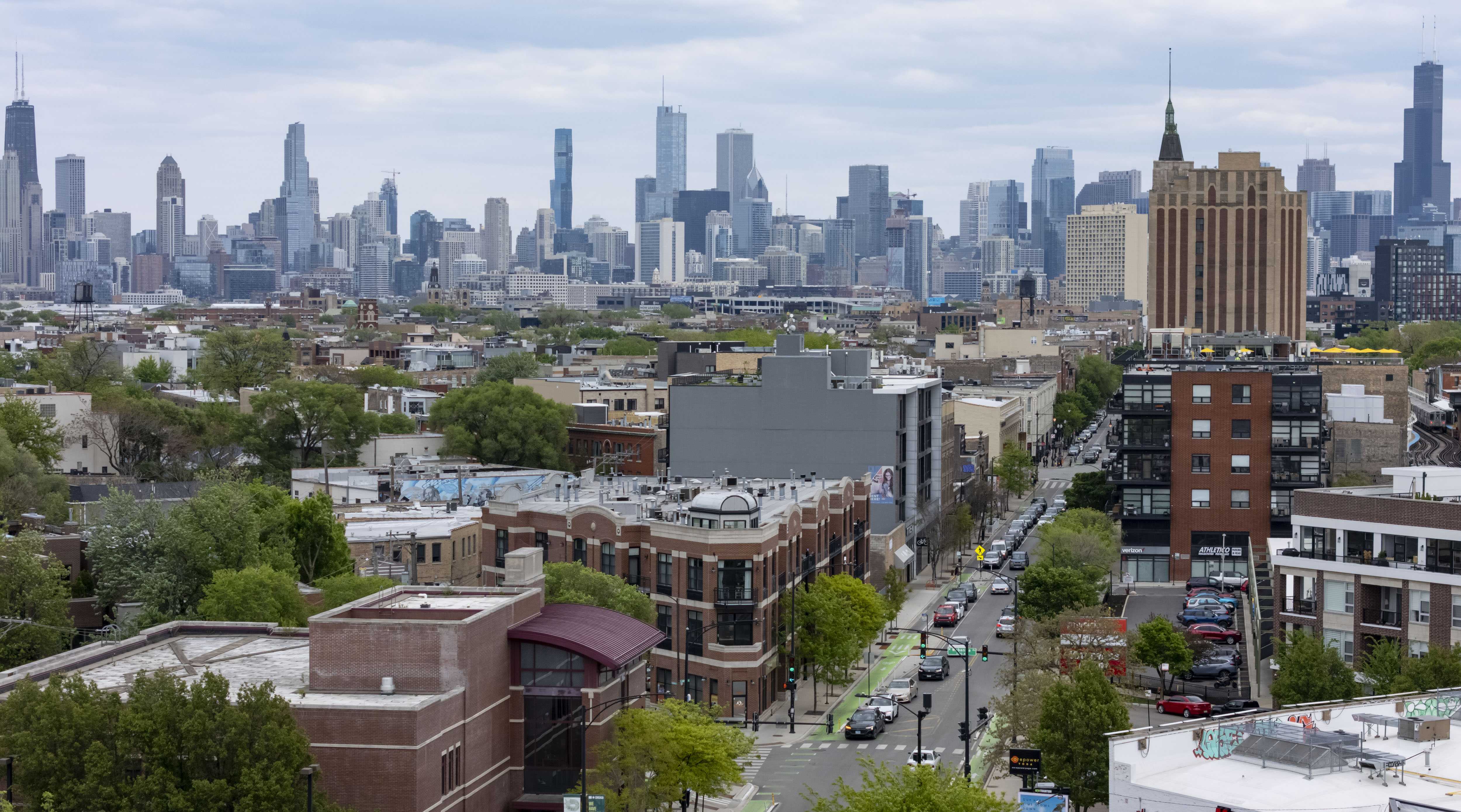

Editor’s note: We asked readers to share their hopes for what Chicago will be like in 25 years as a complement to our recent 2050 op-ed series. We are grateful for the submissions.
Independent, down-to-earth
Chicago, such a great city, so real, so American, with the tough, middle-of-the-country vibe. Chicago needs to retain and live up to its reputation as feisty, down-to-earth, in-your-face and independent.
Chicago was my center for living, as a resident for many years and now as an adjunct member from a suburb. As one who still has roots, connections and family in Chicago, I have dreams of it, perfected. These dreams are centered on the citizens who live, work and relax right there.
Hope is centered on more housing. I challenge the world-class architects, who give our city such a stupendous reputation, to design really attractive, prize-winning, affordable and livable homes. I present elected officials with the goal of inexpensive, frequent and citywide transportation. This can lead to the accessibility of the city’s world-class museums, libraries, sports events and public spaces. Use Chicago’s unique geography for better access to Lake Michigan, its beaches, its parks and sports — walking or running by the shore, swimming, sailing, fishing.
Chicago has such a marvelous mix of world cultures, ethnicity, language, neighborhoods, restaurants, businesses and schools. It has a world-famous opera, symphony and a theater life that is unique. Visit the Chicago area’s zoos, botanic garden, world-class hospitals, universities and research centers. There are arts and science centers and soon a presidential library, all waiting for patrons.
For the next quarter century, we in Chicago’s metropolitan area need to open our minds, hearts and presence to becoming friends and neighbors with these same people. They are able to enlarge our circles and enlarge our education of a greater world. We can do it. We need to do it, our children need to see it and our economy will depend on it.
If we achieve many of these goals, I believe that crime will drop, because we would have relieved some of the worst obstacles to opportunity. Our schoolchildren need to have the same superior education as those in private schools. It will help them flower into happier, creative and really fulfilled individuals.
By some quirk of fate, my little suburban street is on the way to achieving that diversity. Chicago could also do that, one small neighborhood at a time.
— Joanne Hoffman, Highland Park
Better lives through technology
By 2050, Chicago has the opportunity to become one of the world’s leading examples of how technology can improve everyday life without losing democratic accountability or human judgment.
Over the next decade, Chicago could implement artificial intelligence-assisted government systems that reduce waste, lower taxes and improve city services. Residents would see cleaner streets, faster public response times, safer neighborhoods and more transparency from City Hall. Rather than replacing people, artificial intelligence would serve as a tool to help city leaders and residents make better decisions.
Chicago’s technological future should not be feared but guided responsibly. Artificial intelligence and quantum computing will not replace democracy or human judgment; they will help residents reduce inefficiency, improve public safety, expand opportunity and participate more directly in civic life. Technology must remain transparent, accountable and ultimately controlled by the people it serves.
By the 2040s, advances in quantum computing could further modernize healthcare, transportation and public planning. Residents may work shorter weeks as automation increases productivity, creating more time for family, education, entrepreneurship and civic engagement.
Chicago should also establish a minimum standard of living — not only because it is morally right, but because reducing homelessness, untreated mental illness and desperation would lower many of the long-term social costs taxpayers already shoulder today.
At the same time, Chicago must continue rewarding ambition, innovation and contribution. Those who build businesses, create jobs, teach, invent and strengthen their communities should continue to have greater opportunities to succeed. A healthy society requires both compassion and incentive.
High-speed rail and expanded public transit could dramatically reduce traffic congestion, while more greenways and bike corridors would improve neighborhoods and public health. Healthcare could become more preventive and personalized through daily health monitoring and faster access to care.
Chicago has reinvented itself many times before. By 2050, it can once again become a global model — not through ideology but through innovation, accountability and a belief that technology should improve life for everyone.
— Thomas Schoendorff, Chicago
Make city walkable, safe for kids
As a father of two elementary-aged children on the South Side, my greatest fear isn’t that they will be abducted or shot with a gun; it is that they will be hit by a driver while playing outside or while walking to the park or riding their bike to school.
After 100 years of retooling our city to maximize convenience for drivers, one of the clearest outcomes of the urban automotive experiment is the slow erosion of our children’s freedom of movement and the independence that comes along with it. We have traded in real-life exploration and community engagement for a life confined to the indoors and a digital screen.
Over the past 25 years, I have watched as Chicago slowly, and often painfully, took steps to make our city more friendly to people outside of cars — by definition, anyone under the age of 16 — and I applaud the agonizing efforts that have resulted in those changes, but we still have so far to go.
Every child should be able to walk safely to their neighborhood school, their local library, a friend’s house or the corner park to play ball. No parent should fear that their child will be killed simply trying to meet a classmate at the ice cream shop, and yet, that fear is often what keeps our children shackled to their home or their parents who act as constant chaperones.
I teach my children that every tool has its use and that a car is a valuable tool, suited to certain transportation needs. But it is not a tool that we need to use to go to the grocery store three blocks away, or to school five blocks away, or to the library seven blocks away. My kids also know that to get to any of those destinations from their house, they must cross at least one street with heavy, threatening traffic.
For a small child, crossing these streets is like crossing the Grand Canyon.
My fervent hope is that by 2050, Chicago will center our children more and recognize that by prioritizing adult-only transportation options for decades, we deny them the right to access the things most important to their development and place within their community.
Not everyone drives, and this is especially true for our children. But they have a right to freedom of movement in this city as much as any other resident.
— Andrew Mack, Chicago
Make the lake more accessible
Early on, Chicago’s urban visionaries recognized the need to protect the city’s most prized civic asset — the lakefront.
Montgomery Ward promoted the idea that our lakefront should be forever open, clear and free for the public. City planner Daniel Burnham wrote: “The Lakefront by right belongs to the people.”
Thanks to our thoughtful urban planners, today’s Chicago lakefront stretches 29 miles along Lake Michigan, offering parks, beaches and natural habitats. Indeed, the Lakefront Trail is one of the busiest in America.
However, many Chicagoans — especially those from low-income neighborhoods — have never set foot on Lake Michigan’s shores. Studies show that for many residents outside downtown, the lake remains largely invisible or feels inaccessible. Low-income Chicago children may face barriers to beach access including limited transportation, a lack of swimming skills and concerns regarding safety.
My hope is that by 2050, children from all neighborhoods in Chicago will enjoy summer days engaged in lakefront sports and hobbies such as sailing, swimming and fishing.
Inspiring children to enjoy the lakefront involves community-led outreach. Several initiatives are leading the way to promote lakefront-related activities and programs for kids including the Chicago Park District’s learn to swim and Junior Lifeguards programs, the Illinois Urban and Community Fishing Program, and sailing lessons offered by Judd Goldman Adaptive Sailing, Jackson Park Yacht Club and Chicago Yacht Club.
Also, through initiatives such as the Chicago Maritime Museum’s education program with Chicago Public Schools, students are invited to consider maritime careers, such as ship captains, naval architects and marine engineers.
Chicago is the largest city on the Great Lakes. With just a bus ride, Chicago children can experience a whole new waterfront world. When we make the lakefront more accessible, we improve the quality of life for today’s Chicagoans and invest in Chicago’s future.
— Mary Ann O’Rourke, communications director, Chicago Maritime Museum
A popular mayor, strong city
What I hope: The mayor of Chicago is in the second year of reelection in 2050 and enjoys an approval rating of 82%. A WBEZ interviewer credits the mayor’s exceptional people and political skills that helped build strong ties with local and international business interests, sports franchises and unions.
Domestic and international tourism has flourished. Federal grants have helped fund some social programs, public TV and radio, and repairs to aging infrastructure. Homeowners appreciate the overhaul in property taxes.
The mayor said, “Now if we could only do something about that parking meter deal.”
— Jerry Levy, Deerfield
Still full of decent people
What I hope: That Chicago’s lakefront will still look beautiful and inviting. That city pedestrians, bikers and delivery robots are all getting along. That there will be a much greater respect and gratitude for the Chicago Police Department. That potholes and speed cameras will be a thing of the past (I know, too much to hope for). That there will have been a tremendous resurgence in the downtown shopping areas. That all Chicago professional sports teams still play in the city. That the city is financially sound (again, maybe too much).
That artificial intelligence will not prove to be the job-taker people fear and that millions in the city will be gainfully employed. That all city neighborhoods are safe to walk through on a summer night. That Chicago continues to be full of decent, hardworking, “love thy neighbor” people.
— Terry Takash, Western Springs
Put Chicagoans’ welfare first
My hope is that in 25 years, Chicago’s leaders will prioritize the health, safety and welfare of their constituents and put Chicagoans first and foremost. And along with competent leadership, let us hope that Chicago has the fewest homicides of any U.S. city.
— JoAnn Lee Frank, Clearwater, Florida
Return of mom-and-pop stores
Frequently on social media, I hear about this not being my parents’ world anymore. And I have to concede the point, however disturbing. Thanks to evolution, it surely isn’t — now. But what nobody seems to have registered is that just as sure as things always change, they can potentially revert to a former state.
Consider the mom-and-pop stores. These family-owned micro-operations were once common in Chicago, on main streets and off. In the early 1960s as a preteen, though, I saw them start to give ground to their successors. The supermarkets served as shock troops in this commercial war, and I remember being awed by a local entry. That long-gone Jewel Foods on Milwaukee Avenue barely had enough space to accommodate Jewel’s typical produce section of today. But for its time, it was colossal.
Megamalls came along later to dwarf the stand-alone supermarkets, and then the one-stop-shop superstores. How could one slay such Goliaths? They seemed destined to remain forever. And yet, here many of them are struggling to weather another metamorphosis, as e-commerce continues to expand.
Could there be room again for old-style mom-and-pop places in Chicago, where you interact more leisurely with agreeable staff who know you and where you walk home with your purchases?
The chances aren’t great. Still I hope for it, for the resulting stronger sense of community and a less impersonal world.
— Tom Gregg, Niles
May plastic become a relic
I look forward to a day, 25 years from now, when the word “plastic” has been forgotten. It begins with local bans on single-use bags and an end to the era of Mylar balloons.
These things are not just conveniences; they are persistent pollutants that claim the lives of our wildlife and scar our planet for centuries.
The time for a permanent change isn’t in the future — it is now.
— Roberto L. Garcia, Chicago
Submit a letter, of no more than 400 words, to the editor here or email letters@chicagotribune.com.


