















When Jarrett Payton sat down earlier this summer to craft his presentation, to articulate the magnificence of Steve McMichael, to explain why, nearly 30 years after McMichael played his final NFL game, he finally had received admission into the Pro Football Hall of Fame, Payton kept landing in the same places.
He wanted the world to recognize McMichael’s gift for making those around him better.
He hoped to highlight how McMichael squeezed the most out of his abilities and always drained his tank to deliver his best — often at his toughest and most determined when he was counted out.
And he aimed to emphasize that, for a man with such an oversized, boisterous personality, McMichael’s kind heart always has been even bigger.
“There’s no one like him,” Payton said. “He is almost like a superhero out of a comic book, something that you create. And as a football player, you look back and go, ‘Holy cow!’ It’s incredible how good he was, how hard he worked.”
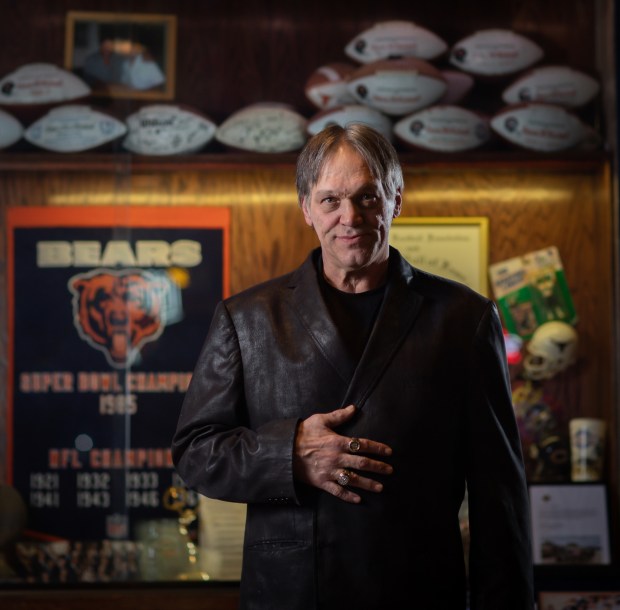
Those themes will resonate Saturday afternoon when the Pro Football Hall of Fame’s enshrinement ceremony takes place in Canton, Ohio. McMichael, more than three years into an intense fight with amyotrophic lateral sclerosis (ALS), will experience that crowning achievement from his bed in Homer Glen, where he’ll be presented with his gold jacket and able to see the unveiling of his Hall of Fame bust.
Payton’s prerecorded video presentation will provide the emotional introduction, insight delivered through the eyes of a lifelong admirer who has had McMichael’s presence in his life since he was a toddler romping around the Chicago Bears locker room in the 1980s.
In what promises to be an emotion-packed weekend and an adrenalizing celebration for Bears fans, Payton’s perspective may be among the most valuable of the entire event.
For starters, his connection to the Hall of Fame’s Class of 2024 may be as strong as anyone’s. In addition to his lasting bond with McMichael, Payton played alongside wide receiver Andre Johnson for four seasons at the University of Miami. And Payton was in his final season with the Hurricanes when a lightning-bolt freshman named Devin Hester arrived on campus.
So, yes, with so many close ties to this year’s class, this weekend hits a little different.
“It’s honestly surreal, man,” Payton said.

He has embraced the honor of being a Hall of Fame presenter for the second time. He is representing McMichael 31 years after standing on the steps of football’s most prestigious museum as a 12-year-old to introduce his father, Walter, for induction.
Now he will be part of a reunion of sorts with McMichael joining Walter Payton and five other members of the 1985 Bears in the Hall of Fame.
Flashback
Jarrett Payton still can recall the details of that Saturday in July 1993 — his pride in his dad, his sweat-soaked gray suit, his uncontrollable anxiety — as he began his brief speech to set the stage for the NFL’s all-time leading rusher to enter the Hall of Fame.
“Let’s try and get this thing over with,” Jarrett began that day, breaking the ice with his youthful trepidation.
An adoring audience laughed.
“Once I heard those laughs,” Jarrett says now, “it was like, ‘OK, I can breathe.’”

He also worked to absorb the magnitude of that moment for his dad. A few weeks shy of starting seventh grade, Jarrett was not a die-hard football fan at the time, believe it or not, far more into soccer and not fully in tune with how celebrated his dad was.
Still, there was something powerful about that Hall of Fame experience.
“I knew how important it was to my father,” Jarrett said. “That was one of his biggest goals as a football player. It was (first) to win a championship and then to be in that conversation as the best to ever play the game.”
Jarrett could feel his dad’s pride. The fulfillment of having so much effort, investment and accomplishment validated at the highest level of the sport seemed incomparable.
Joining Walter Payton in the Hall of Fame’s Class of 1993 that weekend were Bill Walsh, Chuck Noll, Dan Fouts and Larry Little, all of whom helped Jarrett feel more comfortable during the lead-up to the enshrinement while heightening his appreciation for his father’s achievement.
“I got the chance to step back a little in those moments and watch my dad amongst other (legendary) football players,” Jarrett says. “It was like, wow, these are some of the best of the best in that historic class.”
Still, it wasn’t until 2018 that Jarrett truly experienced peak reverence for what the Hall of Fame signifies. While in Canton for Brian Urlacher’s induction that summer, Jarrett walked through the Hall with eyes wide open, ogling every one of the museum’s displays.
“I was looking around just trying to find everything of my dad,” he said. “Just like, ‘Where’s Dad? Where is he?’ I wanted to take every single picture. I became like more of a fan.”
‘I was terrified of Steve’
Jarrett remains a huge fan of McMichael’s as well, appreciative of what his contributions meant to the storied Bears defenses of the 1980s and that iconic 1985 group in particular, the runaway train that sped the franchise to its only Super Bowl championship.
Even with stars all around him — gritty defensive end Dan Hampton, seven-time All-Pro linebacker Mike Singletary, feared pass rusher Richard Dent — McMichael used his passion, intelligence and selfless nature to carve out his niche.
He was a reliable run stopper as well as a menacing quarterback harasser. But he did it all in the name of what the team needed most at any given moment.

McMichael often attracted the spotlight with his rowdy, Texas-sized persona and comedic wit. But he earned the respect of teammates with how damn hard he worked, how he constantly tested his limits to reach his full potential.
As a kid, Jarrett observed McMichael with understandable apprehension.
“I was terrified of Steve when I was little,” he said with a laugh. “You’d hear that loud voice and steer away a little bit, just like, ‘This dude … No. No. Nope.’”
Now he has a deeper admiration for why McMichael so profoundly enjoyed football. For one thing, it gave McMichael an opportunity to be a showman, a platform to entertain. More significantly, it fueled his competitive passion and thirst for taking on the highest challenges.
For McMichael, there was something uniquely intoxicating about the quest to master his craft.
“Steve loved the game,” Jarrett said. “People have to understand that about him. I mean, he looooved the game of football.”

In so many ways, it reminded Jarrett of his dad. Over 13 seasons with the Bears, Walter Payton played 190 regular-season games, his pain tolerance and dedication to teammates paving the way. Through losses. Through wins. Through 3,838 rushing attempts and 16,726 yards.
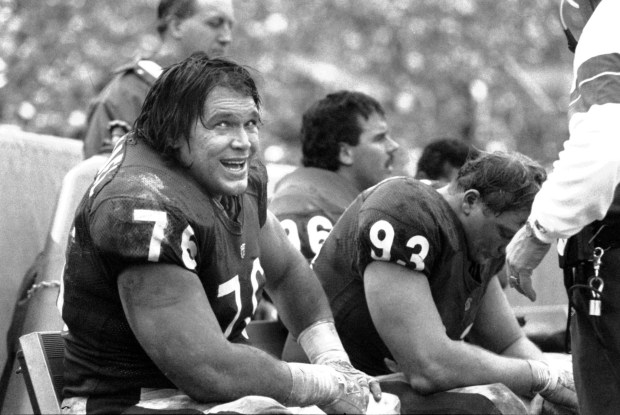
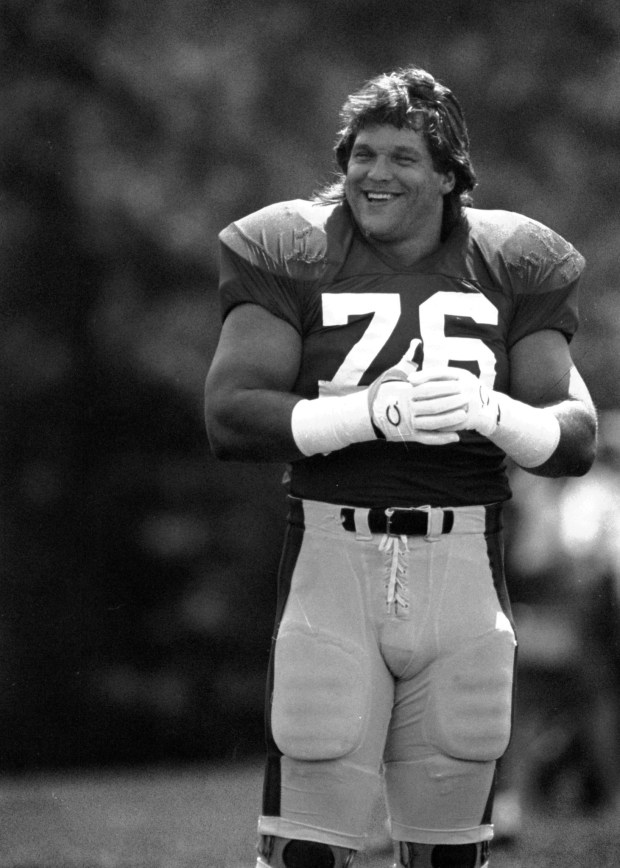
McMichael also was a Bear for 13 seasons: 191 regular-season games played, all in a row. With 92½ sacks, 814 tackles and never a complaint or a question of whether he’d be available to his team.
A helping hand
McMichael’s guidance eventually became a constant for Jarrett for more than 20 years. When Walter died in 1999 at age 46 from bile duct cancer linked to a rare liver disease, Jarrett needed new places to turn for counsel and support.
So many of his dad’s Bears teammates did their part to fill the void. But few proved more gracious and compassionate than McMichael and quarterback Jim McMahon — maybe the last two Jarrett would’ve expected to be so thoughtful and sensitive.
“Two of the craziest dudes,” he said, “guys who were just out of their minds, were the two that always made sure I was OK after my dad passed.”
In 2010, with Jarrett’s own professional football career winding down after stops in the NFL and Canadian Football League, McMichael summoned with an opportunity. As coach of the Chicago Slaughter in the Indoor Football League, he asked Jarrett to come play for him.
Jarrett accepted the invitation and remains profoundly affected by the way that short phase of his life started and the way it ended.
In the beginning, McMichael set firm expectations. This wasn’t some side-stage leisure and a chance to grab a paycheck.
“Steve was like, ‘I don’t just want you to play. I want you to have some type of ownership in joining this team,” Jarrett said.
At the outset, that meant being at the forefront of a marketing blitz and media tour.
“And Steve was with me at every stop,” Jarrett said. “We just kept going, kept going, kept going. He always made me want to keep going.
“Our personalities are similar in that way. And I watched him like, ‘Holy cow! I want to be like that.’”
Jarrett’s experience with the Slaughter also meant becoming a mentor to younger players fighting for a potential career breakthrough. McMichael told Jarrett to remember what his mentors had meant to him: Ed Reed in college at Miami, Steve McNair in the NFL with the Tennessee Titans.
Now a locker room full of driven players was looking to him.
“We had a lot of dudes in their early 20s trying to make it to places where I had already been,” Jarrett said. “And Steve pushed me, like, ‘You’ve got to be that (leader) for these dudes.’ He’d say, ‘You might be nearing the end. But some of these guys are just starting.’”
His perspective sharpened, Jarrett paid his football experience forward.
“There are guys from that team I still have relationships with,” he said. “They saw me buy in. And they saw I was there as a mentor in the same way Steve was a mentor to me.”
That chapter of the Payton-McMichael bond lasted all the way through a playoff loss that season in Sioux Falls, S.D., in which the running back suffered a career-ending hamstring injury. On a training table in the locker room, Jarrett told McMichael he couldn’t push off, he just couldn’t go anymore.
He never has forgotten the stream of tears that immediately poured from his coach’s eyes.
“He was bawling,” Jarrett said. “Honestly. He knew when he heard me say it that it was over. I was done.”
McMichael’s tears signified genuine empathy, an understanding of how intensely emotional the end of a football career can be. His own 15-season NFL career had ended 16 years earlier, and he hadn’t found a way to replace the rush of competing on that stage, of unifying with teammates, of chasing excellence with every drop of fuel in his body.
Yet when Jarrett’s career-ending injury occurred, McMichael also delivered much-needed approval for all that he invested.
“In some ways, it was like, ‘It’s OK. It’s all good. You’ve done enough,’” Jarrett said. “I didn’t have my dad around for that part of it.”
McMichael’s compassion helped.
‘This means so much to him’
For the past three-plus years, Jarrett has been progressively crushed by the vicious blows ALS has landed on McMichael, robbing him first of the use of his arms, then of his ability to walk, then of his voice and ultimately leaving him withered away, bedridden and in need of around-the-clock care.
Jarrett can’t help but think of his dad’s heartbreaking final stages and the agony of finding acceptance with a loved one fighting an unwinnable war.
“This is the second time it’s happened to me,” he said. “It’s hard to see anybody go through something like that. But it’s especially hard when it’s someone close to you, who in your mind you always thought of as unbreakable.”
Jarrett admits he misses McMichael’s voice the most, that booming Texas drawl that constantly spewed jokes and told stories and offered wisdom. Many years ago, McMichael encouraged Jarrett to pursue a post-football career in broadcasting. He’s now a sports anchor for WGN-Channel 9.
“He helped me figure out the vision,” Jarrett said. “He helped me figure out my life plan of what I really wanted to do, and I’m doing it now.”
In that role, Jarrett was in McMichael’s home on the April 2021 day when McMichael chose to take his ALS diagnosis public. Even in the earliest stages of the affliction, it was gut-wrenching to see the first physical signs of McMichael’s battle and even worse to imagine all that was ahead.

Yet when a “Team Mongo” fundraising effort began, with more than $200,000 eventually pouring in through a GoFundMe account, Jarrett experienced McMichael’s gratitude firsthand.
“I remember him calling me that week: ‘Man, this thing is going crazy, baby! I just can’t believe it,’” Jarrett recalled.
That, too, reminded Jarrett of his dad, of that February 1999 day when Walter held a tear-filled news conference to reveal his rare liver disease.
“Hell, yeah, I’m scared!” Walter said that day. “Wouldn’t you be scared?”
Almost immediately, Jarrett said, the public outreach erupted.
“My dad started to get letters at his office from all over the world,” Jarrett said. “He’s opening them up from Germany and Brazil and all these other places. It was an eye-opening moment, like, ‘How did what I’ve done in my life as a football player really impact this many people?’”
Jarrett shook his head, again struck by the parallels.
“A lot of this stuff we’ve been going through with Steve, man, there’s this correlation with my pops,” he said.
Like Walter, McMichael will be venerated as a member of football’s most prestigious fraternity. Like Walter, he will be presented for the Hall of Fame by Jarrett.
“My dad would always say, ‘Tomorrow is not promised to anyone,’” Jarrett said. “And I think that’s been the hardest part leading up to the Hall of Fame (ceremony). I know Steve is holding on. This means so much to him.
“And his battle with ALS shows you the kind of person he is. Because most people would have let go already. But that’s not Steve. Steve has never done that in his life.”
Instead, McMichael keeps fighting, as if he has borrowed a page from Walter’s manual on how to play the game.
“Never die easy,” the legendary running back once said.
McMichael always knew what he meant. And this weekend, with Jarrett delivering the introduction, McMichael’s legacy will land in the place it was meant to be.


