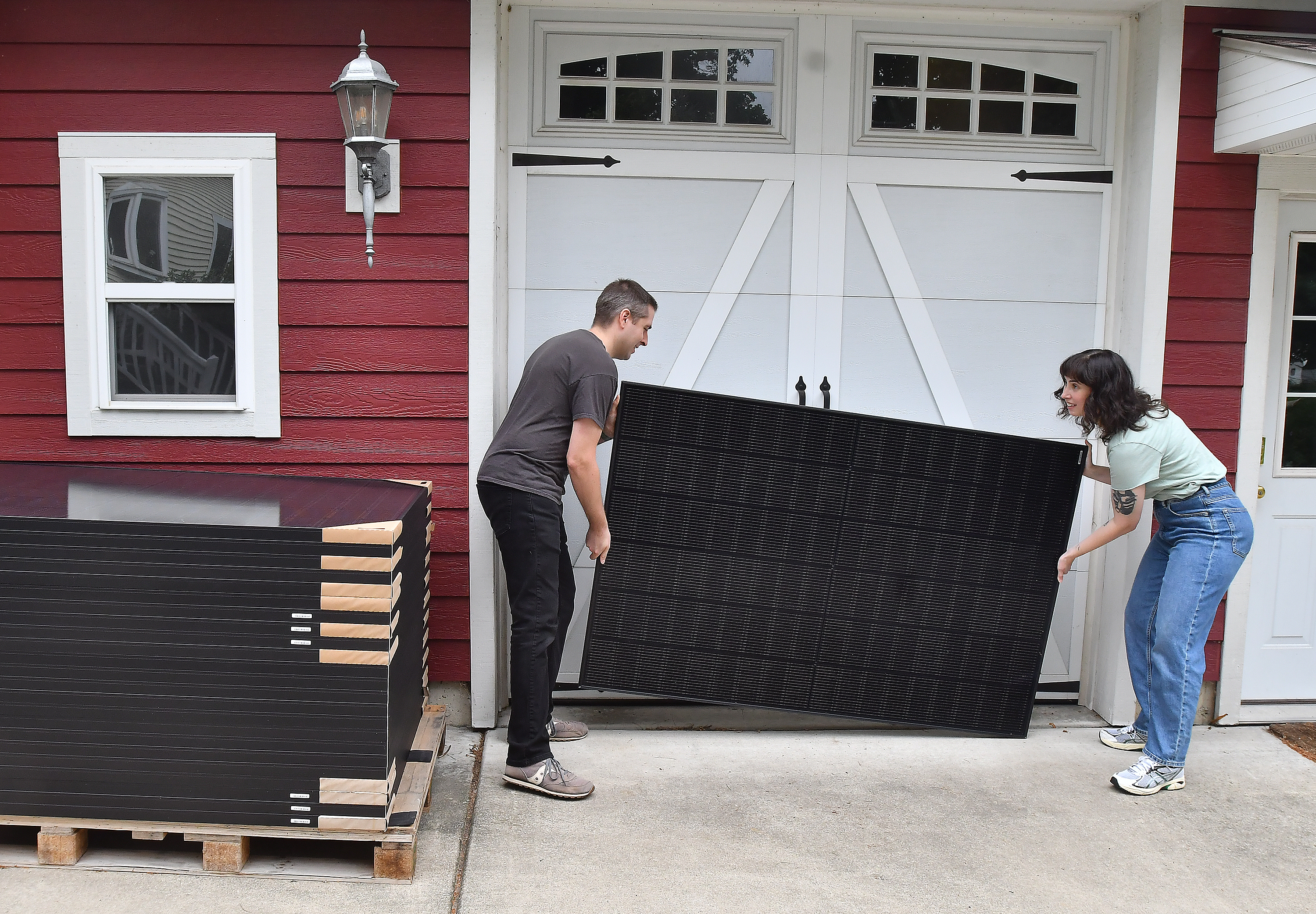

Steven Cergizan of unincorporated Valparaiso is looking to offset the cost of 30 to 35% of the electricity he and his wife Jane Bohnsack use after the installation of about 20 solar panels.
“My goal is to get the system installed by the end of the year,” Cergizan said, referring to the federal tax credit that expires at the end of the year. “If that doesn’t happen it’s OK. It’s still going to be cheaper to install them myself than the quotes I got.”
Cergizan and Bohnsack plan to install a micro inverter system at their home in the 1100 block of Rigg Road, where they’ve lived for three years. “I’ve always wanted solar. I’m sort of a hobbyist and a tinkerer,” Cergizan said.

Porter County adopted a new ordinance covering the installation of personal energy solar systems (PSES) on Aug. 5. The systems will be allowed in all zones. Rooftop and ground-mounted systems are permitted, while wall-mounted solar panels are not.
Cergizan and Bohnsack plan to place their panels on a detached garage. “My property could be better for it, honestly,” Cergizan conceded. He did a lot of research before settling on a system. “I’ve enjoyed learning about how the solar systems function,” he said.
Realtor Nick Benninghoff is also planning to install 20 south-facing panels on his primary property in unincorporated Valparaiso as soon as he’s approved for a permit. “We actually applied yesterday and are still waiting to hear back,” he said, adding that his personal residential installation will be the first for him as a solar rep for Light Skye Energy, a company out of Detroit.
“I’ve been a Realtor for a long time and I’ve been saving up money for solar,” Benninghoff said. “I filled out one of those forms online that I was interested in solar.” He was surprised to learn that his only payment would be the down payment, which is equivalent to the tax credit he’ll apply for when he files his 2025 taxes.
Benninghoff installed solar in March on an Airbnb he owns in another county. “It’s already $25 cheaper on my electric bill right off the bat,” he said. There was a hiccup in the installation there, as the installer didn’t realize Benninghoff’s house had a metal roof. That led to a two-week delay as a different mounting system was ordered.
He’s excited by the double-dipping he plans to get out of the solar at his primary residence. “I have an electric vehicle, so not only is it offsetting the electricity on one, but also the electric we need for the cars. Out west, there’s kind of a lot of people who live this lifestyle, but out here it has yet to catch on,” he said.
Professionally, Benninghoff said Light Skye told him homes with solar are selling for about 5% more than those without. “That’s an added feature for the buyer and a lot of times they’ve already paid them off,” he said.

Those considering applying for a PSES permit should know that the total panel square footage may not exceed 20,000. Those with aggregate collection and/or a focusing area of 10 square feet or less are exempt from the ordinance.
Roof-mounted systems cannot exceed maximum height allowances for each zoning district and cannot project more than six inches from the roof surface in residential applications or more than 4 feet for non-residential properties, nor can they extend beyond the roof edge.
Ground-mounted systems count toward the total impervious surface area and all on-site transmission lines shall be placed underground whenever possible, according to the ordinance. Roof-mounted systems cannot be placed on accessory structures in front yards. All PSES must be placed so that concentrated radiation or glare does not project onto nearby structures or roadways.
Shelley Jones is a freelance reporter for the Post-Tribune.