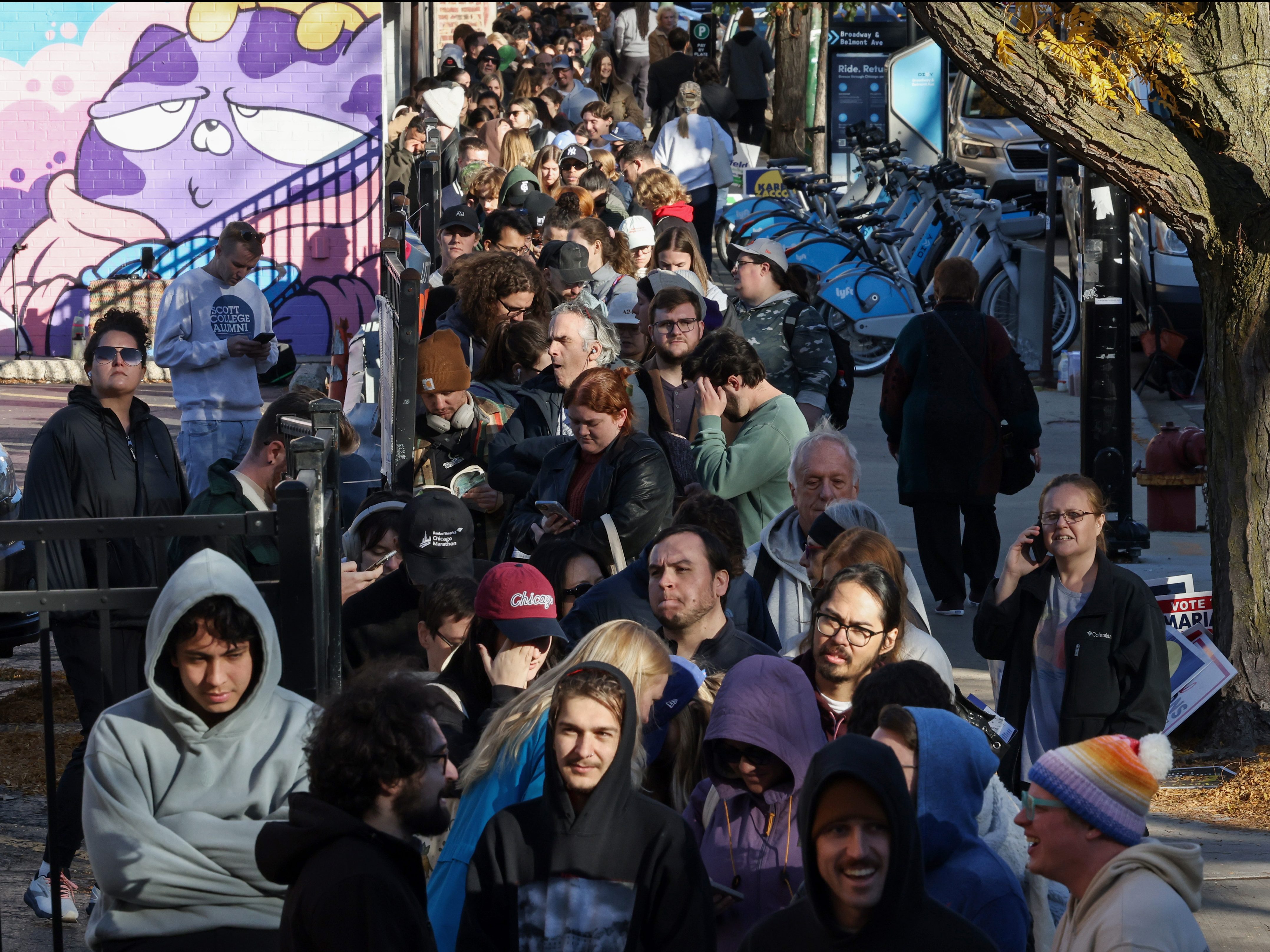


Mayor Brandon Johnson wants to create “democracy zones” near Chicago polling places in an attempt to safeguard voters from potential threats from federal immigration agents. He hoped to implement it in time for next week’s primary elections, but his administration later Tuesday said they were abandoning that idea, and the changes wouldn’t be in place until the November general election at the earliest.
Named the “Reverend Jesse L. Jackson Sr. Fair Access to Democracy Ordinance” in honor of the late civil rights leader who fought for voting rights, the proposed legislation is the progressive mayor’s latest bid to stand up to President Donald Trump, who has suggested a federal takeover of elections and targeted the Chicago area with an aggressive deportation campaign last fall.
According to a copy of the draft ordinance obtained by the Tribune, it would establish boundaries extending 100 feet beyond the existing campaign-free zones codified under state law, and seek to issue fines against federal agents who violated them.
The mayor’s plan says “No area within a Democracy Zone may be used for civil immigration enforcement activity,” though it is far from certain the city has the authority to restrict on-duty federal agents’ movements in the way his ordinance proposes.
“The president has made it very clear that he wants to suppress the vote of working people,” Johnson said at an unrelated news conference Tuesday. “He’s very clear about targeting Black and brown folks.”
The mayor’s staff briefed aldermen Monday with a presentation that said “federal law enforcement outside of polling places is a threat to all voters.”
“The presence of law enforcement outside of polling places can deter voters from participating in elections, especially in Black and brown neighborhoods,” a slide read, noting a ProPublica story that reported U.S. citizens have been detained by immigration authorities across the country.
In addition, the act prohibits the doxing of government workers, defined as intentionally disseminating personal information without their consent, when those details could be used to cause harm. Landlords would also be required to maintain a secure mailbox for every unit, as “when tenants lack secure mail, ballots can be lost or stolen,” the presentation reads.
Violations would be met with $500 to $5,000 fines per day, though it is far from clear that the city has the power to fine on-duty federal agents for violating local laws.
Johnson had hoped to introduce it at a Wednesday City Council meeting, and to fast-track the plan by getting at least two-thirds of aldermen to vote for it. That would have allowed it to take effect immediately, for the March 17 primaries. But that meeting was canceled, and mayoral spokesperson Erin Connelly said he instead wants it in place for the November midterms.
If the ordinance passes, the part affecting landlords would take effect Sept. 1.
Ald. Andre Vasquez, co-chair of the City Council’s Progressive Caucus, said he learned from briefings the plan would add protections “in case something does happen” in Chicago’s March 17 primary. The “mere presence” of federal agents would spark fear and suppress voting, he said.
“I think it makes sense to have whatever we need as far as protection, I don’t see the downside for it,” he said. “You can’t snooze. You can’t be asleep at the wheel.”
Asked by the Tribune if specific intelligence pointing to Trump administration efforts to affect the primary had prompted the introduction, Johnson cited Trump’s rhetoric and pointed to past efforts by the American government to suppress Black voting during the Reconstruction era that followed the Civil War.
“What is provocating is just understanding and knowing our history as a former social studies teacher,” he said. He then turned to the Back of the Yards College Preparatory High School students gathered behind him as he announced applications were open for the city’s youth summer jobs program. “I know none of you ever fall asleep in social studies.”
“Our history gives us indication of what could happen,” he said. “What provoked me is everything that has always provoked me.”
Pressed on the short time between the ordinance’s first circulation and when it could pass on Wednesday, Johnson touted his other ordinances and executive orders aimed at responding to the Trump administration. He argued other cities have followed his lead.
“The most important thing that I want people of the city of Chicago to know is that I’m not sitting on my hands,” he said.