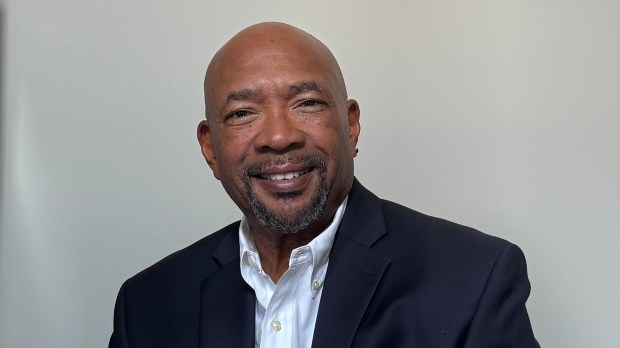


Mayor Brandon Johnson wants to put city government veteran William Cheaks on the frontline of the struggle to move drivers, public transit riders and cyclists through Chicago’s streets as the new head of the city’s Department of Transportation.
Cheaks plans to focus on spending equity across neighborhoods and ramping up communication with the public as projects such as bridge renovations move forward, he told the Tribune.
He shared support for Johnson’s bike lane construction efforts and touted a decadeslong career as a top CDOT and Department of Water Management leader to cast himself as “an ops guy.”
“I want to get rid of paper, like to hold people accountable and get more efficient, because times are tight,” he said.
If approved by the City Council next month, Cheaks would lead a department overseeing more than 4,000 miles of streets, over 300 bridges and viaducts and partnerships such as the Divvy bike-share program. The department has not had a permanent leader since early July, when former Commissioner Tom Carney left to become a top deputy at the Illinois Department of Transportation.
Cheaks said he will begin working as the department’s interim leader Monday, making him the highest-profile new hire among several made by Johnson this week.
The city of Chicago sued Cheaks in 2024 for allegedly refusing to comply with a subpoena from the city’s Office of Inspector General, which was conducting an investigation into alleged violations of the city’s personnel rules and ethics ordinance. In a lawsuit filed in Cook County Circuit Court, the city alleged Cheaks had information relevant to the investigation but had refused to provide testimony.
Cheaks declined to comment on the lawsuit. Court records show that as of January 2025, he had complied with the subpoena, and the city’s lawsuit was dismissed.
Many of the issues that are CDOT’s purview involve tensions between car drivers and pedestrians, cyclists and public transit riders. The Chicago Transit Authority, for instance, has expressed interest in expanding bus priority infrastructure, such as dedicated bus lanes, a move that often draws blowback from people who mostly get around by car.
Cheaks said he expected the push-and-pull between different users of the streets to remain an issue in Chicago.
“There are car people, just bottom line,” he said. “But the way the city is coming up, a lot of people don’t buy cars. A younger generation, they don’t drive. They use bikes and they use the scooters all the time.”
On the subject of bus priority infrastructure, Cheaks said he looked forward to sitting down with the CTA. “If there are any ways I can facilitate that, I’d be willing to talk to them about it,” he said.
But Cheaks also said he saw CDOT as having a broader role in the city than the CTA. “CTA is about moving people,” he said.
CDOT’s goal is “to move everybody,” Cheaks said.
“That’s pedestrians, cars, scooters, Divvy,” he said. “It’s mobility for everyone, so my agenda is a little wider than theirs.”
As for himself, Cheaks said he gets around by car and by motorcycle — a silver 2005 Harley-Davidson Anniversary Edition Fat Boy.
At CDOT, Cheaks will likely be involved in conversations about how to manage the slow march of Waymo, which in February began mapping Chicago’s streets in anticipation of a future autonomous vehicle rollout in the city. Efforts to legalize self-driving taxis like Waymos are underway in Springfield, although they’ve attracted pushback from powerful constituencies including labor unions.
“Me personally, I’m not sure I could get in a car with no driver,” Cheaks said. “I’m older … talking to a driver in front of me suits me better.”
Still, he acknowledged that self-driving cars are likely on their way. “As long as they work the bugs out and no one gets hurt, OK, it’s coming,” he said.
Cheaks did not share many hardened views on how city infrastructure should change in the coming years. Instead, he said he would “continue with this mayor’s agenda.”
Asked how he views the Complete Streets program — which has drawn pushback from some pro-car residents and groups while adding bump-outs, bike lanes and other pedestrian and cyclist-focused features to roads across Chicago neighborhoods — he cited his experience living on the North Side.
“I think those elements play a huge role in traffic calming and slowing traffic down,” he said. “I have no opposition to them. I just like to see that they’re put in place where they serve the most benefit, not just throw them up willy-nilly, just because.”
He previously worked as a deputy commissioner at CDOT for a dozen years, then worked as managing deputy commissioner at the city’s Water Department. In 2022, he left the city for the engineering firm d’Escoto Inc., where he worked as a senior manager on the Bally’s Chicago Casino project, according to his LinkedIn profile.
Cheaks touted his bureaucratic experiences, promising to optimize city services and make the department more proactive in communicating with aldermen and Chicago residents alike. In the past, Friday was his “field day,” he said. He would pull up unannounced to construction sites to check in on crews.
“You know, cat’s away, the mouse will play. But if they know you’re checking on them, they never know when you’re going to show up,” he said.
Cheaks’ appointment comes as Johnson has struggled to make appointments for critical city leadership positions.
The CTA has been without a permanent leader for more than a year, with some transit advocates and aldermen bewildered by the mayor’s hesitation to appoint the agency’s popular interim leader, Nora Leerhsen, to the permanent position. Chicago Public Schools also went more than a year without permanent leadership before the city’s Board of Education approved interim leader Macquline King for the job last month.
And the mayor is embroiled in a power struggle over leadership of the Chicago Housing Authority, where board members openly revolted against him by installing a CEO of their choosing, Keith Pettigrew, in a process Johnson says violated state law.
Johnson also fired the deputy mayor for community safety, Garien Gatewood, last month. The mayor announced on Wednesday that Emmanuel Andre would replace Gatewood. Andre most recently worked as a senior leader at the Cook County public defender’s office, according to a Johnson administration news release.
Johnson also announced Militza M. Pagán has been promoted to deputy mayor for labor relations, Max Budovitch to deputy mayor for business, economic and neighborhood development, and Allison Novelo to press secretary.