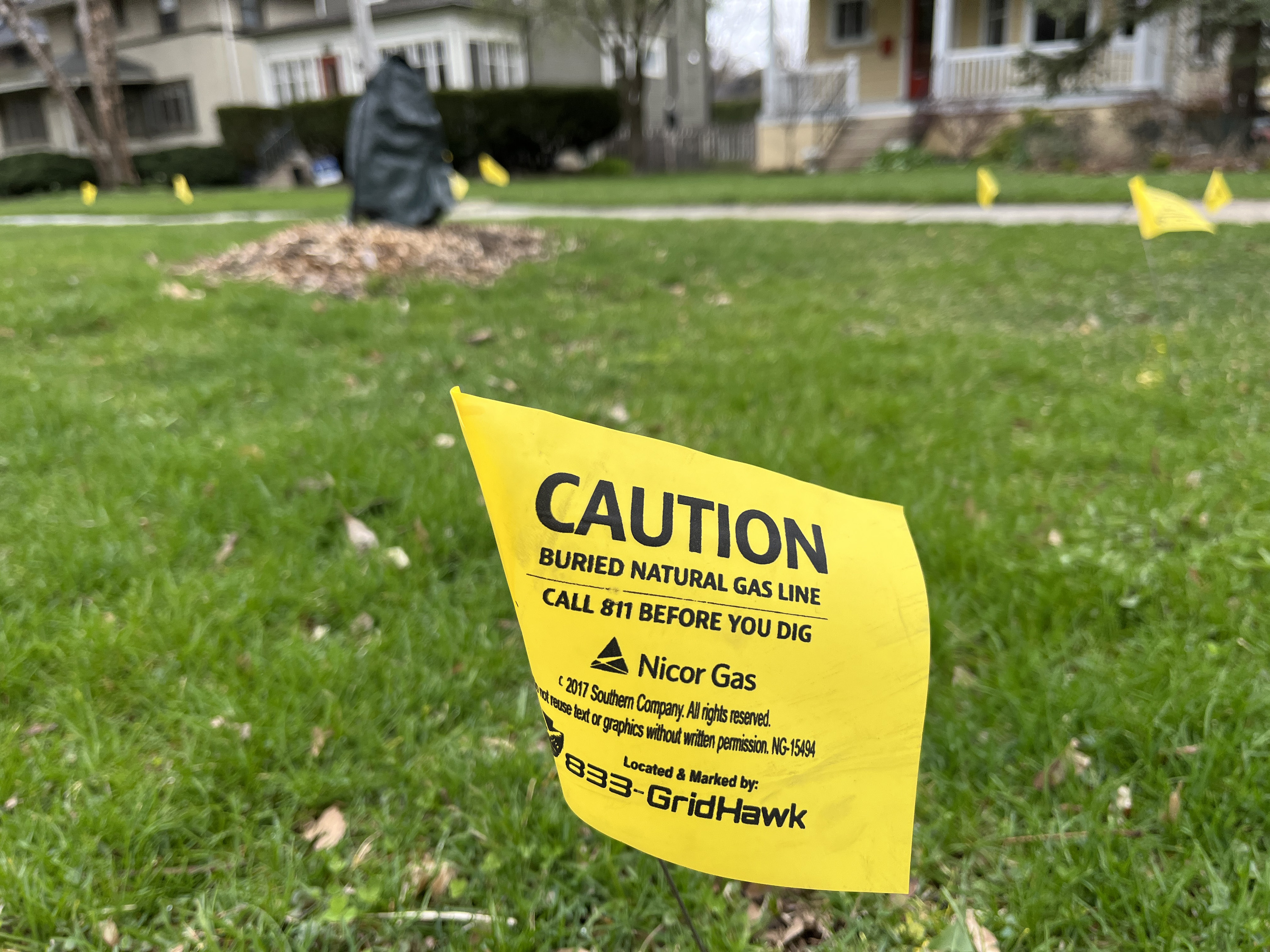

Before you dig a hole to plant a tree, set a fence post or build a deck, first check for possible dangers below ground: the utility lines that bring necessary services to your home.
“It’s easy to hit a gas or electric line or even a sewer pipe when you dig,” said Sharon Yiesla, plant knowledge specialist in the Plant Clinic at The Morton Arboretum in Lisle. “Fortunately, with a little forethought, it’s also easy to avoid the utility lines by having their locations marked before you start your project.”
Every yard contains underground pipes that bring in services such as natural gas and water and carry away sewage. In some yards, below-ground conduits also bring in electricity, internet, cable TV or phone lines. These utility lines may not be deeply buried; some can be in the top foot of soil.
Striking any of those pipes or cables can be an expensive and sometimes dangerous problem for you and your neighbors. Damage from digging has led to power outages, fires, explosions and even deaths.
To help homeowners and contractors dig safely, utility companies and municipalities will mark the locations of the lines with colored flags or nontoxic spray paint. The service is free.
To arrange for utility locating in Illinois, call 811. Inside the Chicago city limits, that toll-free number will connect you to the city’s utility locating program. Elsewhere in Illinois, it will reach JULIE (the Joint Utility Locating Information for Excavators), a not-for-profit founded by Illinois utility companies to avoid line damage.
You can also enter a request online. Within Chicago city limits, visit ipi.cityofchicago.org/digger. Elsewhere in Illinois, juliebeforeyoudig.com.
Place the request at least 14 days before you start your project. In fact, it’s a good idea to have it done early in the planning stages.
If you have your utilities located soon after you move into a new home, you can make a record to guide all future projects.
Getting utilities located early can help you plan for a new tree or shrub, because site conditions are crucial to choosing which species or cultivated variety to plant. “You should always choose the site before you choose the tree,” Yiesla said. “Consider not just what is underground, but any overhead utility lines nearby.”
Once you’ve settled on a site for a tree or a project, you will need to have the utilities located again a couple of weeks before you actually start work, because the official location is only valid for 14 days.
Bear in mind that the locator will only mark gas and electric lines that were installed by the utilities or the municipality. There may be other lines that were installed by the homeowner, such as a gas line connecting to an outdoor grill or an underground electrical conduit to a shed or garage. The utilities have no way to know about those, so it’s up to you to keep a clear record of the locations of any private gas or electric lines to avoid damaging them.
Many home projects, not just tree planting, involve digging far enough down to strike gas or electric lines. If you’re building a deck, the footings for the support posts need to be set at least 36 inches deep. Landscape projects such as patios, paths and water gardens need deep excavations to make space for the underlying gravel layers. Regrading to change the slope of a lot may also endanger utility lines.
“Knowing what is below ground is essential information for planning any kind of project in your home landscape,” Yiesla said.
For tree and plant advice, contact the Plant Clinic at The Morton Arboretum (630-719-2424, mortonarb.org/plant-clinic, or plantclinic@mortonarb.org). Beth Botts is a staff writer at the Arboretum.