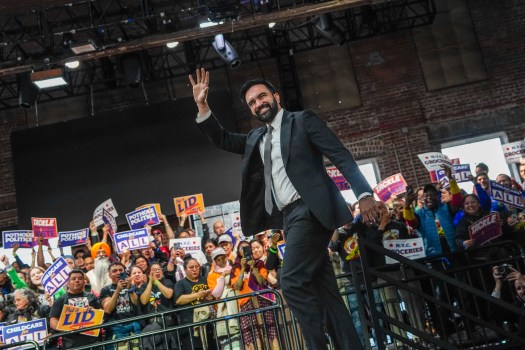

“Pothole politics,” New York City Mayor Zohran Mamdani declared last Sunday at a celebration in Queens of his 100th day in office, is “our 2026 answer to sewer socialism, where government is not too busy, not too self-important, not too mired in paperwork to fix the problems of this city no matter their size.”
You don’t have to be a socialist to want to see a government take care of a city’s small problems — symbolically, and actually, potholes.
If you’ve not heard of the phrase “sewer socialism,” that phrase was coined in 1932 by Morris Hillquit, then the leading American socialist. He’d been struck that the Milwaukee branch of the adherents to his cause were forever boasting about their superior sanitation systems. At the time, the constructive Wisconsin socialists were focusing not so much on political posturing or marching around town railing about the rich, but on cleaning up city neighborhoods and improving the quality of citizens’ lives, one functional drain at a time.
So there’s an interesting bit of labor history. And you didn’t need the day off school to learn about it.
So unlike Chicago Mayor Brandon Johnson, who wastes political capital on unpopular causes such as closing schools for a day to teach kids how to talk like their teacher’s union wants, Mamdani effectively is rebranding socialism not so much as anti-capitalist or anti-fat cat, but as a way of fixing the nagging little problems of a very big city. The local government, he has been arguing, should be just as fixated on your small irritations as you move around town as you are yourself.
It’s interesting how things come around. The idea of paying attention to things like potholes, downed trees, unplowed alleys and unfenced vacant land is synonymous with the Daleys’ longtime rule of Chicago, even though neither father nor son would have been caught dead aligning themselves with socialist mayors. Richard J. and Richard M. just understood what people most want from their big city mayor and they also had an innate sense that this is what they were best at, too. And so they were. Chicago has not had a great pothole mayor since.
Heck, Pothole Politics used to be a Republican specialty. Mamdani has said he is interested in the methods of former New York Mayor Fiorello La Guardia, a Republican who had plenty of fans on the left.
That admiration of La Guardia might explain why Mamdani hasn’t been shy about showing up at the White House and flattering President Donald Trump, even as Illinois politicians merely fire off aggressive speeches of dissent — La Guardia was famous for snagging federal money.
In the 1930s, some saw La Guardia as a socialist, others as a man far too close to fascist Italy. Meanwhile, the New Deal cash flowed into New York and its singular infrastructure grew and grew.
Socialists like to spend money — lots of other people’s money, of course — and Mamdani has been hampered by the fiscal stewards of Albany who, thankfully for New York City, aren’t likely to allow his more egregious schemes that would only drive away more of the city’s crucial affluent class. A hundred days in, most savvy New Yorkers are surmising there will be a useful detente.
But is Mamdani wasting his time railing at Albany in one press conference after another? No, he’s doing things like personally helping to fix the concrete dip on the Manhattan side of the Williamsburg Bridge, an irritation for cyclists who risk losing control when they hit the bump.
His administration hasn’t just filled more than 100,000 potholes, they’ve also led off speeches with that accomplishment, without irony.
To the delight of many in Brooklyn, Mamdani is moving forward on a major redesign of Grand Army Plaza Eastern Parkway, reconnecting the historic Soldiers’ and Sailors’ Memorial Arch directly to the beautiful Prospect Park (as originally intended), creating a new pedestrian and market space and eliminating a harrowing place to cross the street. He is doing so without demonizing drivers. It’s worth noting that this project is located in a very affluent area of Brooklyn, filled with highly educated Mamdani supporters. They’re unlikely to forget this project. And they vote.
The advantage of people seeing you take care of the little stuff is that they’re more inclined to believe you can handle the bigger issues; in some ways, this is an affirmative flip of the so-called broken window theory of policing, not that Mamdani would welcome the comparison.
It’s also worth noting that all of these little fixes are very video friendly at a time when many get their news from social media. It boggles the mind to imagine a city videographer making TikToks from the malapropisms of either Daley, but this is now a different time. Whatever you think of Mamdani’s work so far, anyone can see that his PR strategy has been as masterful as his determination not to pit New Yorkers against each other.
As we’ve watched, we’ve also come to see that a big part of the advantage of being the guy who cares the most about the little stuff is that you can far more easily avoid having to talk about the big, divisive stuff, which can be very advantageous for a big city mayor who wants to get re-elected, or elected somewhere else.
Not a bad first 100 days in New York at all.
Submit a letter, of no more than 400 words, to the editor here or email letters@chicagotribune.com.