
James Mertes sees dead people — on a court jury list.
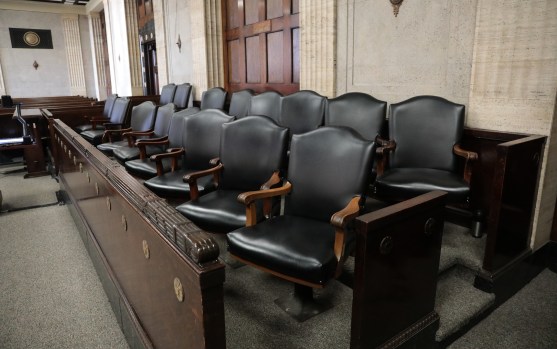
Mertes, a criminal defense attorney, was alarmed by the glut of dead people whose names turned up on a recent list of potential jurors in rural Whiteside County. Now, he and county prosecutors are wondering whether Illinois has sufficient safeguards to purge the deceased from its jury pools.
The issue could potentially affect other criminal trial cases — making the case the “canary in a coal mine” for the statewide jury system, Mertes said.
“It’s extremely difficult to believe this problem doesn’t exist in other counties,” Mertes said. “Our system of justice is predicated on the idea that a jury represents a fair cross section of the community, so you get different perspectives. Then you can have faith in the integrity of that verdict.”
Whiteside County State’s Attorney Colleen Buckwalter has conceded the problems with the jury pool process, and has stated in court that her office has not been given any guarantee that the pool is purged of those who’ve passed away.
At issue is the Sixth Amendment right to “an impartial jury.” The U.S. Supreme Court has interpreted that to mean the pool from which jurors are chosen should be a “fair cross-section” that is “broadly representative of the community.”
The issue came to light in the case of 32-year-old Michael Cover, who is charged with felony aggravated battery of a police officer, for allegedly grabbing the wrist of an officer to prevent him from pulling out his Taser, and with misdemeanor obstructing justice for not complying with the officer’s command to access his phone.
Mertes, as Cover’s attorney, discovered the county clerk was using a list of potential jurors provided by the Administrative Office of the Illinois Courts, but was excluding anyone under 21, over 80, anyone who owed the county clerk money, anyone with a pending civil case and anyone ever charged with a criminal case in the county.
After a hearing in March that revealed these exclusion criteria, a judge discharged the jury pool as invalid.
Subsequently, the circuit clerk was blindfolded and pulled names randomly out of a box — but a judge again threw out that jury pool, because it had been subject to the same exclusions.
The clerk then agreed not to exclude particular groups from the pool. A new pool was generated using ChatGPT to randomly pull names from the list of 48,000 provided to the county by the state courts office.
Last Monday, the defense filed a request to again discharge the jury pool, not because of the exclusions, but because of problems that arose with the new list of names.
Of 200 people pulled on the list, 60, it turned out, were dead, according to the court filing. There were county death certificates for 43 of the potential jurors, and more deaths confirmed through obituary announcements. Of the remaining potential jurors, the average age was 72, and the youngest was 42.
The state list contained 48,000 names of county residents — yet the 2020 U.S. census showed an adult population of only about 43,000, suggesting it was mathematically impossible to have that many eligible residents.
These “jaw-dropping” revelations, Mertes argued, meant that the jury pool was skewed to older and dead people, thereby excluding younger adults from the pool, violating the state and federal constitutions. He also said he rarely, if ever, sees Black or Latino people in the jury pools in Whiteside County.
But some county officials dispute the idea of statewide problems.
In DuPage County, the court administrator’s office reported that it hasn’t had a problem, sharing a demographic breakdown for its latest juries that showed an even distribution of all ages.
The county holds about 100 trials a year, and issues summons for about 900 potential jurors a week, with about two-thirds of the people showing up.
Dan Wallis, the court administrator for McHenry County, said that McHenry and many other counties use jury management software to randomly pull names from the state list. The county sends summons to those named, and if family members call the office to tell them the person has died, that name is removed from the list.
“I would disagree on its face, if you’re truly randomizing your selection,” Wallis said. “Could we get people on our list who passed? Sure, it happens all the time, but it doesn’t mean the jury selection system is flawed. It’s still a randomized group that are qualified as jurors.”
Under state law, the Illinois courts list is compiled from state agency lists of registered voters, driver’s licenses, state identification cards, and claims for unemployment insurance.
One or more of the agencies compiling these lists — the Illinois State Board of Elections, the Secretary of State, and the Illinois Department of Employment Security, evidently is not purging dead people from its lists, Mertes said.
The Board of Elections gets monthly data on deaths from the U.S. Social Security Administration and the Illinois Department of Public Health, and forwards that to county and city election officials, spokesperson Matt Dietrich told the Tribune. But it’s up to local officials to purge the deceased from voter rolls — the state board can’t do it.
“We don’t have authority to register or remove voters from voter rolls,” Dietrich wrote in an email. “That is solely the responsibility of local election authorities.”
The Cook County clerk’s office, for instance, reports that it checks the state board names against the state’s vital records, takes reports of deaths from family members and removes anyone listed as deceased.
But because the state board doesn’t purge the names, those names apparently stay on the state list that gets sent to the courts.
The Administrative Office of the Illinois Courts declined comment due to the pending case. It recently posted online a brief description of its process, stating only that it removes names that are duplicates. Court filings indicate the courts also get Social Security data, which could be used to identify deaths.
Unlike licenses and unemployment, which have limited duration, voter registration lasts indefinitely unless someone is purged. Federal law requires states to periodically remove ineligible voters, but if someone dies or moves away, there’s no requirement to notify the state.
As a result of these discrepancies in the jury pool, Mertes is again asking the court to discharge any jury panel using the same system, and to find that the state court list of potential jurors is flawed.
Mertes said that a state court task force is looking into the issue, and a hearing is set in the court case for May.