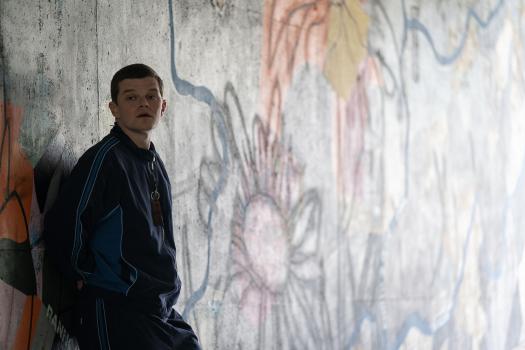

In February, at the British Academy Film Awards, there was a surprising upset. A young English actor, Robert Aramayo, the star of “I Swear,” a British indie directed by Kirk Jones, won best actor over Leonardo DiCaprio, Ethan Hawke, Michael B. Jordan, Timothée Chalamet and Jesse Plemons. His portrayal of Scottish Tourette syndrome activist John Davidson is a truly stunning turn, but ironically, the events of that evening also proved why the film is so necessary right now.
Davidson, in attendance at the BAFTAs that night, involuntarily shouted several offensive phrases, including a racial epithet (much like the film’s framing device, during the ceremony when he received his Order of the British Empire and shouted “(expletive) the queen”). While the handling of the outburst by BAFTA and the BBC wasn’t ideal for anyone involved — they censored a “Free Palestine” message in the broadcast but not the slur — the outrage and fallout from the event show that Davidson’s lifelong mission to educate the wider population about Tourette syndrome is ongoing, and so important.
In 1989, Jones saw the BBC television documentary “John’s Not Mad,” about a teenage John, and how he, his family and community dealt with his Tourette syndrome. The documentary stuck with Jones, and searching for a new film subject, he decided to make a biopic about Davidson, leveraging his own home in order to finance the film himself, without notes or input from financiers on content or casting.
Because if you’re going to make a film about Tourette syndrome, and Davidson, who suffers from tics, obsessive-compulsive disorder, echolalia and coprolalia, there’s going to be a lot of swearing. The film’s title is an amusing declaration of intent, but it also plays on the oath taken in a courtroom, which John struggles to do during a trial in which he’s been accused of starting a bar fight, when he inadvertently knocked a pint out of someone’s hand. He can’t manage to get through the oath without several outbursts insulting the judge, but the trial is the first time in “I Swear” when we see John and his advocates achieve a breakthrough with law enforcement starting to understand his condition.
The first act of “I Swear,” in which the tics start to present in a young, bright 14-year-old John (Scott Ellis Watson) is devastating. It’s 1983 in Galashiels, Scotland, and his involuntary movements and outbursts are seen as misbehavior and teenage rebellion, and treated in kind. He’s ostracized, bullied, ridiculed, beaten. His family falls apart.
It’s a relief, then, when the film skips ahead 13 years, when John (Aramayo) and his mother (Shirley Henderson) have learned to tolerate his condition. But he’s not thriving, as an unemployed, heavily medicated burden to his mother. She enjoys the break when he spends the afternoon with an old friend, Murray (Francesco Piancentini-Smith), a fateful day that becomes a turning point.
John meets Murray’s mother Dottie (Maxine Peake), a mental health nurse who welcomes him without judgment. The only time she admonishes John about his language is to scold him for apologizing too much. She takes him in, finds him a job at a community center with an endlessly understanding boss, Tommy (Peter Mullan), and continually shows up for John, as he’s met with violence from the public and the state.
He’s beaten by thugs with a crowbar for an unfortunate outburst, exploited by neighbors in the council estate and arrested, all because people don’t understand Tourette syndrome. His tics are not naughty mischief, but an uncontrollable action. It makes for an exhausting, agonizing, anxiety-ridden existence that dictates how John exists in public space and in relationship to other people. The most emotional moment in the film is simply when he’s able to quietly walk through a library.
In many ways, “I Swear” is the platonic ideal of a Sony Pictures Classics movie (the studio distributing the film in the U.S.). It’s based on an unconventional true story from recent history, set on the British Isles, with a tone that alternates between humorous and sorrowful before delivering an uplifting and humanist message, with skillfully invisible filmmaking that takes a backseat to the performances and story. Jones has to massage a few details (the documentaries about John are not mentioned) and some relationships could be further fleshed out, but in cramming 40 years of life into one film, he maintains fealty to the emotional truth of the story, capably representing John’s tortured existence and desire to make things better for younger generations.
“I Swear” is a film that was made with a lot of bravery and heart. It’s an important extension of John’s advocacy, but it’s also deeply moving and very entertaining. It’s about getting comfortable with people who are different from us, and uncomfortable moments like the ones at the BAFTAs have so much potential for that continued growth and understanding.
Katie Walsh is a critic for Tribune News Service.
“I Swear” — 3 stars (out of 4)
MPA rating: R (for language throughout and some violence)
Running time: 2:00
How to watch: In theaters April 24