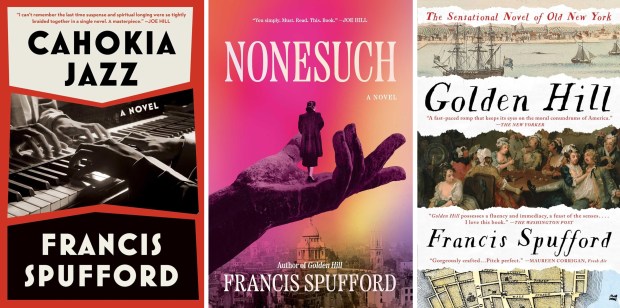

By its description, Francis Spufford’s “Nonesuch” is not a novel for me.
Historical fiction set during the London Blitz of World War II, combined with time travel fantasy, is catnip to many, but I have had something of an aversion to fantastic elements in narrative going way back, and feel like I’ve read more than my share about that particular era of history.
But I have been aware of Spufford’s strong and growing reputation as a writer of original fiction (“Golden Hill” and “Cahokia Jazz”), so I picked up a copy of “Nonesuch” from a bookstore display, started reading, and by the end of the four-page prologue decided that I needed to read the rest.
“Nonesuch” is one of the more enjoyable reading experiences I’ve had in a while. It tells the story of Iris Hawkins, a young, independent woman working as a clerk at a London financial firm who has both the brains and desire to be more than a clerk, but is hamstrung by the mores of the era.
Iris also enjoys the company of men, different men at different times, and she is both confident in her allure and careful with her public presentation and perception so as not to run afoul of the mores that govern women’s propriety. Iris is also judgmental, manipulative and occasionally unkind, the sort of person you want to sit next to at a wedding to share the dish, but also not wholly likable.
In short, she’s interesting.
As the novel opens, post-prologue, we are in the days before the full hostilities between Great Britain and the German Reich. Iris is going about her life both professionally and socially when she spends a night getting swept up into a more bohemian crowd than usual. She decides to seduce Geoff, an intense young man working behind the scenes in the new medium of television. Iris does this as a challenge to Lall, a beautiful ice queen who Geoff seems enamored with, but who reveals herself as a sympathizer with the rising fascist movement, rather than the democratic resistance.
This choice entangles Iris with Geoff and his father, a kind of archivist for a shadowy secret society, and a hapless man. Soon, the supernatural intrudes into Iris’s life in ways that cannot be ignored, ultimately revealing a plot involving time travel that will fundamentally change Great Britain’s stance toward Hitler and the war, ensuring a fascist Europe under Hitler’s thumb.
“Nonesuch” is a novel about ordinary people during war, a supernatural time travel story, and also a romance of sorts. Iris has a past hidden from the reader that makes her wary of deep emotional attachment, a wariness that the stolid and clever Geoff breaks through. I was worried about the plot descending into a series of escalating supernatural battles (the stuff that turns me off some fantasies), but Spufford manages to season the story with some unexpected twists and a villainess who is both scarily formidable and has a legible rationale for her actions, making her far more interesting than a stock-character baddy.
I will admit that I personally found some of the supernatural action sequences a little dull — though this is a me problem — and Iris occasionally seems more two-dimensional than three-dimensional, complicated but not surprising. But these things did not hinder my enjoyment of Spufford’s storytelling.
My biggest complaint is that while the main narrative does wrap up tidily, the story also spins forward in a way that demands a sequel (which Spufford is already working on).
I don’t want to wait to see how the whole story turns out.
Book recommendations from the Biblioracle
John Warner tells you what to read based on the last five books you’ve read.
1. “The Bee Sting” by Paul Murray
2. “Everything Is Tuberculosis” by John Green
3. “The Antidote” by Karen Russell
4. “The River is Waiting” by Wally Lamb
5. “Niccolo Would Like a Word” by Jan Graham
— Kate P., Lisle
This is a little tangential to Kate’s list, but it shares a desire to tell a capacious story tethered to the lived experiences of individual humans: “Deacon King Kong” by James McBride.
1.”The Woman in Suite 11″ by Ruth Ware
2. “The Brutal Telling” by Louise Penny
3. “Killing Moon” by Jo Nesbo
4. “Never Flinch” by Stephen King
5. “Tomorrow, and Tomorrow, and Tomorrow” by Gabrielle Zevin
— Matt L., Glen Ellyn
A different kind of tension than some of these books, but I think it’ll still have Matt locked in: “The Abstinence Teacher” by Tom Perrotta.
1. “The Hallmarked Man” by Robert Galbraith
2. “The Heiress” by Rachel Hawkins
3. “Assassins Anonymous” by Rob Hart
4. “Who is Maud Dixon?” by Alexandra Andrews
5. “The Family Upstairs” by Lisa Jewell
— Jessica Y., Riverside
Hoping that Jessica is not yet familiar with Kate Atkinson’s Jackson Brodie series, which starts with “Case Histories.”
Get a reading from the Biblioracle
Send a list of the last five books you’ve read and your hometown to biblioracle@gmail.com.
John Warner is the author of books including “More Than Words: How to Think About Writing in the Age of AI.” You can find him at biblioracle.com.