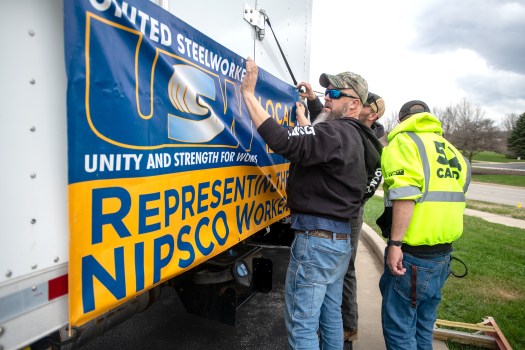
A museum to honor Northwest Indiana’s steel heritage might finally come to fruition.
The Portage Redevelopment Commission signed a memorandum of understanding Thursday with the Northwest Indiana Steel Heritage Project as the first step toward negotiating a lease for the open-air pavilion on the city’s far north side.
The Calumet Steel Heritage Center, as the planned museum is tentatively called, would occupy the 4,000 square feet on the enclosed side of the open-air pavilion.
The open-air side of the pavilion will continue to be available for events like Brewfest and family gatherings. Last winter, it was used for the city’s first ice rink.
“That building began as a U.S. Steel training facility,” Mayor Austin Bonta said, so it would be returning to its roots.
“We’ve been seeking a use for that side of the facility for a very long time,” Bonta said.
It’s currently being used for storage. Among the other proposals over the years was to turn it into a makerspace, something that ultimately occurred at the NEO Adult Education building on the city’s southwest side.
The Marquette Greenway will pass by the museum, Bonta said. The 60-mile bike path between Chicago and New Buffalo will be finished in a few years.
“You go the whole way through, you’re going to be passing the steel museum,” Bonta said, providing a boon to tourism in Portage.
“We’re proud to be in steel country,” he said, and he’s glad to see this museum come to Portage.
The museum has been talked about for decades. Former Indiana Dunes National Park Superintendent Costa Dillon floated the idea of creating a similar museum at Gary’s Union Station, but it failed to get traction.
The Northwest Indiana Steel Heritage Project has been working on it for about 18 years, President Robert Meyer said. With the prospect of the Portage site, the nonprofit’s board has been beefed up with representatives bringing their unique talents to the board. One member works for the Field Museum. Another is an attorney. A third is an accountant. Others have museum experience.
Vice President Tom Cera brings the gift of communication. Meyer said Cera made the presentation to the Portage Redevelopment Commission because he’s better than Meyer at doing so.
Meyer is a retired millwright who worked for five employers at the Burns Harbor steel mill originally built by Bethlehem Steel.
Cera explained the museum would have interactive exhibits with artifacts from various steel mills in the area. “We have to start slowly,” he said, and do it right.
Getting the space ready for the museum involves updating the HVAC system and making sure the other mechanicals are ready for occupancy, he said.
The Calumet Heritage Partnership, which has been pursuing federal designation as a national heritage area, is a related effort, Meyer said.
The enclosed side of the Portage pavilion totals about 4,000 square feet, with two 1,000-square-foot rooms with roll-up doors, plus some smaller rooms.
“Both of the large areas have rol-lup doors,” Meyer said, which will come in handy. “We have a fire engine from Inland Steel as part of our collection.”
Meyer hopes people with their own personal collections will contribute artifacts for a permanent donation or temporary loan.
Once the lease with the Portage Redevelopment Commission is signed, Meyer said, the nonprofit’s board will be able to start fundraising efforts. He’s not sure of the cost yet.
“It’s a fabulous idea. I love it,” Councilwoman Penny Ambler, a member of the commission, said.
“I’m the daughter of a steelworker. I couldn’t be more proud,” commission member Judi Jozwiak said. Thursday’s meeting was her final one before stepping down.
In other business, the commission is negotiating with Ozinga on the CNG filling station. Ozinga is the only company that responded to the city’s request for proposals for a public-private partnership.
Ozinga offered two options: to house it at the city’s street department complex or on land the Redevelopment Commission owns on U.S. 12 near Ind. 249. Bonta favors the latter for better public access.
“We see tremendous benefit in drafting a public-private partnership,” he said. The city would retain the land, but the cost would be put on Ozinga.
The city has been working on this project for years.
The commission also contracted with DLZ to offer conceptual design and detailed construction estimates for relocating the youth baseball fields from downtown to a yet-to-be-determined site. “There are a number of locations in the city we’ve looked at,” Redevelopment Director Dan Botich said.
Doug Ross is a freelance reporter for the Post-Tribune.