
The Illinois House took a big step Wednesday toward keeping the Chicago Bears in the state when it approved legislation allowing the team to negotiate long-term property tax breaks for its planned $2 billion stadium at the former Arlington International Racecourse.
But the Bears are far from the only local franchise hunting for new stadium deals, and nearly 100 graduate students on 16 teams at the University of Chicago’s Harris School of Public Policy and its Mansueto Institute for Urban Innovation brainstormed throughout the school year on ways to keep sports teams in the city, without busting the municipal budget.
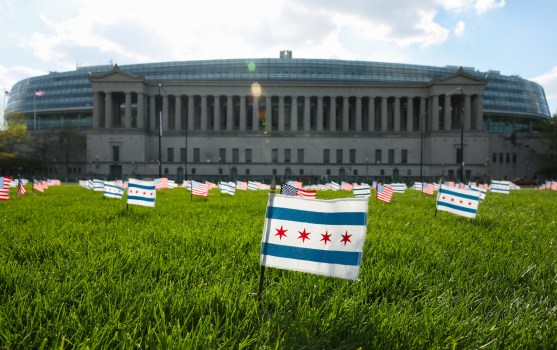
Participating graduate students said they hope city taxpayers can avoid what happened in 2003, when Chicago sank hundreds of millions of dollars into the reconstruction of Soldier Field. The city successfully kept the Bears on the lakefront, but like many U.S. cities, found that expensive stadiums may boost civic pride, but they also remain completely empty almost every day of the year.
“Publicly financed stadiums do not generate meaningful returns or economic activity for their host cities,” Joe diTomasso, a Harris graduate student, said at the school’s “Shark Tank” style competition on Thursday, where three teams of finalists competed for a $10,000 prize. “We are still paying off the renovation of Soldier Field.”
The Bears are likely to skip town for Indiana or Arlington Heights long before that debt is retired. Other teams also want new stadiums, including the Chicago White Sox, who have unveiled plans for a new downtown ballpark, and women’s soccer team the Chicago Stars, which needs a permanent home after its lease at SeatGeek Stadium in suburban Bridgeview expired.
Justin Marlowe, a Harris professor and the contest’s faculty lead, said decisions on whether to fund these projects, and how the public will benefit, will affect Chicago for decades, so city officials, teams and other stakeholders should listen to solutions developed by young people.
“We wanted to give the next generation an opportunity to sound off on these big policy challenges that they are going to inherit,” he said. “We want them to have their say.”
Previous contests at Harris tackled possible solutions to the pension crisis, and how to help Chicago’s downtown fully recover from the pandemic. Judges for this year’s contest included Ald. Bill Conway, 34th, David Wells, former chief financial officer of Netflix and Tovah McCord, executive director of Nicor Illinois Community Investment and former foundation director for the Chicago Blackhawks.
DiTomasso, along with team members Alison Collard de Beaufort, Andres Camacho Baquero and Taha Rashid, proposed keeping public ownership of Soldier Field, but giving its tenant full operational control, much like the control enjoyed by real estate developer Steven Ross over Florida’s Hard Rock Stadium. Ross responded by investing his own capital and transforming the stadium into a year-round attraction and events space. In return, Chicago could charge a much higher rent than currently paid by the Bears.
Students Anna Koh, Firouz Niazi and Lyndsey Wang proposed founding a public Chicago Sports Authority. It would issue revenue-backed bonds, fund new infrastructure needed for stadiums, such as public transit, and receive in return an ownership stake in the sports team.
The winning proposal came from Harris students Charlie Schraw, Christina Tsai and Liz Williams, who called on city leaders to restructure how they fund all stadium deals, strengthen community benefits agreements, limit taxpayer risk and avoid subsidizing billionaires.
The group pointed out that the Illinois Sports Facilities Authority currently funds Soldier Field and Rate Field, the South Side home of the White Sox, with a portion of the city’s hotel tax. But the tourism slump during the pandemic forced the city to cover its debt payments by dipping into the general fund.
“The city can borrow smarter, Chicago can be put first,” Williams said.
The team proposed starting the Stadium Securitization Corporation, a new entity that would issue bonds, collect revenues from stadium taxes, pay off the debts and stop raids on the city’s general fund.
The SSC would help fund new stadium deals and handle negotiations with sports teams of all sizes, including major league baseball teams like the White Sox, and smaller women’s teams, such as the Stars and a potential expansion team from the Professional Women’s Hockey League.
“Our plan allows the city to come to the negotiating table with leverage, not desperation,” Williams said.
But any funding deals would not be giveaways, she added. All teams would have to provide defined community benefits, such as funding youth sports leagues, commitments for affordable housing, public transit access, climate resilience plans and 30-year nonrelocation agreements.
Schraw said upfront arrangements like that would avoid the controversy happening now with the Chicago Fire stadium now under construction just south of downtown in developer Related Midwest’s new neighborhood called The 78.

Although Fire owner Joe Mansueto agreed to privately fund the 22,000-seat, $750 million stadium, it still requires public TIF funds for much-needed infrastructure upgrades and nearby residents worried about displacement and traffic are pressing for a community benefits agreement.
“Residents are still asking why their input wasn’t considered at the start,” Schraw said.
One of the judges asked the winning group whether everything required by this plan would make it more difficult to ink deals with local sports teams, and whether the city should be willing to pay extra for the civic pride that comes from successful hometown teams.
Williams said that, as a sports fan, she wants to root for, and spend money on, teams willing to build deep relationships with the city.
“If I knew that you’re contributing to youth sports, I think I would become a bigger fan,” she said. “Give us a reason to have that pride, and we’ll give you cash.”