
One hundred years ago, a few thousand miles away across the Atlantic, a quiet moment in history rippled across northwestern Europe.
The day was April 18, 1926. Ireland was coming off centuries of British rule and a bloody civil war and hadn’t paused to understand where it stood, or how it had changed, in years. But the young nation was dawning a new age. And that spring night, Ireland conducted its first census in more than a decade — its first as a free state.
Today, there are few living testaments to that headcount. But newly revealed records show that one of them is just a few miles outside of Chicago. And she’s a spitfire.
At 105 years old, Roselle resident Nancy Lally is part of a group of centenarians whose names are on the Irish census of 1926, which the National Archives of Ireland digitized and publicly unveiled earlier this month after a century spent sealed by law.
Today, it’s estimated there are at least 1,200 people still living who are on the demographic record. And while that number is likely greater, factoring in emigration and lineage lost over the decades, it represents just a tiny fraction of the nearly 3 million people tallied at the outset of Ireland’s independence.
Lally was just 5 years old when the enumerators came to her family’s farm in the Irish countryside. The officials took down her family’s information, and her father signed at the bottom.
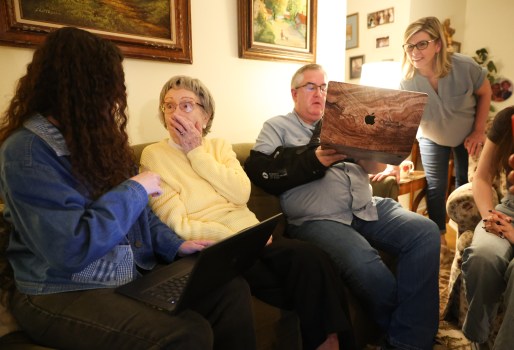
On April 18, at the stroke of midnight in Ireland on the 100th anniversary of the count, the long-awaited records went live. Lally waited for the moment with her grandson and great-granddaughters. Together, crowded on a couch in her northwest suburban home, they searched for their family’s account on the National Archives website.
When her grandson announced that he had found the right form, Lally adjusted her wide-brimmed glasses with one hand, raised her eyebrows and leaned in close.
“Oh my god,” she trailed off as she explored the page.
A touch of life
Prior to 1926, Ireland had already long kept systemic tabs on its population. The country’s first successful census took place in 1821, followed by subsequent tallies taken every 10 years, according to the National Archives. That is, up until the 1911 census, after which unrest put the practice on pause.
Between late 1918 and 1921, Ireland was consumed by a war for independence against British rule, which had loomed over the island since the 12th century. Irish nationalists had rebelled against British rule for hundreds of years, but revolution started to become more palatable to the larger public during World War I, according to Sean Farrell, a history professor at Northern Illinois University and 19th century Irish historian.
A turning point was the Easter Rising rebellion, when Irish republicans revolted against British rule in 1916, Farrell said. Though rebels surrendered, the uprising set the stage for the broader push against British occupation and ultimately, the establishment of the Irish Free State in 1922. The tensions, however, didn’t end there. What followed was a year of civil war, as the country fought over different visions for what it meant to be free and independent.
But by the mid-1920s, Ireland’s focus shifted to garnering a greater sense of stability. The country began to take stock, starting with its inaugural census as a free state.
Officials polled for varying information. Yes, the basics of name, age and sex, but also birthplace, religion, occupation, even agricultural holdings. The 1926 census yielded more than 700,000 household returns, per the National Archives. It’s those individual returns that Ireland just made openly accessible for the first time.
Ireland preserves census records under a 100-year-rule, which maintains that anything more than high-level data gleaned from population counts be kept sealed for a full century before they can be publicly released, National Archives Director Orlaith McBride told the Tribune.
The moratorium serves to balance personal privacy with humanizing history, according to the country’s Central Statistics Office. McBride, for instance, pointed to census returns from sensitive locations.
“Certainly, (people wouldn’t have wanted) that information … to be in the public domain in 1926,” she said. But the idea is that over time, that kind of data loses its present-day implications and can eventually be unveiled to offer a snapshot of yesterday.
To prepare for the release of the 1926 census, archivists spent nearly three years conserving, digitizing and transcribing the decades-old data, McBride said. The state has also taken painstaking care to ensure that anyone and everyone can relish in the work.

The 1926 database is freely available online. As of Friday, some 33 million people had engaged with the digital records since they were released, including more than 1 million from the U.S. alone., according to the National Archives.
Farrell, the historian, called the access remarkable.
“This openness … allows you to touch that life in a certain way, you know?” he said.
The moment enumerators came around and conducted the census isn’t something that Lally remembers. But she and the count’s other standing centenarians, and the physical records to show for their place in the juncture, provide a living link to the past. They paint a picture of what history looked like and how it’s progressed in real-time, and — for Lally especially — outline the origin of a long and still continuing story that she herself can’t quite grasp has stretched on for more than 100 years.
‘I feel like I could still hold a job’
Lally still remembers the little things. She remembers growing up on her family’s farm in County Wicklow and each spring, looking forward to feeding lambs by the bottle. She remembers the gallop of hooves as she rode in a buggy and when automobiles started to take over the road, much to her parent’s chagrin.
She remembers the big candle her mother would bring out on Christmas, getting into trouble and dancing. There was lots of dancing.
Sitting down with the Tribune recently, Lally reminisced and revisited her life, which she recalled with impressive detail and a sharp tongue. Though she lost her hearing a couple of years ago, she fielded questions — floated via large bold type on a laptop — with ease.
“Honest to God, those years went by so fast,” she said. “I can’t believe my age. I feel like I could still hold a job.”
Lally was born in Dublin in 1920. Her father was a countryman, but her mother loved the city. They married young and over the years, had 11 kids (Lally was the second oldest).
When Lally was 2 years old, her parents moved their family about 28 miles south of Dublin. Living in the countryside kept her relatively removed from the tumultuous period she’d been born into.
“(The farm) was wonderful,” she said. “Filthy dirty, but it was healthy and happy. We always had plenty of fun and something to occupy our minds.”
Lally recalled as a teenager going to parties at a nearby estate (a scene she likened to the “Hollywood crowd”) and later, taking her first job at a drapery store in Dublin.
She stayed in Ireland until after World War II. Then Lally jetted off to London, a move she said “all the young ones” from her area made because there were better opportunities for work in England. She landed a gig as a waitress at a hotel, a real ritzy spot, and on weekends she’d go to socials to “dance (her) heart out,” she said.
Lally never planned on getting married — she liked to keep free. But then she met John.
It was one of her brothers that introduced her to her husband, Lally said. At first, she thought he was weird. Still, after a little more time spent together, she learned he was refined, kind and loving. She married him when she was 29 years old. Lally moved back to Ireland — John worked for Guinness — and they started their family. But in the early 1950s, they were due for another move, this time across the ocean.
Lally had always wanted to immigrate to America. It wasn’t until she’d married John, who had family in Chicago, that she had someone to follow. In 1953, with their 3-three-old son Ivan, they packed their things, got on a ship and sailed to the United States.

They settled on Chicago’s West Side and that’s where they stayed until they moved out of the city and into the western suburbs in the mid-60s. Ivan went on to serve in the Vietnam War, then returned to work as a police officer for the village of Hillside. Along the way, he had Kelly, Lally’s grandson (who she called “the greatest joy of our lives”).
Kelly followed in his father’s footsteps. After a short stint in the Army, Kelly spent 27 years with the Carol Stream Police Department. He retired last year.

Today, Kelly visits his grandmother at her house in Roselle a couple of times a week. His two daughters, who are also local, likewise visit often. Kelly does the grocery shopping, but Lally still cleans and cooks for herself (and only takes one baby aspirin and one blood pressure pill a day).
Lally’s been without John for nearly two decades, but her house is lined with framed memories — of him, of their family.
“It’s been a good life,” she said. Lally paused, then summed up the sentiment with a laugh.
“Working,” she said, “(but) living for dances (on) the weekends.”
A great honor
Kelly heard about the 1926 census through family still in Ireland. As the National Archives prepared to release the count this year, it had also launched an effort to find centenarians like Lally who would be willing to share first-hand testimony and act as representatives of the records.
“It’s been on the TV and in the papers (in Ireland) for the last almost year and a half,” Kelly said, recalling what their family abroad had told him.
The archives ultimately appointed 48 ambassadors. They span communities across Ireland and cities around the world.
Lally said she doesn’t know how she feels about the attention. She’s a quiet person, she explained, and has always kept to herself.
“This is my penance,” she said wryly.
Her grandson thinks it’s incredible. Their whole family does.
As they spoke with the Tribune, Kelly brought up their family’s census ledger again on his phone. He zoomed in close on his great-grandfather’s signature — William Byrne, it read in tilted cursive.
Seeing her dad’s handwriting, Lally sighed.
“God love him,” she said. “William, you were a great man.”
She blew him a kiss.