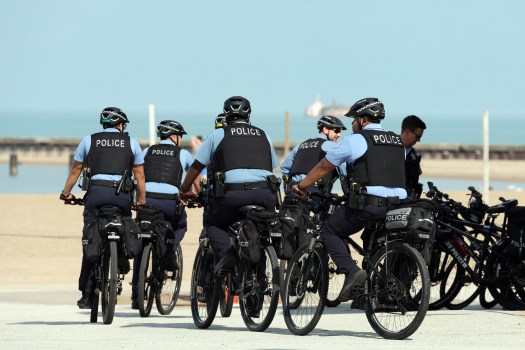

Back in the day, our version of a teen takeover was the annual egg fights on Halloween. Teens from different neighborhoods roamed the streets to pummel one another using eggs as ammunition. The risks were maybe getting stopped by a police officer or two. The reward was a small taste of freedom and neighborhood pride. As a police officer working Halloween, patrolling in a cruiser splattered in yolk, I found delight in cracking the eggs of the new generation of egg throwers. It was the least I could do.
Today, teens are no different from any other generation, still searching for freedom and the thrill of playing chicken with authority. Egg throwing faded away. Teen takeovers didn’t.
The impulse hasn’t changed. What has changed are the platform, the scale and sometimes the consequences. That’s exactly why the response has to be smarter.
Today’s teen takeovers are spontaneous swarms fueled by Instagram and TikTok. The disruptive behavior includes fighting, destruction of property, injuries and sometimes fatalities. Cities are responding. In Atlanta, police increased presence across the metro area, responding to a planned unauthorized gathering that resulted in 14 arrests and the recovery of 10 firearms. In Washington, D.C., officials implemented a juvenile curfew zone near Navy Yard, and the teens simply went elsewhere.
That last detail matters. Because it gets to the heart of what curfews actually accomplish.
Mayor Brandon Johnson won’t even call it a takeover. He calls it a “teen trend.” Words matter in policy. If you can’t name the problem, you can’t solve it. But the solution isn’t to swing to the other extreme either. The Chicago Fraternal Order of Police president calling the mayor a coward doesn’t keep a single teenager off the street. The answer lies somewhere between denial and outrage, and that’s exactly where this conversation needs to go.
When I was a police officer, curfews rarely came up in conversation among officers. When they did, the process was simple: We carried a card, wrote down the violator’s information and either drove the younger ones home or filed the card at the station. It was a quota system more than a safety strategy.
Parents were almost never held accountable. And honestly, what would accountability even look like? Impose a fine on a family already living under the poverty line? That solves nothing.
I know this from both sides of the equation. Once, when I was a teenager, a police officer brought me home for being out past curfew. I begged him not to ring the doorbell. He didn’t.
And you know what? Even if he had rung the doorbell, I still would have gone out the next night. I still tried to outsmart the police. Because that’s what teenagers do. The curfew didn’t change anything. The fear didn’t change anything. What changes teenagers isn’t punishment alone; it’s something worth staying home for or someone worth listening to.
Even Johnson acknowledged it: “All of the data indicates that setting arbitrary curfews — they don’t lead to any positive results.” Charlotte Gill, a criminology professor at George Mason University, confirmed the same; in some cases, crime actually increased during curfew hours. Curfews apply to all minors, including those coming home from work, school events or visits with friends. They risk increasing unwarranted police contact and disproportionately affecting certain neighborhoods. They treat the visible problem, large crowds, rather than the root cause.
The same overreaction that sends young people into the justice system over minor infractions is exactly what cities risk when they treat every teen gathering as a criminal enterprise. I saw this firsthand.
I remember stopping an 18-year-old while in a license plate-reader cruiser. He was driving a stolen car but claimed an acquaintance had lent it to him, unaware it was reported stolen. The keys were in the ignition. I knew immediately this was a misdemeanor. The assistant state’s attorney disagreed and upgraded it to a felony.
In court, the error was obvious to everyone. When the case was called, the defense attorney stunned the courtroom by announcing her client would plead guilty. The judge intervened. Clearly and compassionately, he explained to the young person that a guilty plea would leave a felony on an otherwise clean record.
The courtroom held its breath. Everyone was rooting for this kid to walk out the door.
He pleaded guilty anyway.
One bad decision. One overcharged case. One permanent mark on a young life. That is what overreaction costs.
Johnson is right that young people need support. But support without structure isn’t compassion; it’s abdication. The question isn’t whether to punish or support. It’s whether we’re willing to do the harder work of both.
Chicago already has models that work. Programs such as READI Chicago combine cognitive behavioral intervention with subsidized employment for high-risk individuals. Cure Violence deploys credible messengers, often former gang members, to interrupt conflicts before they escalate. Communities Partnering 4 Peace puts peacekeepers on the streets precisely when and where they’re needed. These aren’t theories. They’re evaluated by the University of Chicago Crime Lab and credited with reducing violence in target areas. The city doesn’t need to invent a solution. It needs to scale the ones already working.
Before we treat every teen gathering as a threat, we should ask: Is this an epidemic or a trend? The response to each should look very different. And getting that wrong has consequences that last far longer than any Halloween egg fight.
Louis Martinez is a retired Chicago Police Department officer and criminal justice professor at Oakton College. He is the author of “The Violent Brain: A Study in Neurocriminology.”
Submit a letter, of no more than 400 words, to the editor here or email letters@chicagotribune.com.