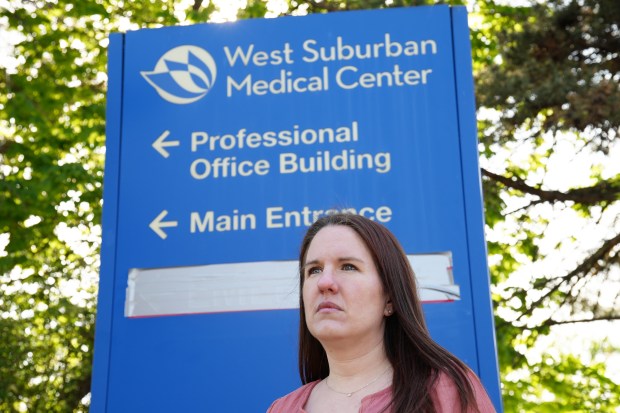
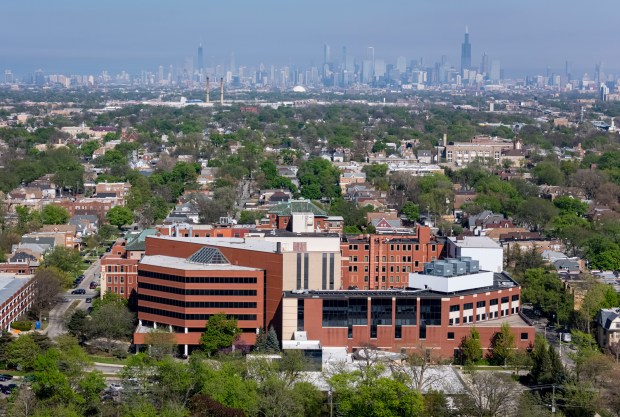







When Sallanshell Wilson saw a family member of one of her patients walking down a lengthy hall at West Suburban Medical Center with a cane, she noticed that every few steps the woman slouched to the right.
At that moment, Wilson thought, “If she had a walker, that will keep her more stable and possibly prevent her from falling,” she said.
Wilson, a former registered nurse at the hospital, took it upon herself to buy a walker for the woman, paying for it out of her own pocket.
“God gave me that to do,” Wilson said. “He let me know, hey, you can prevent a fall today.”
In scenarios like these, she’d often tell patients the same thing when they could regain the ability to walk properly: “I’ll see you at the mall.”
Wilson is just one of hundreds of employees who lost their job earlier this month after officials announced West Suburban Medical Center was temporarily shutting down last month amid a longstanding financial crisis.
West Suburban and its sister hospital, Weiss Memorial Hospital, were acquired by Resilience Healthcare from Pipeline Health System in 2022. Weiss closed down in 2025 after its Medicaid funding was cut due to the hospital being out of compliance with rules related to nursing services, physical environment and emergency services.
West Suburban’s closure was a shock to some patients and staff, who were only given a two-day notice that it was shutting down because of financial issues, but the hospital’s decline was becoming apparent in the months and years leading up to the announcement, according to former staff members.
The climate control at West Suburban didn’t work at times and some rooms registered temperatures of up to 100 degrees during the summer and rooms were chilly during the winter, said Sylvia Williams, the former nurse director at West Suburban. This lasted from August to December 2025, she said, and only in January did the heating partially work.
The Illinois Department of Public Health visited West Suburban last summer while the air conditioning was not working, Williams said. Her 34-bed medical-surgical unit was reduced to about 17 patients because of the HVAC system not working, she said. The other patients were spread throughout the hospital, she said.
Williams said she allowed some of the patients to bring in space heaters, while others were given multiple blankets to help offset the cold temperatures.
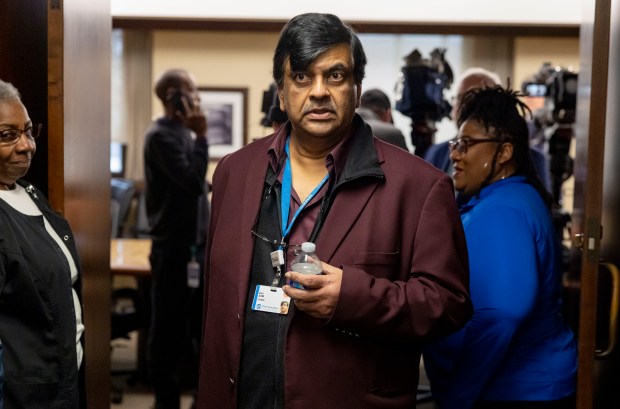
Rose O’Hare was a social worker for three years at West Suburban until she left in 2024. When Dr. Manoj Prasad, the Resilience Healthcare CEO, bought the hospital, O’Hare said she noticed changes.
An elevator broke down and wasn’t fixed. TV services, the only entertainment in the hospital, were canceled, O’Hare said. Contract service providers said they were not being paid and eventually left.
O’Hare also reported being concerned by what appeared to be an unusual amount of amputations.
“I don’t think that many people need their legs cut off as a first line of defense,” she said. “I used to have little support groups because I’d have like five men all have their legs cut off that week. It’s really, really sad because that impacts your quality of life forever.”

After some time there, O’Hare decided to make a change after the air conditioning stopped working at West Suburban while she was pregnant.
“That was what did it for me,” she said. “I said after I deliver, I can’t be here anymore.”
Now a medical social worker at Loyola University Medical Center, O’Hare described the difference in the way similar situations were handled at West Suburban, including ones that sometimes resulted in amputations.
“Here, they revascularize, they get blood flowing again, people get to keep their legs for the same conditions,” O’Hare said.
Williams, the former nursing director, said leadership had dwindled at the hospital over the last six months. Positions were cut, causing people in other departments to fill in, she said. And when people would question Prasad or offer suggestions on improving the hospital, eventually their positions were “eliminated or he tells them ‘you’re not a good fit,’” Williams said.
“We don’t have anybody to go to,” she said. “He’s the CEO, he can basically do whatever he wants.”
There were multiple issues within the hospitals Prasad said he’d fix, but never did, Williams said. Nurses couldn’t hear when they were being summoned on the nurse call systems within the hospital and the telemetry system, which monitors a patient’s heart rate, didn’t work consistently, she said.
“When IDPH comes, they see it, but (Prasad) has people walking around with them, so you’re careful because at the moment you seem like you’re going to say something, you’re dispensable,” Williams said.

She knew conditions at the hospital were getting bad, but she didn’t think it would shut down, she said.
“We never thought it was going to get to this point,” Williams said. “We were hoping that IDPH would come and see something and tell him that he’s got to fix it or else.”
Williams lost her job when West Suburban shut down and has been unable to find another job since.
Deborah Baker was working at her second job when she received the news via a phone call from a colleague that West Suburban would close two days later.
“It was like a shock to me,” she said.
Baker started working at West Suburban when she was 19 years old, a time when the hospital had a better reputation, she said. Now, 34 years later and a registered nurse, the downfall of the hospital is heartbreaking for her.
“I love what I do as a nurse — to do for others what they can’t do for themselves,” she said.
Baker said there was a lot of work that needed to be done with the hospital. The dishwashers didn’t work, the food service had gotten worse — patients were being served food on Styrofoam, she said, and the broken elevators were a nuisance.
And despite having outdated equipment, or not having the proper equipment at all, Baker said, they all did the best they could.
“We were dealing with what we had,” she said.
Like Wilson, she sometimes spent her own money to help patients, sometimes buying food for them, Baker said. After being there for over 30 years, to see the hospital shut down was disheartening for Baker.
“To go from a thriving hospital in a neighborhood, being well known, to what it is now, is very heartbreaking,” Baker said.

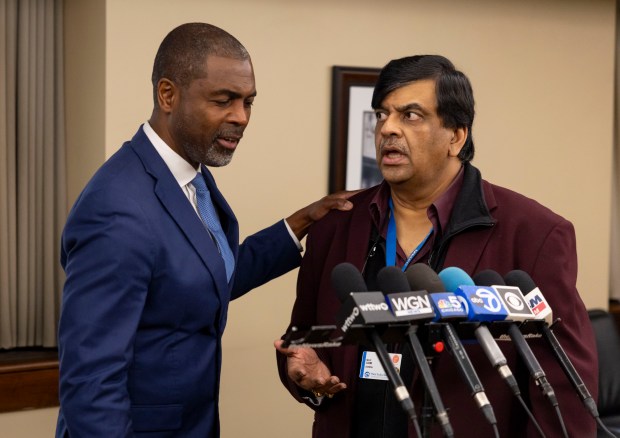
The Oak Park community united earlier this month to devise a plan to address public health in the absence of the hospital. Of the dozens of people at the meeting, multiple attendees said they’ve lost trust in Prasad. That group included Williams.
“We’re hoping the hospital reopens, we’re all committed to going back to patients,” she said. “We just don’t have the faith that Dr. Prasad is the person that needs to do that. We don’t trust him.”
The owner of West Suburban’s property, Ramco Healthcare Holdings, filed a lawsuit to remove Prasad from the hospital. Resilience Healthcare, the owner of the hospital, filed its own lawsuit alleging that Ramco improperly tried to evict Resilience from the facilities.
Ramco asked a judge to appoint a receiver to take control of the hospital’s operations so it can be reopened.
Prasad, who did not respond to comment for this story, said he wanted to reopen the facility this summer, but government officials and Oak Park community members have been dubious of that claim. Still, steps toward reopening the hospital have been made.
West Suburban reopened its clinic, which initially offered primary care visits, then some specialty visits and testing, according to a Tribune article.
With the closure of Weiss and West Suburban, community members are left without a necessity, and Wilson said that absence is unsafe and “detrimental” to the community.
Without the hospitals, she’s concerned about where people experiencing medical emergencies would go. Throughout her time there, she sees West Suburban as more than just colleagues and patients, she said.
“When you take away a hospital, you take away a life sometimes, you take away someone’s loved one, someone’s brother, someone’s sister,” Wilson said. “You take away what helps make a community, and that is family.”
Though there is no current confirmation on what’s to come regarding the hospital, Wilson looks forward to the day it fully reopens … and can tell another patient she’ll see them at the mall.