
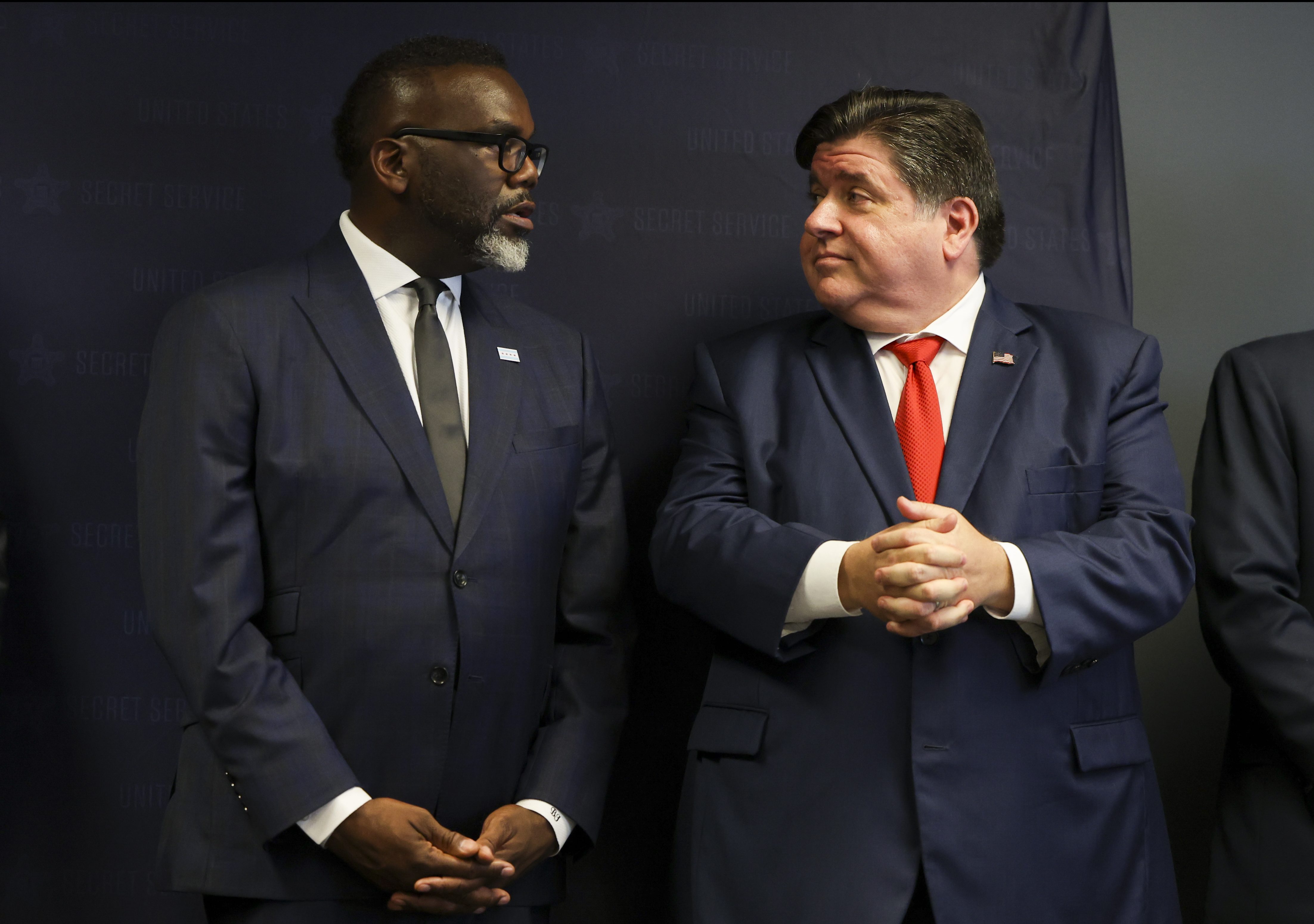

Gov. JB Pritzker said Monday he expects the Illinois General Assembly to pass legislation incentivizing a Chicago Bears stadium and other major development projects before the end of the spring legislative session, while also repeatedly dinging Mayor Brandon Johnson for having “no plan” to keep the team in Chicago.
“That’s problematic. I’d love them to be in the city, but we’re three years in now, and he still has no plan,” Pritzker said of the first-term mayor, who earlier this month during a visit to Springfield made a last-ditch effort to claim the Bears needed to keep playing their home games in Chicago.
The state House passed a so-called megaprojects bill last month that would allow the Bears to make special payments to local governments in lieu of higher property taxes, an effort to keep the team in Illinois rather than losing it to Indiana. But the legislation has sat in the Senate for several weeks amid concerns over whether its property tax relief provisions would be workable.
Illinois lawmakers face a May 31 deadline to advance a stadium tax proposal during the spring session. The Bears have long focused on the former Arlington International Racecourse site in Arlington Heights, which the team purchased in early 2023. More recently, the team has said it is also considering a site in Hammond, after Hoosier lawmakers and the governor of Indiana earlier this year passed legislation to build a stadium across the border, though more work remains to be done before that site could become a reality.
Two years ago, the Bears and Johnson laid out elaborate plans for a new publicly owned domed stadium near Soldier Field, where the team currently plays, but those plans fell flat in Springfield, and the prospect of the Bears staying in Chicago quickly dimmed as no new widely backed ideas have been floated publicly.
Earlier this year, Pritzker said the only two options for the team appeared to be Arlington Heights and Hammond, with Illinois legislation aimed at helping the team pay property taxes to move to the former racetrack site.
Pressed by reporters early Monday on Johnson’s pitch to keep the team in Chicago, Pritzker doubled down on his criticisms of Johnson and the mayor’s last-gasp effort to keep the Bears from leaving the city.
“This is kind of typical. The mayor has shown up every spring at the end of session to pronounce what he would like to see happen,” Pritzker said, adding that the budget process starts months earlier. “To show up in May and have a bunch of demands seems like late in the game, and it’s unfortunate that’s happened most years.”
In a prepared statement, the mayor’s office pushed back on Pritzker’s assessment and said it’s continuing to work on a solution.
“For the past two years, the City has continued to advocate for a publicly owned stadium and has not supported the advancement of a privately owned stadium,” spokesperson Allison Novelo said in an email. “The City’s proposal remains the only plan centered on public ownership alongside a funding mechanism that does not burden property taxpayers while keeping the Bears in Chicago.”
Pritzker said he expects both chambers to vote on an amended megaprojects bill by the end of the month.
In the Illinois legislative efforts, the Bears are seeking certainty about how much the team would have to pay in property taxes for the next 40 years for building on the Arlington Heights site, while lawmakers are trying to balance those concerns as the public has pushed back about giving away benefits to a multibillion-dollar sports franchise.
The Bears and megaprojects bill is one of many pieces of unfinished business left in Springfield with less than two weeks to go, including several of the governor’s priorities, including his ambitious housing agenda that calls for removing significant local oversight for residential developments to encourage more construction of multifamily housing.
But as with the Bears bill, the governor expressed confidence that some parts of his ambitious housing plan — a centerpiece of the agenda he unveiled in February — will reach the House and Senate floors in the coming days, despite the bills receiving only subject matter hearings so far and not advancing in either chamber.
“There is, I think, a pretty good prospect of many of them, maybe most of them, passing,” Pritzker said, though he declined to specify which provisions appeared closest to passage.
Pritzker’s housing proposal would loosen several restrictions that currently limit residential density statewide. One provision would allow four-to-eight-unit buildings on many lots now zoned for single-family homes. Another would permit accessory dwelling units — commonly called granny flats, or ADUs — in backyards across the state. Additional local rules for building size and height could still apply, but the prospect of allowing more four- or six-flats on quiet suburban streets raised alarms for some local leaders.
Supporters say the changes would spur new multifamily construction and eventually push down housing costs by increasing supply.
The Illinois Municipal League, which opposes Pritzker’s plan, recently introduced a rival proposal that touches on similar ideas but strips out the mandates that have drawn resistance from local officials.
Pritzker dismissed the Illinois Municipal League’s bill as “just all about the state spending a whole big bunch of money and not doing what we really need to do.”
“We’re just trying to make it a little bit easier for a homeowner, for example, to create a duplex and maybe bring in their own grandparents or parents to live next door to them,” Pritzker said Monday.


