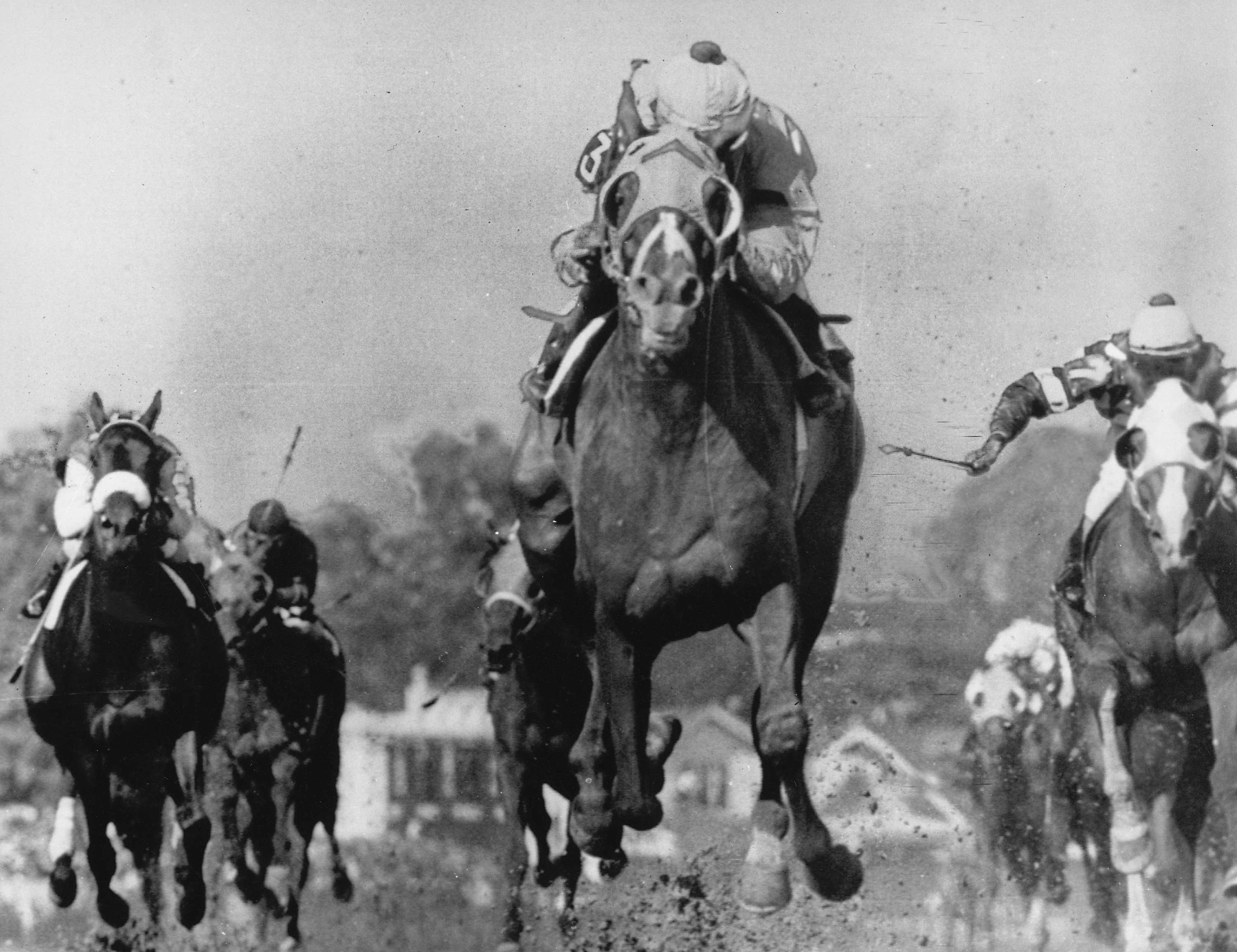

With Illinois racing at an all-time low in terms of popularity and prestige, nostalgic die-hard fans searching for an upper can look back to the spring of 1970 and celebrate the 56th anniversary of Dust Commander becoming the only Illinois-bred horse to win a Triple Crown race.
The compelling 5-length conquest by the 15-1 long shot came in the Kentucky Derby.
Owned by Robert Lehmann and his wife, Verna; trained by Don Combs; and ridden by Mike Manganello, the son of Bold Commander and the broodmare Dust Storm was a bargain-basement $6,500 acquisition at the September 1968 Keeneland yearling sale.
At the sale, Dust Commander was identified as a Kentucky-bred, and when he raced in the Kentucky Derby, that’s how the colt was listed in the Churchill Downs program and in the Daily Racing Form past performances.
It wasn’t until the Monday after the Derby that it was revealed he came into the world on an Illinois farm outside Metropolis, adjacent to the Kentucky border, that was owned by the Pullen brothers, Tom and Jim.
They had purchased Dust Storm for $900 after Bold Commander impregnated her in Kentucky, and the brothers subsequently tried to sell her but were unsuccessful. So they brought her back to their Illinois farm, where she gave birth on Feb. 8, 1967, making her newborn son an Illinois-bred.
When Dust Commander was about 6 weeks old, he and his mother were sold to W. Paul Little of Lexington for $8,063 and the buyer took them to Kentucky, creating some confusion because the sire was based there.
Acting under the misconception that Dust Commander was a Kentucky-bred, Little filled out the paperwork to that effect when he entered the yearling in the 1968 fall sale at Keeneland, so Lehmann had no idea he was buying an Illinois-bred.
If he had known, he probably wouldn’t have purchased the colt. In those days, Illinois-breds were considered second-class citizens of American racing.
Under a rule enacted by the state legislature in hopes of stimulating the breeding program, a race-a-day restricted to Illinois-breds went into effect at Illinois tracks in 1968. Track owners deplored the rule because sophisticated bettors were turned off by the lower quality of the state-breds, producing a negative impact on daily wagering, while veteran racing writers derisively referred to the horses as “ill breds.”
Dust Commander’s racing career began inauspiciously in 1969. He started 14 times, won four races, placed once and showed twice, earning $25,245. The highlight of that 2-year-old campaign came on Dec. 27, when he won the Miami Beach Handicap at now-defunct Tropical Park. His breeders were erroneously listed in the program and Racing Form as W.P. Little, T. Wilson and J. Curry.
Competing as a 3-year-old, Dust Commander was winless in his first six outings. In Kentucky Derby prep races at Florida’s Gulfstream Park, he gave no clue that he was bound for glory. He finished fourth in the Hutcheson at odds of 40-1 and 11th in the Fountain of Youth as a 62-1 shot.
When the colt moved to Kentucky in the spring, he scored his first victory of the year in a 1 1/16-mile Keeneland allowance race on April 8.
That performance persuaded Combs to run Dust Commander 15 days later in the 1 1/8-mile Blue Grass Stakes. Sent off as the longest shot in the field at 35-1, he thrived on the sloppy track and won by three-quarters of a length.

Verna Lehmann believed it was a case of divine intervention. With her husband in India — where he was one of three men hired to track and kill a man-eating tiger — she went to the race at Keeneland accompanied by some special guests: Archbishop Emmanuel Milingo of Zambia and two nuns from his parish.
The Lehmanns were devout Catholics and had sponsored the archbishop’s education when he was a child and young man, and he was visiting the United States for a religious meeting in Cincinnati.
When Dust Commander was in the walking ring before the race, Milingo asked Verna if he could bless the colt. She gave the archbishop permission and he did so when Dust Commander stopped his pre-race walk. When Dust Commander won, she took it as a sign he was destined for bigger and better things, so she entered him in the Kentucky Derby.
When Robert Lehmann called from India a few days after the race to tell her that he and his fellow hunters had killed the tiger, she told him that Dust Commander would be running in the Derby, which at the time was 10 days after the Blue Grass.
He was surprised and said, “You know we can’t win the Derby,” but then she told her husband that the archbishop had blessed the colt and she was confident he would win again.
Robert came to Churchill Downs, spiritually prepared to reinforce the blessing. In his left pocket he had the rosary he’d received from his grandmother for his seventh birthday and had carried daily ever since.
Milingo couldn’t attend the Derby because of the meeting in Cincinnati, but he asked the Lehmanns to use all of his Blue Grass winnings to make another bet to win.

There were 17 horses in the 1¼-mile Derby, and Dust Commander had post position 2. He was soundly bumped at the start, then advanced on the inside before going slightly wide in the stretch, accelerating in the final eighth and winning with authority over the second-place finisher, 2.80-1 favorite My Dad George. There was a $32.60 payoff kickback for those who bet $2 on him to win.
Thanks to his Blue Grass betting bonanza, the archbishop had a lot more than that riding on Dust Commander, and he went back to Zambia significantly richer than when he came to America.
The Derby victory was the last of Dust Commander’s career. He came out of the race with an injured left front ankle but ran in the Preakness and finished ninth in the field of 14. He passed up the Belmont, and in stakes races in New Jersey and Kentucky that summer and fall, the best he could do was a second by disqualification. In five outings the following year, Dust Commander was never in the mutuel money — failing to finish first, second or third.
The Lehmanns retired him to stud at their Golden Chance Farm in Kentucky in 1972, and he was relatively successful, siring, among others, 1975 Preakness winner Master Derby and Run Dusty Run, the second-place finisher behind Seattle Slew in all three 1977 Triple Crown races. From 1974-79, he stood in Japan before returning to Kentucky to stand at Gainesway and Springland Farms.
Dust Commander died in 1991 at age 24.
By then the Illinois-breds — the subject of so much ridicule and scorn when the race-a-day was introduced — had become a success story. This was thanks in large part to the efforts of the late Dick Duchossois, who joined the Illinois Thoroughbred Owners and Breeders’ Foundation in the early 1970s when it was a loosely knit group of mainly hobby horsemen. He was instrumental in making it an effective lobbying organization.
Thanks to the Racing Act of 1975, by 1985 the number of thoroughbreds foaled in Illinois had increased from 481 at the time of the legislation to 1,859.
Although Duchossois’ acquisition of Arlington Park in 1983 and his ownership of the luxurious track overshadowed his achievements as a breeder, his beautiful Hill ‘N Dale Farm near Barrington was a model breeding farm, as impressive as any of those in Kentucky. Horses bred by Duchossois were victorious in stakes races in both the United States and Europe.
Other Illinois breeders went on to produce the winners of world-class races. Buck’s Boy outran a stellar field of European and North American grass horses to take the $2 million Breeders’ Cup Turf in 1998 and was voted North America’s champion male turf horse. Work All Week won the $1.5 million Breeders’ Cup Sprint in 2014, and The Pizza Man won the Arlington Million in 2015.
Unlike Dust Commander’s 1970 Kentucky Derby conquest, those victories weren’t regarded as a fluke.
Neil Milbert is a freelance writer who covered horse racing and other sports during his 40-year career with the Chicago Tribune.