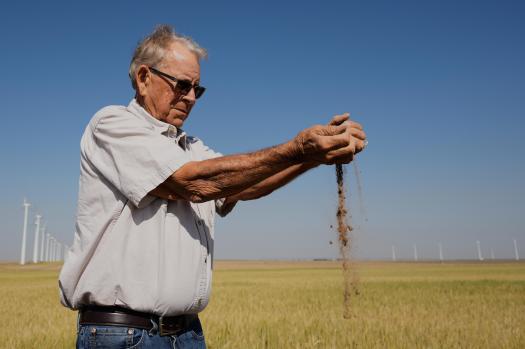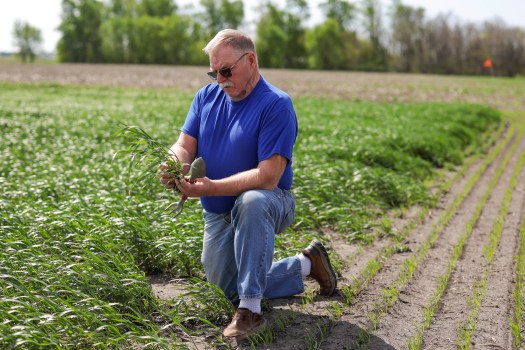

Harold Wilken still remembers the moment nearly 30 years ago when he was sprayed with herbicides after a hose broke on his family farm in Danforth, Illinois.
A decade later, Wilken was diagnosed with cancer. He said he believes years of herbicide exposure contributed to his health problems, including tonsil and lymph node cancer.
“I’m done with this,” Wilken said of herbicides.
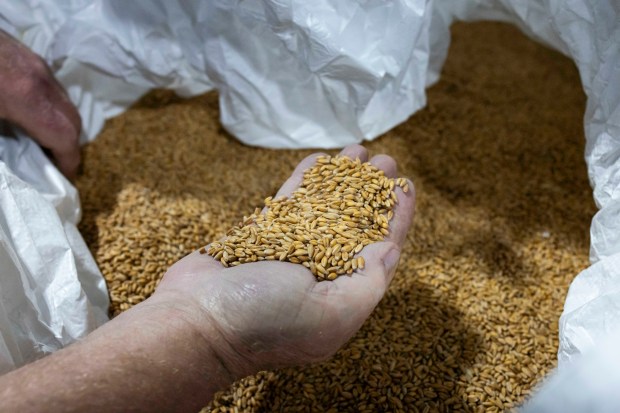
Today, Wilken grows 4,000 acres of grain, rye, corn and soybeans in central Illinois with his son — without the use of synthetic chemicals like Roundup. His farm, Janie’s Farm Organic, is named after his daughter who died in a car accident.
“It helps to keep her spirit alive,” Wilken said.
For Wilken and farmers nationwide who face routine exposure to agricultural chemicals, a high-stakes U.S. Supreme Court case involving Roundup feels personal.
At the center of the case is glyphosate, the active ingredient in Roundup, one of the herbicides used most widely by conventional farmers.
Justices heard oral arguments Monday from Monsanto, Roundup’s manufacturer, as they decide whether a federal law issued over 50 years ago overrides state requirements for companies to warn consumers about potential cancer risks.
In Illinois — the nation’s leading soybean producer and a top corn producer — glyphosate is heavily used to boost crop yields. But critics say widespread reliance comes with health and environmental risks, as long-term exposure has been linked to cancer and other chronic diseases.
“All of the stuff I sprayed, a lot of it’s carcinogenic, and I probably breathed some of that in,” Wilken said. “It was a risk I took. But as an organic farmer now, I wish that I would have gotten wise to this earlier.”
The Supreme Court case stems from a 2023 lawsuit filed by Missouri gardener John Durnell against pesticide manufacturer Monsanto. Durnell says decades of Roundup use caused his non-Hodgkin lymphoma.
Illinois joined 18 states defending consumers’ ability to file lawsuits in state courts against pesticide manufacturers for not including warning labels on products. Fifteen other states, including Iowa and Missouri, filed a brief emphasizing the importance of preserving access to affordable glyphosate.
Meanwhile, President Donald Trump issued an executive order in February, 10 days before the start of the Iran war, invoking the Defense Production Act to boost domestic production of glyphosate, calling it “crucial” to national security and agricultural stability.
This move intensifies concerns among critics about the broader implications of federal support for these chemicals.
In the case of Monsanto v. Durnell, some agricultural groups warn it could usher in what they describe as an “era of impunity” for chemical companies if federal law is interpreted to shield them from liability.
Seeking accountability
The U.S. Environmental Protection Agency approved Roundup in 1974 under the Federal Insecticide, Fungicide and Rodenticide Act, stating that it posed no adverse health effects when used as directed.
Since then, Monsanto, now owned by Bayer, a German-based agricultural science company, has faced extensive litigation over claims that exposure to Roundup causes cancer. The cancer research agency for the World Health Organization classified glyphosate as “probably carcinogenic to humans” in 2015. In February, Bayer agreed to pay billions of dollars to settle tens of thousands of lawsuits, while continuing to deny that glyphosate is carcinogenic.
As of 2023, Bayer removed glyphosate from its residential lawn and garden products following thousands of claims related to Roundup.
The chemical, however, remains widely used in agriculture, particularly for genetically modified corn, soybeans and cotton. Herbicides, a type of pesticide, are used to kill unwanted plants like weeds. Pesticides can be used to kill insects, rodents and weeds.
In 2023, a Missouri jury awarded Durnell $1.25 million, finding that Monsanto failed to adequately warn users about potential cancer risks. Now, Supreme Court justices will weigh in on whether federal pesticide law preempts state-level claims.
Monsanto has asked the Supreme Court to rule that the company shouldn’t be liable for complying with federally approved labels — overriding any state lawsuits like Durnell’s.
“The security and affordability of the nation’s food supply depend on farmers’ and manufacturers’ ability to rely on the science-based judgments of federal regulators,” a Monsanto spokesperson said.
But opponents of Monsanto say that argument would effectively block consumers from seeking accountability in court.
“Pesticides are one of the most omnipresent — and potentially dangerous — aspects of modern life,” said Nathan Leys, an attorney at FarmSTAND, a legal advocacy group for farmers and farmworkers, who authored an amicus brief in the case.
“Shielding manufacturers from accountability is no way to run a modern country, especially when we understand more than ever about the risks,” Leys added.

During Monday’s oral arguments, Supreme Court justices pressed Monsanto on its position that EPA’s approval of Roundup decades ago should override emerging scientific evidence.
“Are you saying that if new information comes out in the 15-year interregnum between registration and reregistration that casts doubt on the efficacy or the safety of this product, you could have a product that is misbranded even though it has been registered and initially labeled properly, correct?” Justice Ketanji Brown Jackson asked Monsanto attorney Paul Clement.
Clement said misbranding and registration are distinct issues, sidestepping whether new information could make a product misbranded if it’s still under an EPA-approved label.
Justice Neil Gorsuch pushed the point further, asking, “You’re saying a registered product can never be misbranded?”
Justice Brett Kavanaugh suggested that new scientific developments should be addressed through future regulatory changes, rather than retroactively holding manufacturers liable for products that complied with EPA requirements at the time.
“To Justice Jackson’s good point about new science, you’re saying the way you account for new science is on a process that changes the requirements going forward, not on a process that retroactively tells you that what you did yesterday as ordered by EPA is somehow illegal,” he said.
For Durnell and thousands of others who say Roundup caused their cancers, the Supreme Court’s ruling could determine whether consumers retain the ability to challenge product safety warnings in court.
“Missouri and federal law have long protected public health by allowing injured victims to sue when manufacturers fail to warn them of risks,” Ashley Conrad Keller, counsel for Durnell, said earlier this month.
‘Era of impunity’
The case has drawn national attention, including from state officials. Earlier this month, Illinois Attorney General Kwame Raoul joined an amicus brief urging the court to preserve states’ authority to hear claims about pesticide manufacturers’ lack of warning labels on products.
“Limiting the ability of injured consumers to seek justice through the court system is un-American and only rewards large corporations,” Raoul said in an April 2 statement.
Leys added that state level lawsuits are a necessary safeguard for users of pesticides.
“If I were a state attorney general, I’d want my state to have the power to protect its people from companies that engage in that kind of behavior,” he said.
Monsanto, however, argues that a Supreme Court ruling in its favor would ensure nationwide consistency in pesticide labeling.
“Companies should not face liability under state law for complying with federally approved labeling,” a Monsanto spokesperson said.
Fifteen other state attorneys general sided with Monsanto, arguing in their brief that it’s “neither appropriate nor lawful to permit other states’ laws to jeopardize that access” to glyphosate.
The case has also divided the agriculture industry. Groups such as the National Agricultural Association, the American Farm Bureau Federation and 12 state farm bureaus have backed Monsanto’s petition to the Supreme Court.
Opponents, including advocates for small farmers in Illinois, warn that a ruling in favor of the herbicide manufacturer could weaken accountability for health risks tied to federally approved chemicals.
“Farmers should be able to trust they’re being told the full story about the products they use,” said Liz Stelk, executive director of the Illinois Stewardship Alliance, a farmer-led nonprofit focused on advancing sustainable agriculture in the state.
“If companies aren’t held responsible for sharing those risks, farmers, farmworkers and rural communities will bear the burden,” Stelk said.
Leys said the implications extend beyond glyphosate.
“FIFRA (the federal act) applies to many pesticides,” he said. “I worry about an era of impunity for manufacturers with significant political influence who can use the regulatory process to shield themselves from liability.”
A ‘ubiquitous’ poison
Glyphosate has been under increased scrutiny in recent months as the Trump administration calls for more domestic production of the chemical, framing it as a national security priority.
Widely known as a weedkiller, glyphosate is also a key ingredient in military munitions such as white phosphorus, raising questions about whether recent executive orders to increase domestic production of glyphosate are being driven more by defense needs than farming concerns.
But some farming groups and organic farmers dispute the notion that glyphosate is indispensable.
“Monsanto and its allies overstate its importance and understate the availability of alternatives,” Leys said.
He pointed out that an overreliance on the chemical has led to health and agricultural downsides, including the emergence of herbicide-resistant weeds such as waterhemp and Palmer amaranth in Illinois.
“It’s really amazing to me that Monsanto in its amici didn’t even really gesture at the problem of glyphosate resistance,” Leys said. “We use glyphosate, it becomes less effective, and then we turn to more toxic chemicals. Farmers and farmworkers end up facing greater exposure as a result.”
A 2021 study by the National Institute of Health found at least 48 weed species have formed glyphosate resistance.

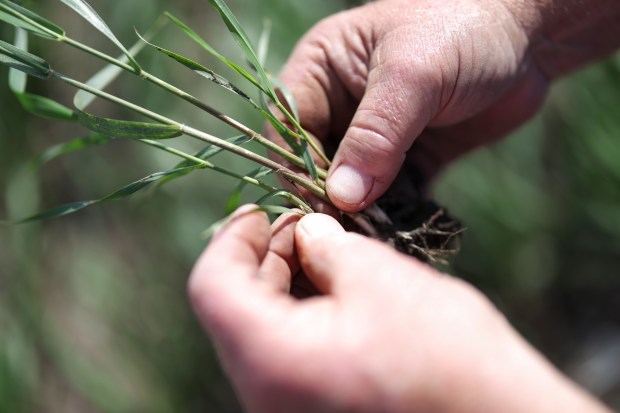
The emergence of these weeds in Illinois further pushed Wilken toward organic farming.
“The guys had to find a different herbicide to spray with the Roundup in order to kill the weeds,” Wilken said. “It just didn’t make logical sense.”
“I could see we were doing things to our soil, it was getting tougher to farm, it was pooling more water on top of the soil,” he added.
Organic farmers can still be affected by glyphosate drifting from neighboring fields, which can threaten the certifications of organic farmers, whether they’re responsible for the synthetic sprays or not, said Stephen Rivard, co-founder of Iroquois Valley, an Illinois-based firm that helps finance farms transitioning to organic practices.
“I stood in my Rock Creek Farm in Will County with my co-founder when the farmer across the street was spraying his fields,” Rivard said. “It’s illegal, but the wind was blowing pretty hard and (the pesticides) were just spraying over into our land.”
“It’s so ubiquitous a poisonous problem that it’s almost impossible to avoid it entirely,” he added.
Rivard, who’s also an emergency response physician, believes organic is essential for restoring both soil and human health. He started Iroquois Valley after treating patients with severe pesticide exposure, witnessing firsthand the health impacts of synthetic chemicals on rural Illinoisans.
“My first exposure to farming and the chemicals used was tragically when a 10-year-old spilled some of the organophosphate that was in his dad’s farm shed and came to the emergency room struggling for breath,” Rivard said. “He eventually died, breaking my heart.”
After studying the connection between the rise of chronic illnesses and pesticide exposure in the United States, Rivard said he made it his life’s mission to help farmers move away from synthetics and embrace organic agriculture.
Wilken was the first conventional farmer to join Iroquois Valley in 2007, gaining financial support from the investment company to help him transition his operations to organic.
Rivard said Wilken’s story reflects a broader shift, as more conventional farmers move away from chemical-intensive practices out of concern for their health.
“It’s a strong motivator for many farmers in our portfolio,” Rivard said. “I’m saddened by their personal tragedies. But I want the awareness to grow. I want people to know the risks that they’re taking by farming chemically.”
Still, the transition to organic can be financially out of reach. In the meantime, many farmers rely on synthetic herbicides to stay afloat, Wilken said.
“If you have marginal land and a lot of weeds, (Roundup) gives farmers the ability to basically make a living,” he said.
Wilken credits Iroquois Valley with making his transition possible. But without similar support, other farmers may have few alternatives.
“When you don’t have competition, you don’t have real options,” Stelk said, referring to the lack of alternatives to Roundup. “Farmers may have to rely on products they’re not fully comfortable with.”
For this reason, Illinois farm groups like Illinois Stewardship Alliance debated speaking out against Monsanto in the Supreme Court case, acknowledging the need to balance effective weed control with concerns about safety.
Ultimately, Stelk said the case shouldn’t be about limiting farmers’ options but ensuring transparency of the health risks that come with pesticide use.
The Supreme Court is expected to give a final ruling on the case by the end of June.
For Leys and farming advocates, the stakes are clear.
“In my view, federal and state law require the same basic principle,” Leys said. “You shouldn’t be able to sell a pesticide without warning people about its foreseeable health risks.”
Wilken said his son plans to carry on Janie’s Farm as an organic farm after he’s gone.
“If nothing else,” Wilken said, “if my son doesn’t have to handle a gallon of pesticide, it will all be worth it.”