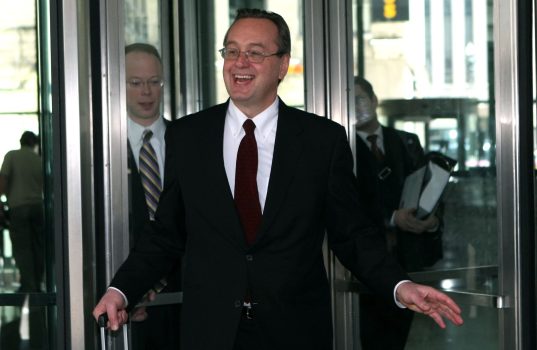

When it comes to an effective cross-examination, longtime Chicago attorney Joseph Duffy says there’s nothing better than confronting a witness with a document.
“If a witness is telling a story, there is only so far you can go,” Duffy told the Tribune in an interview this week. “But if you’ve got a document that is totally inconsistent with what they are saying, then you’ve got him. They can’t move off it. And there is not a jury in the world that likes a liar.”
It’s an art that Duffy mastered over his decades as a trial lawyer, both as a federal prosecutor and later in white-collar defense. He once used bar receipts to show that an undercover agent had been lying about how many drinks he bought an allegedly corrupt yen trader during an investigation at the Chicago Mercantile Exchange in the 1980s. “He said maybe one or two. I pulled out this receipt that said it was 12 beers,” Duffy said.
Decades later, Duffy’s seven-day cross-examination of FBI mole Stuart Levine during the trial of political fixer Antoin “Tony” Rekzo, drew daily crowds for must-see legal theater, with Duffy mixing in alternating doses of humor and scorn as he questioned Levine about his drug use and shifting memory.
“Do you have telepathic power, Mr. Levine?” Duffy asked Levine after he asserted that Rezko had misspoken during a conversation that was captured on a government wiretap.
Duffy spoke to the Tribune after winding up a remarkable five-decade legal career earlier this month, a path that began as a young IRS agent, wound through high-profile corruption investigations as a prosecutor at the U.S. attorney’s office, and continued as one of the country’s top white-collar criminal defense attorneys.

“I loved being a lawyer,” said Duffy, whose last high-profile case was the 2023 trial of former Ald. Edward M. Burke. Duffy said although he still feels like he has gas in the tank, he’s looking forward to traveling and spending more time with his family, including nine grandkids.
“If you want to be a trial lawyer, the time commitment is extraordinary,” he said, quoting the famous line from Supreme Court Justice Joseph Story about the demands of the job: “The law is a jealous mistress.”
Retired Chicago attorney Mark Rotert, who met Duffy at the U.S. attorney’s office in the late 1980s and was later partners with him in a renowned boutique criminal-defense firm, said Duffy was always known as a fair practitioner on both the business and courtroom sides of the law.
While every attorney has their strengths and weaknesses, Rotert said Duffy was legendary for his preparation, whether it was the star witness or a seemingly routine figure in the trial.
“Any defense attorney can get up for the Stuart Levines of the world, but the real pros are the guys who are prepared for every witness,” Rotert told the Tribune. “Joe was the guy who could ferret out the nuggets with every witness … he played two or three moves down the chessboard.”
Born in Chicago’s Old Irving Park neighborhood, Duffy’s family moved to the north suburbs when he was a grade schooler. Shortly after graduating from DePaul with a background in finance, he took the unusual step of joining the IRS as a revenue agent. There, he found himself assigned to a unit called CRIMP, or “Crime Rampant in Machine Politics,” which was one of several specialized strike forces at the time that focused on organized crime.
“We audited public officials and any companies doing work with government entities that required scrutiny,” Duffy said, adding he personally audited a number of governors, mayors, and other elected officials.
He soon was assigned to the U.S. attorney’s office as an agent to help assist them in bringing criminal tax cases to trial. It was Duffy’s first taste of a courtroom, and suddenly he’d found his calling. “I said ‘Oh my god, I got to do this,'” he said.
Duffy worked that job while also attending school at John Marshall Law School four nights a week. It was during that time that he was involved in his first big political case: the investigation into outspoken Illinois Attorney General William Scott, who was charged with tax evasion involving the misuse of campaign funds.
As the trial neared, Duffy had already been offered a position as a prosecutor by then-U.S. Attorney Tom Sullivan, but that was put on hold when Scott suffered a heart attack and the case was delayed for nearly a year. “I had to be an agent so I could testify,” Duffy said. “I had to sit on the bench.”
Scott, who publicly blasted Sullivan for bringing the charges and launched an unsuccessful bid for president while he was under indictment, was convicted in March 1980 of one count against him, ending his political career. According to news accounts from the verdict, as the jurors were being polled, Scott’s wife strode across the courtroom to Sullivan and yelled “You hypocrite!”
Scott tugged at her arm and said, “Don’t give the hypocrite the satisfaction.”
Once Duffy fully joined the U.S. attorney’s office, his financial expertise allowed him to quickly move from small-time prosecutions to bigger cases involving complex bank fraud and political corruption, first under Sullivan and later what he called an “all-star lineup” of U.S. attorneys, including Dan Webb and Anton Valukas.
Those included the high-profile investigation into Continental Bank and millions of dollars in imprudent loans that its officer, John Lytle, had made to an Oklahoma-based bank in exchange for kickbacks of $585,000, leading to the near collapse of Continental and a massive, $4.5 billion government bailout.
In early 1985, Duffy caused shockwaves in Chicago when he announced at the sentencing of Victor Albanese, a $900-a-month investigator for the City Council Finance Committee who’d been caught taking bribes for a corrupt judge, that a grand jury was investigating a slew of judges, aldermen, police officers and other city employees.
At the time, Duffy said the government had obtained more than three dozen wiretaps in which Albanese — who was a protege of mobbed-up 1st Ward Ald. John D’Arco — was heard boasting how he could “fix” just about anything, from parking tickets and building code violations to zoning changes. Still, Albanese had refused to cooperate.
“Everyone in the nation has heard of Operation Greylord, but it hasn’t fazed Mr. Albanese a bit,” Duffy said then, according to a Tribune account of the bombshell hearing. “The only effect Operation Greylord has had is to up the price of the bribe.”
In his interview with the Tribune, Duffy said being a federal prosecutor in Chicago at that time “was the best job that any lawyer could ever have.”
“We were very independent from main Justice then,” he said, unlike in the current administration where you are expected to “jump and salute and do whatever” bosses in Washington, D.C., want you to do.
“We didn’t let them direct or guide anything we did,” Duffy said.
Duffy chose to leave his dream job in the U.S. attorney’s office in 1990, jumping to a multinational firm that was then called Schiff-Hardin, which at the time was lacking the experience of former federal prosecutors in its ranks. Duffy said he threw himself into trial work wherever he could to get a “strong comfort level” before juries.
One of his first big wins as a defense attorney came soon after joining the firm. In 1991, Duffy represented a Mercantile Exchange member accused of fraud involving the trading of yen futures, which stemmed from one of the largest and costliest undercover operations the FBI had undertaken.
Duffy said the trial, which included 11 defendants and 360 counts, took place over more than five months, ending with a marathon, month-long jury deliberation. The jury acquitted trader John Baker on many counts and hung on the rest, he said.
“That was my first trial as a defense lawyer, and it was a huge success,” Duffy said. “I probably should have just stopped and retired right then … it’s not going to get much better.”
Like any criminal defense attorney, particularly a former federal prosecutor, Duffy knew that the deck was usually stacked against him in court. “The only time you could win a federal case as a defense lawyer was when the government overcharged or made some material mistake,” he said. “… They are so good and have so many resources, by the time they bring a case it’s mission impossible.”
Eventually, Duffy decided that big-firm life wasn’t the best fit for him, joining forces with another well-known Chicago attorney, David Stetler, to form a boutique defense firm that would become a go-to for high-profile defendants, corporate officers and antitrust cases for the next two decades.
“We were so blessed and so fortunate that all of our business came from large law firms … we never had to market,” Duffy said of the firm, which later added Rotert as a third partner.
It was there that Duffy had some of his more memorable moments in the limelight — including his cross of Levine in the midst of the ongoing corruption probe into then-Gov. Rod Blagojevich. Once again, it came down to preparation — with a bit of flair for the dramatic.
“I would say that was probably my best ever,” Duffy said. “I spent so much time and energy getting to know all the facts … every time Levine would try to move off a question I would bang him with a tape or a document. A witness will play with you for so long, but once they realize you have command of a case they stop.”
Duffy said he would always try to stay in tune with the jury, watching their reactions and checking in with his trial partners on how he was being received. “You have to be sensitive to it and know when to sit down and stop, he said.
With Levine, he said, there were so many different topics to delve into — his admitted acts of corruption, drug use, sex acts — he got the sense the jury was paying attention to every word, “getting ready for the next bomb to drop.”
Some 15 years later, Duffy was slated to do another epic examination of a government witness, this time of former Ald. Daniel Solis, the FBI mole who cooperated against Burke. But Solis wound up being called only as a limited defense witness, and Duffy’s trial partner, Chris Gair, wound up taking the reins on the questioning.
Though Burke, like Rezko, was convicted, Duffy said the former alderman’s case illustrated there are many milestones in a defense attorney’s work beyond just trying to win a not-guilty verdict. It begins, he said, with trying to prevent your guy from being charged in the first place. And if you go to trial and lose, your job is to keep him out of prison.
In advance of Burke’s sentencing in June 2024, his defense team submitted hundreds of letters from supporters and ordinary citizens who had tales to tell about Burke helping them through “some kind of personal tragedy,” Duffy said.
“His public persona was not very positive,” Duffy said. “But in private he was a very religious and thoughtful and caring guy. He didn’t share that with the public, so nobody knew anything about it.”
Burke was sentenced to two years in prison, and wound up serving only about 10 months behind bars.
“If you lose you just can’t give up,” Duffy said.
jmeisner@chicagotribune.com