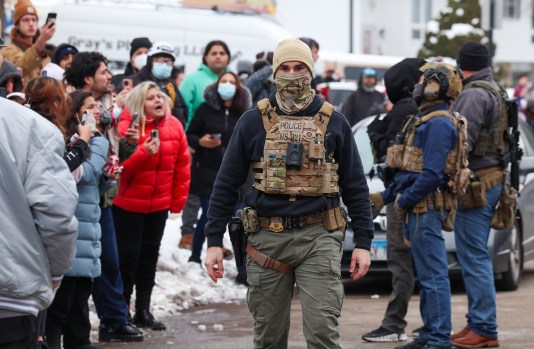

Despite seeing grounds for aggravated battery charges, Kane County State’s Attorney Jamie Moser says she cannot legally file criminal charges against a federal agent who used excessive force during an ICE incident late last year.
Mosser reviewed hours of video from police body and squad car cameras, including footage showing one situation in which a federal agent shot a man with a pepper ball that then ricocheted and struck a woman in the face, she said.
In her opinion, it showed the agent violated state law on Dec. 6 by using excessive force, she said. In any other circumstance, it would have warranted an aggravated battery charge, Mosser said.
“However, federal law constrains my ability to charge federal agents when they commit state crimes,” she said.
The legal constraint is the U.S. Constitution’s Supremacy Clause, which says a state court has no criminal jurisdiction over a federal agent while they are performing their authorized duties. In researching the law, she spoke with prosecutors in her office, a scholar on the U.S. Constitution and other experts.
“If this was a local police officer who is governed by state law, I would charge aggravated battery,” Mosser said.
She admits she is frustrated by not being able to prosecute the agent.
“It’s awful. I cannot hold somebody accountable for committing a crime in my county where two people were injured,” Mosser said. “I’m very upset for these two victims and the community that there’s nothing we can do. I really hope the federal government holds them accountable.”

While she doesn’t like that federal law prevents her from filing criminal charges, “it doesn’t mean I should file (them anyway). I have to follow the law,” she said.
She hopes the video can be used by the federal government to discipline the agent involved and train him on proper police tactics.
The Dec. 6 incident that led to the clashes between federal agents and the community started with a car crash in which the agents were attempting to take an undocumented man into custody as part of a U.S. Immigration and Customs Enforcement effort. The man was able to flee agents and barricaded himself in an apartment on Maple Lane.
The barricade standoff drew a large crowd of people, some of whom interacted verbally and physically with the agents at the scene before the man eventually was taken into federal custody.
Mosser is awaiting additional information from the governor’s office regarding the initial car crash between the man and agents.
“Once we have that information, we’ll be able to take a look at it. Ultimately, I don’t know if it will change my overall decision. The only decision is what happened when he entered into another person’s home unauthorized,” she said.
The man has been deported to Venezuela, where he remains. He could still be charged even if he’s not in this country, she said.
The homeowners “deserve justice even if this individual never comes back,” Mosser said.
She also reviewed another incident in which a federal agent tackled a person. She couldn’t give an opinion on the action because there were no details about it but she did say a person cannot use force to resist an arrest.
The scene was chaotic, Mosser said, with federal agents pepper-spraying community members, engaging with protestors, raising non-lethal weapons and even unholstering their guns. While some protestors complied with the agents’ orders, others did not, she said.
In addition to the three complaints, Mosser reviewed how Elgin police responded during the situation and whether any violated the Illinois Trust Act, which prohibits law enforcement from assisting with federal immigration enforcement unless presented with a federal criminal warrant.
Community members alleged that Elgin police didn’t do anything to stop federal agents from attacking the public, but her review found that Elgin police were not presented with a federal criminal warrant and arrived when the altercations between agents and protestors were either ongoing or had taken place, Mosser said.
Elgin officers “were really concerned about the safety of the people and providing help to access medical treatment,” Mosser said. “They acted professionally although faced with people who were very dissatisfied with the actions of the federal government.”
The case took about five months to review due to the amount of evidence and the many aspects that had to be considered, she said. She wanted to take the time needed to make the right decision, Mosser said.
With her review now done, she is continuing her efforts to change the state’s Trust Act and is working with Elgin Police Chief Ana Lalley on the issue.
“Our proposals include allowing federal authorities to notify local police of enforcement activities that may result in public unrest or protests. By amending the act in this way, we believe we can keep all residents of Illinois safer,” Mosser said.
She will be in Springfield in the next few weeks and hopes to find a legislator to sponsor the changes she’d like to see made, she said.
Gloria Casas is a freelance reporter for The Courier-News.