A crowd marches in a peaceful May Day parade in Chicago’s Loop toward Grant Park on May 1, 1934. Among the paraders, were Joseph Weber, secretary of the Trade Union Unity League, William Gebert, communist organizer, and Nina Spies, widow of August Spies, who was hanged for his role in the Haymarket Riot of 1886. The leaders of the demonstration said the parade represented “a fight against war and fascism and for workers’ unemployment insurance legislation.” (Chicago Tribune historical photo)
Here’s a look back at what happened in the Chicago area on May 1, according to the Tribune’s archives.
Is an important event missing from this date? Email us.
Front page flashback: May 1, 1974
The May 1, 1974, edition of the Chicago Tribune and coverage of the Watergate scandal involving President Richard Nixon. (Chicago Tribune)
1974: The Tribune became the first news organization to publish the entire 246,000-word transcript of the Watergate tapes, scooping even the government printing office by several hours.
1867: Illinois quickly passed an eight-hour workday law, which went into effect on this date. Workers thought the vague language of the law could be enforced, and employers thought otherwise. Thousands of workers marched through Chicago to support the eight-hour workday, but a failed general strike proved the employers right.
1886: Three days before the Haymarket Affair — in which a bomb was thrown during a Chicago labor rally that resulted in the death of eight police officers and at least four civilians — tens of thousands marched on Michigan Avenue in a campaign to reduce the customary 10- to 12-hour workday to eight hours.
Though the U.S. honors workers in September — with Labor Day, which also has Chicago roots — the May 1886 events are commemorated in Chicago by a memorial on Desplaines Street, north of Randolph Street: A bronze statue of a wagon that served as a speakers’ platform during the labor meeting.
The Statue of the Republic, at 65 feet tall, stood across from the domed Administration Building at the 1893 World's Columbian Exposition. (Chicago Tribune archive)
1893: The World’s Columbian Exposition opened in Chicago. Beating out New York to host the spectacular world’s fair was a miracle considering just 22 years earlier the city was in shambles following the Great Chicago Fire.
The Ferris wheel, Cracker Jack and zippers were new-fangled things introduced to the more than 20 million attendees before the fair closed five months later.
Louise Bicknese Luetgert, wife of sausage king Adolph Luetgert, disappeared and was thought to have been murdered by her husband. (Chicago Tribune archive)
1897:Louisa Luetgert, wife of Adolf Luetgert, owner of the A.L. Luetgert Sausage & Packing Co., disappeared. Luetgert was convicted of her slaying on Feb. 9, 1898, and dissolving her body in a vat of lye and sentenced to life in prison.
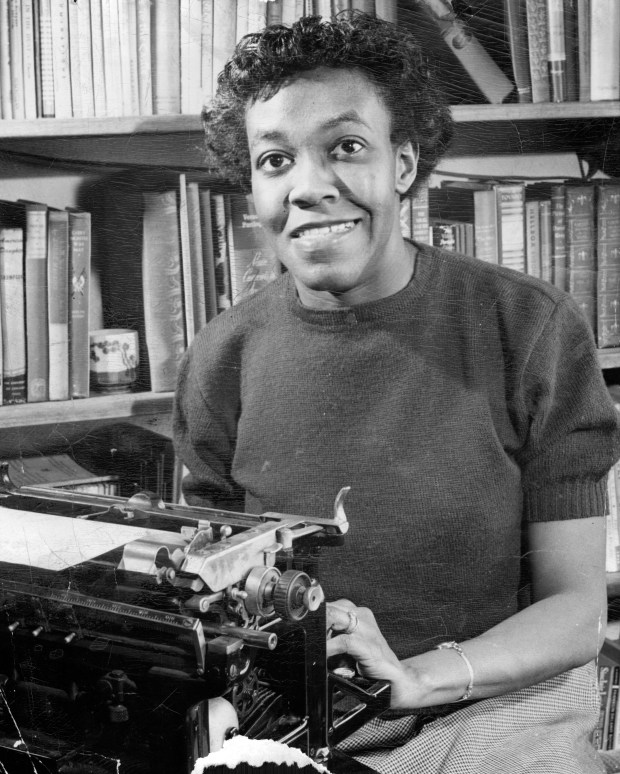
Gwendolyn Brooks, a 32-year-old housewife and part-time secretary, has won the Pulitzer Prize in poetry for “Annie Allen,” a ballad of Black Chicago life on May 1, 1950. Brooks is the first Black woman to capture one of the famed awards. (ACME photo)
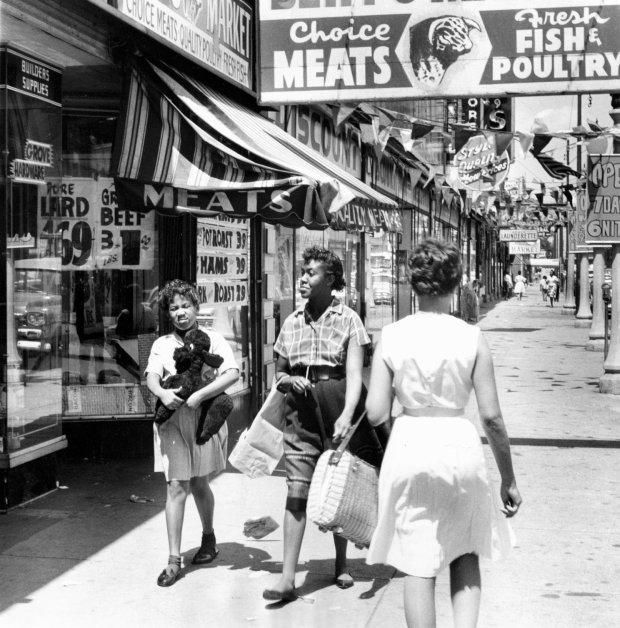
Poet Gwendolyn Brooks, center, walks unrecognized by people in Chicago in 1961. Brooks lived on the South Side for most of her life. (Chicago Tribune archive)
Gwendolyn Brooks writes at a table next to her books, circa 1961. (Robert MacKay/Chicago Tribune)
Poet Gwendolyn Brooks at an event at Columbia College on June 17, 1963. (Arthur Walker/Chicago Tribune)
Poet Gwendolyn Brooks walks out of her home at 7428 S. Evans Ave. in the Grand Crossing neighborhood of Chicago in 1961. Brooks lived in the same house on the South Side from 1953 to 1994. (Robert Mackay/Chicago Tribune)
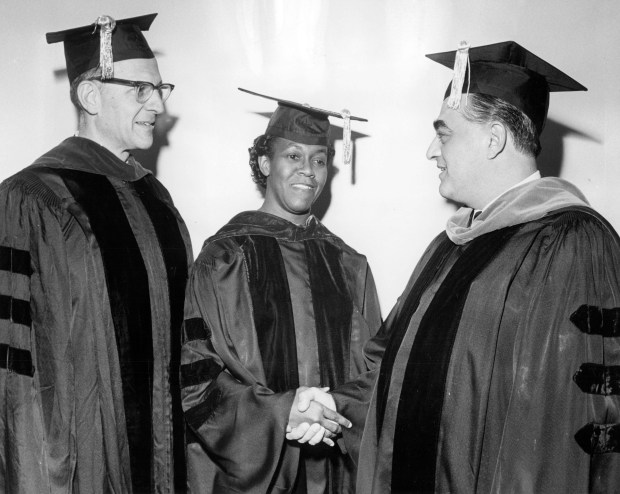
Gwendolyn Brooks, center, and Ald. Leon Despres are congratulated by Columbia College President Mirron Alexandroff, right, at the commencement exercise where Brooks and Despres were given honorary degrees on June 16, 1964, at the Prudential Building. (John Vogele/Chicago Tribune)
Gwendolyn Brooks, of Chicago, was named by Gov. Otto Kerner, right, the new poet laureate of Illinois on Jan. 8, 1968. Brooks, a Pulitzer-Prize winning author and poet, succeeds the late Carl Sandburg. (UPI Telephoto)
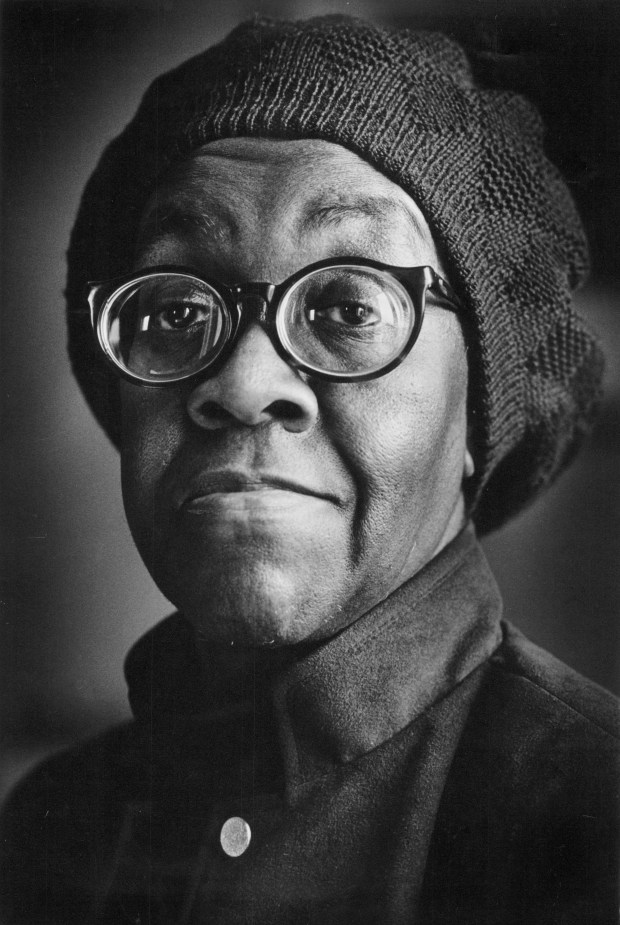
Poet Gwendolyn Brooks, shown here on Aug. 5 1966, won the Pulitzer Prize for poetry in 1950 and gave voice to the experience of African- Americans with her first poetry anthology, "A Street in Bronzeville," in 1954. (Arnold Tolchin/Chicago Tribune)
Illinois' poet laureate Gwendolyn Brooks, center, shares her thoughts on verse with poetry award winners at the University of Chicago on June 11, 1981. (Walter Kale/Chicago Tribune)
Gwendolyn Brooks reviews papers in a sun-lit area of the Library of Congress on Dec. 13, 1985, in Washington, D.C. Brooks was the consultant in poetry to the library. (Paul F. Gero/Chicago Tribune)
Gwendolyn Brooks on Dec. 13, 1985, at the Library of Congress in Washington, D.C. (Paul F. Gero/Chicago Tribune)
Poet Gwendolyn Brooks talks with student writers after a poetry reading at Ancona School in Chicago on Feb. 10, 1992. (Ovie Carter/Chicago Tribune)
Gwendolyn Brooks, Illinois poet laureate, celebrates her 70th birthday by blowing out the candles on a huge cake surrounded by young aspiring poets at Ida Noyes Hall at the University of Chicago on June 7, 1987. (Walter Kale/Chicago Tribune)
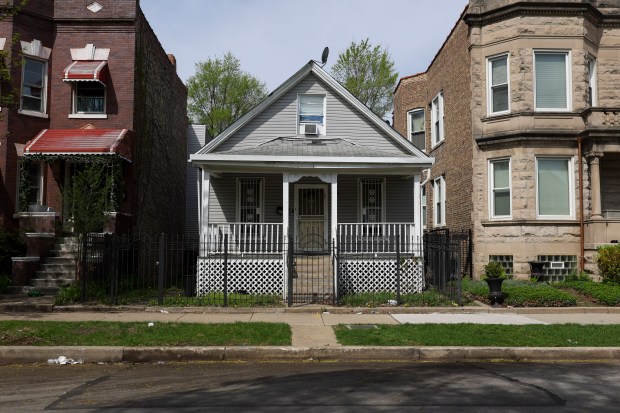
The home of Pulitzer Prize-winning poet Gwendolyn Brooks from 1953 to 1994 in the Grand Crossing neighborhood of Chicago, seen April 29, 2025. (Eileen T. Meslar/Chicago Tribune)
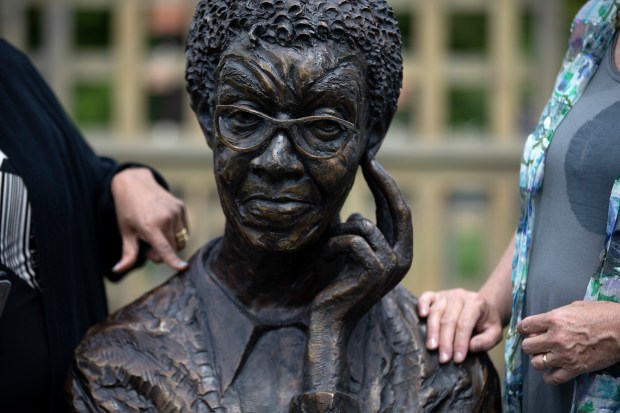
Nora Brooks Blakely, daughter of poet Gwendolyn Brooks, left, and sculptor Margot McMahon speak to a group of children about poetry and the new statue of Brooks at Gwendolyn Brooks Park on June 6, 2018, in Chicago. (Erin Hooley/Chicago Tribune)
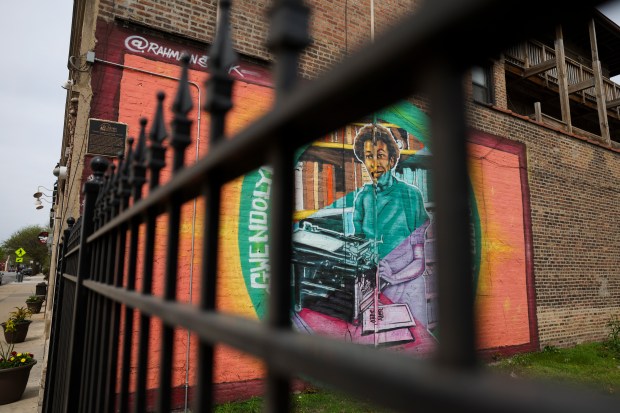
A mural on the wall of 316 E. 75th St., shown April 29, 2025, celebrates Pulitzer Prize-winning poet Gwendolyn Brooks, who lived in Grand Crossing from 1953 to 1994. (Eileen T. Meslar/Chicago Tribune)
A new statue of poet Gwendolyn Brooks, sculpted by Margot McMahon, stands in Gwendolyn Brooks Park on June 6, 2018, in Chicago. (Erin Hooley/Chicago Tribune)
1 of 17
Gwendolyn Brooks, a 32-year-old housewife and part-time secretary, has won the Pulitzer Prize in poetry for “Annie Allen,” a ballad of Black Chicago life on May 1, 1950. Brooks is the first Black woman to capture one of the famed awards. (ACME photo)
1950: Poet Gwendolyn Brooks won the Pulitzer Prize for poetry in 1950, for “Annie Allen,” a collection of works about a Black girl growing into womanhood while wrestling with racism, sexism, poverty and loss.
A review in the Tribune praised its “quick sense of the life of many people, the small intensities and the big disasters.”
White Sox manager Paul Richards, left, is shown with Orestes "Minnie" Miñoso in an early undated photo. (Chicago Tribune historical photo)
1951:Minnie Miñoso became the first Black player to play for the Chicago White Sox, homering in his first at-bat against Vic Raschi of the New York Yankees.
September 12, 1961 -- Chicago White Sox scoreboard lights up with fireworks at Comiskey Park following a solo home run by Sox shortstop Luis Aparicio in the 5th inning against the Yankees. The game was halted by rain after the fifth. Yankees won 4-3. (UPI)
00314768A TALK-WHITESOX (BASEBALL PRO)
1960: Comiskey Park’s exploding scoreboard debuted. Al Smith stepped up in the home half of the first inning of a doubleheader on May 1, 1960, and put the defending American League champs ahead with a two-run homer off Jim Bunning. Then the fun began.
Smith triggered the public debut of owner Bill Veeck’s biggest, baddest pinball machine — his $300,000 exploding scoreboard. The tradition of saluting White Sox home runs continues to this day.
Former news anchor Carol Marin after she appeared on the "Late Show with Tom Snyder" on CBS Television on May 5, 1997, in Los Angeles. Marin resigned from Chicago's NBC-affiliate WMAQ-TV, Channel 5, after the station signed talk show host Jerry Springer as a commentator. (Frank Wiese/AP)
1997: WMAQ-Ch. 5 evening news anchor Carol Marin quit after management hired talk show host Jerry Springer to deliver news commentaries. She had been at WMAQ for 19 years. Co-anchor Ron Magers quit two weeks later.
The Farnsworth House in Plano was surrounded by floodwaters from the Fox River on May 19, 2020. The house was designed and constructed by Ludwig Mies van der Rohe between 1945 and 1951. (Zbigniew Bzdak/Chicago Tribune)
2004:Farnsworth House, a steel-and-glass masterwork by architect Ludwig Mies van der Rhode, opened for tours after preservationists spent $7.5 million to buy and keep the icon of 20th century modernism in Illinois.