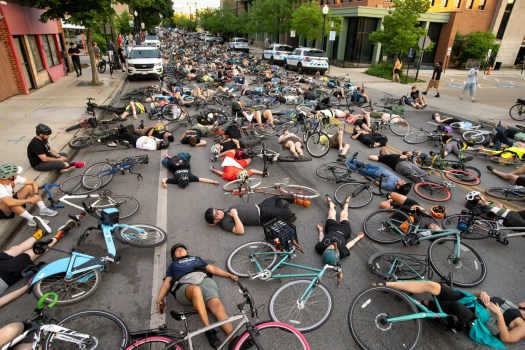
I am deeply disappointed to read an editorial (“A sensible compromise on Archer Avenue takes more than bike activists into account,” May 1) about a safe streets project based solely on conjecture and loose claims, rather than facts and data. We can all argue about whether we think a safe streets project is worthwhile or whether it will impede traffic, but to argue about changing a street safety project without discussing safety is malpractice. It is as if the Tribune Editorial Board were arguing against hiring school nurses based solely on cost and inconvenience to the school district, rather than on the safety benefits and the data being used to support it.
The Chicago Department of Transportation has published several fact sheets leading up to this project (including this fact sheet on traffic safety in Brighton Park) that make a clear and strong case: that Brighton Park has crashes and fatalities, especially involving pedestrians, far in excess of the average community area and that significant changes were needed.
Specifically, the CDOT fact sheet states that “80% of Brighton Park residents said they experience dangerous driving when getting around the neighborhood. 2 out of 3 said dangerous driving and a lack of safe walking and biking infrastructure is their biggest barrier to getting around. Crash data backs up these concerns — there are 47% more crashes and 33% more injuries in Brighton Park than the average community area. 14 people were killed in crashes in Brighton Park between 2019 and 2023.”
CDOT also cites where these drivers come from, noting that many do not live in the area: “70% of drivers that cause a crash in Brighton Park live outside of the neighborhood. Over half of drivers who hit someone walking or biking don’t live on the Southwest Side.”
Any argument around a safe streets project, whether “for” or “against,” should be rooted in facts and reality, not conjecture about bike entitlement, or whether people can ride in winter or with cargo (which they can and do).
I would encourage anyone concerned about this project to walk and bike around the areas with and without improvements and to examine the city’s available alternative corridors for biking nearby, of which there are essentially none. That would help create a more sensible argument that holds up to scrutiny, and move conversations in our city forward, rather than pitting us against each other.
— Viktor Köves, Chicago
Editorial’s attack on Streetsblog
The editorial about the changes being made to the 12th Ward traffic safety project on Archer Avenue includes a hidden, and erroneous, attack on Streetsblog Chicago.
The Tribune Editorial Board makes a misleading statement about the city “removing costly ‘improvements.'” In reality, the modifications to the Archer plan do not include permanently removing concrete infrastructure that will protect people on foot, bikes and e-scooters. Rather, the Chicago Department of Transportation is adjusting the locations of some of the concrete, making room for 17 more car parking spaces. As Streetsblog opined a week before the editorial, that’s “a reasonable compromise.”
The editorial also makes a veiled attack on Streetsblog. It accuses Chicago bike advocates of “demonizing anyone who dares to oppose their views as members of the ‘right-leaning political class.'” It’s obvious the editorial board is referring to Streetsblog, because “right-leaning political class” is a direct quote from a Streetsblog post.
Contrary to what the board insinuates, Streetsblog did not simply smear “anyone” who opposes the Archer project with that label. Rather, we singled out four people:
• Ald. Ray Lopez, 15th: He disparaged the Archer project, and CDOT’s Complete Streets program in general, at a February City Hall committee meeting. As Block Club Chicago recently reported, Lopez “repeatedly defended (Donald) Trump’s immigration roundups on conservative and right-wing media.”
• Urban Center CEO Juan Rangel: His moderate to conservative lobbying group has promoted weekly demonstrations against the Archer project that have taken place for almost five months just northeast of the 12th Ward office. Local Ald. Julia Ramirez, 12th, is a progressive who supports the safety initiative.
• Claudia Zuno: After attending the protests regularly for two months, in February, Zuno announced her aldermanic campaign against Ramirez, with Lopez’s and Rangel’s endorsements. Her platform includes removing “obstructive bike lanes” and bringing back the controversial ShotSpotter technology.
• Eva Villalobos: Urban Center donated more than $25,000 to her 2024 pro-charter schools campaign for the school board. She co-organizes the weekly rallies.
These folks are, in fact, members of the right-leaning political class.
Meanwhile, Streetsblog stated, “Brighton Park residents’ and merchants’ discontent with the Archer initiative (isn’t) completely unwarranted.”
So clearly it was inaccurate for the editorial board to imply Streetsblog is “demonizing anyone who dares to oppose their views as members of the ‘right-leaning political class.'”
— John Greenfield, editor, Streetsblog Chicago
Archer’s death toll matters
The Tribune Editorial Board’s concern for driver convenience and business loading zones on Archer Avenue is understandable, if predictable. But calling Archer “a bizarre candidate” for bike infrastructure misreads the geography entirely.
The neighborhoods Archer passes through — Brighton Park, McKinley Park and Archer Heights — are threaded with rail lines, an interstate highway, a canal and intermodal yards that make movement on foot or bike among these neighborhoods nearly impossible except along Archer itself. It isn’t one option among several. For many residents, it’s the only continuous surface route connecting their neighborhoods. The question was never whether to put bike infrastructure there — it was how.
The editorial accuses cycling advocates of “moral righteousness,” and the charge may be fair in some cases. What it misses is that the other side of this argument has a body count. Numerous pedestrians and cyclists have been killed along this very corridor in recent years. Each of those deaths is a policy outcome, not an act of God. When we treat the conditions that produce that toll as the baseline against which “improvements” are measured, we’ve already made a moral judgment; we’ve just made it quietly.
Disagreeing about parking spaces while that death toll stands unchallenged is not a position above the fray. It’s a choice — and one worth owning honestly.
— Tony Adams, Chicago
HB1429 doesn’t offer solution
The April 24 letter (“What unhoused neighbors need”) supporting House Bill 1429 argues that the legislation strikes a humane balance between compassion and order. In practice, it does the opposite.
HB1429 would affect local governments’ enforcement of existing public safety ordinances in parks and public spaces. Chicago’s ordinances include commonsense rules prohibiting open flames and propane tanks — restrictions that exist for a reason. Fires linked to encampments have caused extensive damage in Gompers, Legion and Eugene Field parks, creating dangerous conditions for the unhoused, park users and nearby residents.
Illinois is a home rule state for a reason: Communities face different challenges and need the flexibility to respond appropriately. HB1429 undermines that principle.
Chicago offers a cautionary example. A lack of consistent enforcement has contributed to increasingly unsafe and unsanitary conditions in some public parks, including open drug use, discarded needles, off-leash dog attacks, alcohol abuse, battery and environmental degradation. These conditions are not humane for those experiencing homelessness, nor are they acceptable for the broader community.
Compassion is not permitting encampments to persist indefinitely; it requires solutions that move people toward stability. One example — already in practice in places like Bloomington, Illinois — is the development of tiny home communities on appropriate sites, paired with supportive services. These models offer dignity, safety and a pathway forward, rather than leaving individuals in precarious and hazardous situations.
Supporters of HB1429 list two organizations that have withdrawn opposition but fail to mention that the Illinois Municipal League and the Illinois State Association of Counties, along with more than 70 municipalities and mayors statewide, remain opposed. Public concern is also evident in the more than 800 witness slips filed in opposition of the earlier versions of the bill, many of which raised issues still present in the latest amendment.
HB1429 does not resolve homelessness. It risks entrenching it in public spaces. Legislators should reject this approach and focus instead on solutions that are both compassionate and effective. Illinoisans should contact their state representative and ask them to vote “no” on HB1429.
— Ellen Youniss, Marion Gielow and Fernando Hernandez, Legion Park Neighbors Alliance, Chicago
Accountability for gunmakers
American gun manufacturers generated nearly $20 billion in record revenues last year. These companies profit as families are torn apart. A life-changing incident for parents, siblings, relatives and friends can happen in an instant while gun manufacturers face minimal legal or financial repercussions.
The proposed, and long overdue, Responsibility in Firearm Legislation (RIFL) Act seeks to change that.
This legislation would be the first in the country to hold gun manufacturers accountable, building a regulatory framework that covers fees rather than leads to litigation. The RIFL Act would cause gun manufacturers to account for their role in the illegal access to weapons; it would force them to obtain a state license and pay an annual fee, create a state fund focused on victim assistance, and, starting Jan. 1, 2028, prohibit retailers from selling guns from unlicensed manufacturers.
The fees collected from the new licenses and violations would go into the RIFL Fund, which would provide victims of gun violence with much needed assistance. The fund would cover medical and mental health care, rehabilitation, prescriptions, lost wages or tuition, funeral and burial, emergency relocation, disability accommodation, property damage, probate costs and emergency childcare.
Contrary to the Crime Victim Compensation Application offered in Illinois, this fund would offer far more expansive and intentional support needed in a survivor’s recovery. It would also promote the principles of post-traumatic growth focused on a survivor’s ability to create meaningful outcomes out of tragic situations.
Locally, public officials, law enforcement, healthcare providers and community organizations have stepped up to support gun violence victims. Through funding, free services, or employment of new techniques to curb crime and support mental health, our joint efforts have been successful in decreasing shootings and homicides. The reality is that more support is needed.
My organization, Chicago Survivors, provides free services and programs to the families of gun violence victims, including identifying, applying for and securing funding sources needed for the healing process. The limited funds and providers make it difficult to support every family in need and impairs the positive effects of violence prevention and crime victim service efforts.
On Friday, Chicago Survivors will join physicians, survivors, advocates and community organizers in Springfield to push for passage of the RIFL Act.
Every voice matters as we seek to hold gun manufacturers accountable and increase our support for families affected by gun violence.
— JaShawn Hill, Chicago
Give NICU parents options
In his op-ed “There is a hidden cost to the Abbott verdict for premature babies” (April 17) referencing a $70 million jury verdict against infant formula-maker Abbott, Dr. Alexander Crider argues that the real hidden cost for premature babies is that they could lose access to critical nutrition.
That scare tactic omits one significant fact: A clinically proven alternative to cow milk formulas has existed for nearly two decades for the smallest premature babies. Specialized preterm infant nutrition made from human donor breast milk is widely available in neonatal intensive care units, but parents may not be told this option exists.
Parents also may not be told about the increased risks associated with cow milk nutrition and necrotizing enterocolitis (NEC), the potentially deadly intestinal disease at the center of the verdict. While larger preemies may be able to tolerate cow milk-based products, complications decrease and survival increases when the smallest preemies are fed solely human milk nutrition.
Every NICU parent deserves complete, honest information, including all available nutritional options, so they can work directly with their care team to make the best decision for their baby. During the trial, Abbott’s expert testified it would be “cruel” to discuss NEC risks with frightened mothers, a position the judge called a “sexist trope” that women are too emotional to handle such facts.
I’m a NICU mom whose baby died after nine days, and I’m the leader of an organization supporting NICU parents. Parents often feel like they have to ask for permission to care for their baby. Evidence proves involved parents create better outcomes for babies, but this cannot happen if information is kept from them to “protect them.”
NICU moms are some of the most incredible women I have ever known. What is cruel is not allowing them to be the amazing moms they are by withholding valuable information. The humane and responsible thing is to allow parents to learn all of the options and then make a decision with the medical team. Parents do not want to go rogue; they simply want medical providers and the industry to present all available options.
Information and education are at the heart of these NEC lawsuits, not a desire to eliminate formula or punish a manufacturer. Parents are not asking to practice medicine. We are asking to be told the truth and treated as partners in our children’s care.
If we want fewer NEC tragedies, let’s start there.
— Michelle Valiukenas, founder and executive director, The Colette Louise Tisdahl Foundation, Glenview
Note to readers
In honor of our “Chicago 2050” op-ed series, we’d like to hear from you about your hopes for what Chicago will be like in 25 years. (Sincere thoughts only.) Send a letter of no more than 400 words to letters@chicagotribune.com. Be sure to include your full name and your city/town.
Submit a letter, of no more than 400 words, to the editor here or email letters@chicagotribune.com.