
For the average parent, a 7-year-old behind the wheel going somewhere between 17 and 20 mph is enough to cause a heart attack.
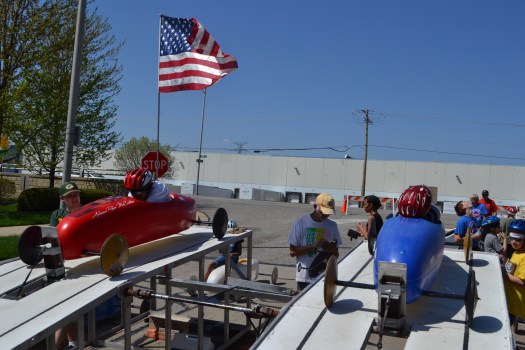
But this weekend, parents from across the Chicago area will be helping their children do just that when they race down the street in engineless, gravity-powered cars during the Greater Chicago Soap Box Derby’s 2026 spring rally being held in Naperville.
In races Saturday and Sunday, parents will help load their drivers at the top of a starting ramp before sending them down a 700-foot-long track at the corner of Diehl and Frontenac roads.
“The whole day is a fun activity,” said Stan Iglehart, race director for the Greater Chicago Soap Box Derby organization. “It’s kind of like going to Great America. When you go to a soap box derby race, you got 30 or 40 kids that are racing, and only two cars race at a time.”
It is one of several races taking place in the Chicago area this year and an opportunity for competitors to earn qualifying points for the All-American Soap Box Derby World Championships in Akron, Ohio.
Race participants range in age from 7 to 20 and compete in three divisions: stock, super stock and masters. Each division has its own age, height and weight requirements.
Soap box derby racing is not your average spectator sport — at least not for parents.
“It’s one of the few sports out there that you cannot drop your kid off or sit on the sidelines and watch them. You have to be an active participant,” Iglehart said. “It’s a team sport with the driver and parent.”
That partnership begins long before race day and starts with securing the car. For some people, that can be an official kit purchased from the International Soap Box Derby organization. But for those in the Chicago area, Iglehart encourages kids and their parents to borrow one of the two dozen cars he owns.
From there, he will usually invite the kids and their parents to come to his home, where he walks them through the process of building the car.
“I’ve had a lot of people in the Chicago area, they don’t know anything about building and nuts and bolts. … Three or four hours later and they’re like, ‘Wow, I had no idea that you could do this,’” he said.
After the car is built, the parents are involved as a car handler — someone who helps the driver figure out how to get the most energy out of the car, including finding ways to most effectively distribute the driver’s weight in the vehicle in order to gain the most speed.
Success, organizers say, often comes down to a constant exchange between the driver and the car handler: what the child feels on the track, where the driver is gaining or losing speed and how the pair can adjust before the next race.
“There’s those excitements of, ‘We won, keep going on,’ or, ‘Hey, we struggled. Let’s go make a change,’” parent Leslee Butler said. “It’s teaching the child to make those decisions and own, ‘I didn’t have the best drive,’ or ‘I’m really confident that my car needs something different.’ And we kind of let them have their voice with that.”
Butler and her husband, Brian, know that process firsthand. Brian used to participate in soap box derby racing in the 1990s and about a decade ago, the pair took their child, Logan Sennholtz-Linder, to his first race in Naperville at age 7.
“He wasn’t really into traditional sports, as you can call them, and so to keep him active, we said, ‘How about you try something like soap box derby?’” said Butler, who now serves as treasurer for the Greater Chicago Soap Box Derby organization.
Within his first year of racing, Sennholtz-Linder qualified for the world championships, where he would compete on a hill in which cars could travel between 35 to 40 mph.
“His first trip down the world championship hill terrified me,” Butler said. “He hadn’t had the experience on a faster track other than our local one so he didn’t realize that those little corrections he would make on the steering would cause such a dramatic change on such a fast hill.”
As his vehicle traveled down the world championship hill the first time, Sennholtz-Linder found himself losing control and cutting over to different lanes before making it to the end of the race, she said. He was shaken up afterward but his family encouraged him to try racing down the hill again — a “get back on the horse mentality,” as Butler described it.
A few days later, he placed third in the world.
Since then, the family has traveled all across the country to compete in soap box derby racing. Sennholtz-Linder, who is now 17, is still racing. His 8-year-old sister Brilee competes too.
“She’s literally grown up at the track,” Butler said. “By the time she was three weeks old, she’d been to four states and three tracks.”
Only Brilee will be competing this weekend. While Butler hopes she will secure a win, she noted that helping her daughter gain more confidence is the priority.
“She’s excited. She loves racing,” Butler said. “We’re hoping there’s going to be some new Chicagoland people trying this out.”
The 2026 Chicago Spring Rally will be held Saturday and Sunday, May 16-17. Each day will feature a morning race at 8 a.m. and an afternoon race at noon. The event is free for spectators. For those interested in participating, go to greaterchicago.soapboxderby.org/event/may-16-17-2026-chicago-spring-rally.
cstein@chicagotribune.com