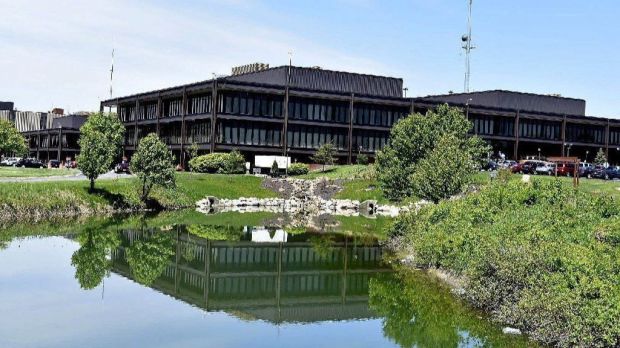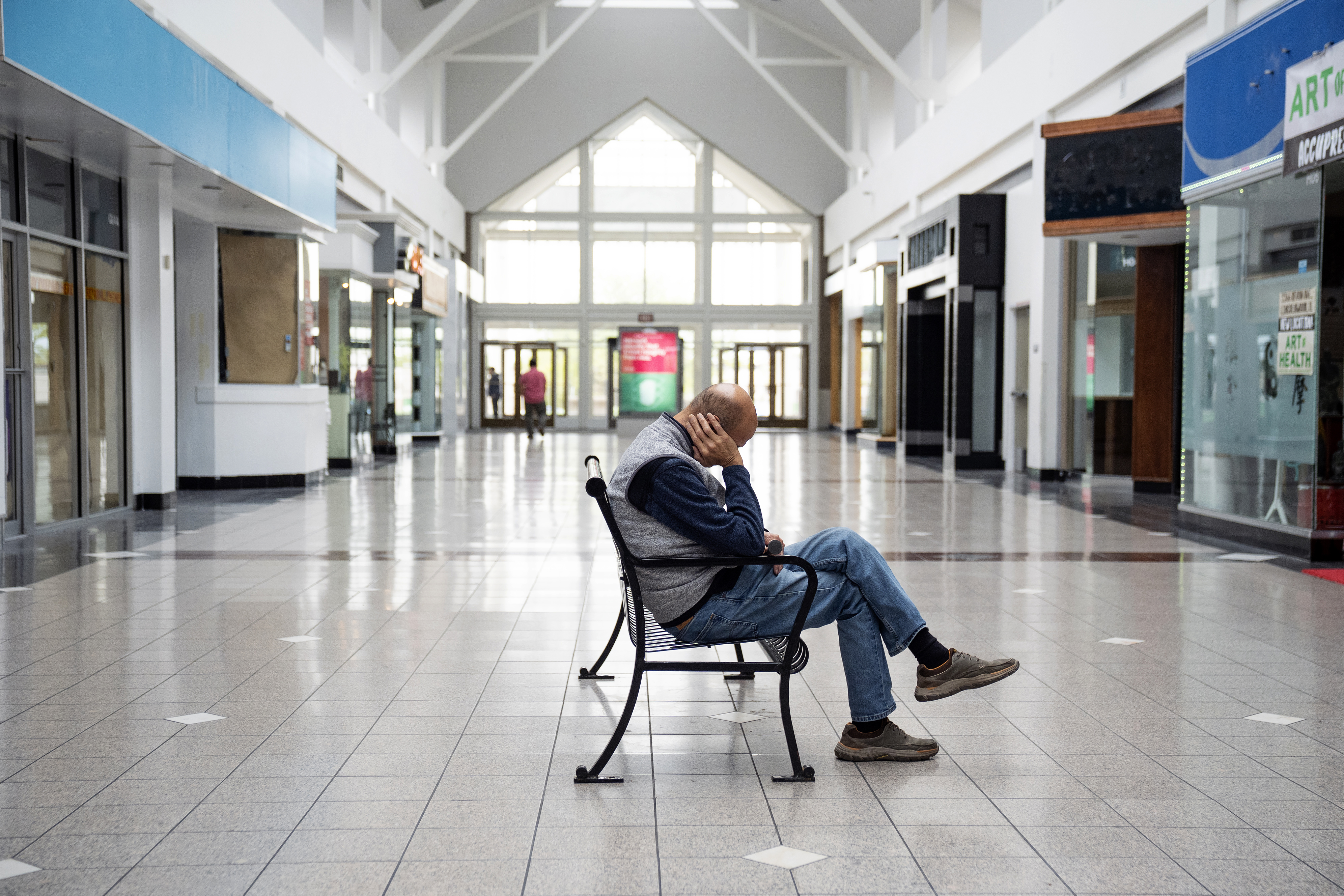
Storefronts once crammed with shoppers, now covered by tarps. Flickering lights. Sweatpants-clad mall-walkers with nothing to look at and nowhere interesting to stop.
A man takes off one shoe, then another, and reclines in a lifeless wing of Ford City Mall. He props his bare feet up on a nearby chair.
“What?” he said. “Who’s gonna stop me here?”
Such is the last breath of another dying mall.
A few decades ago, massive buildings, like Ford City on Chicago’s Southwest Side, were rife with crowds of loitering teenagers who spent hours mingling in arcades and food courts. Much like their youthful, emotional heartbeats, malls in the ’80s and ’90s bustled, becoming as quintessential to American culture as hot dogs and apple pie.
Today’s teens have no shortage of movies and TV shows romanticizing what malls were like in their parents’ youth. Look no further than the opening sequence in “Fast Times at Ridgemont High” or Regina George summoning her fellow Plastics with the line “Get in loser, we’re going shopping” in “Mean Girls.”

Across Chicagoland, malls memorialize “the good old days.” But now, many of them are past their prime, becoming as old and gray as the generations that once frequented them.
For some local malls, the end is already inevitable.
A judge pushed back a hearing on Ford City’s fate until May 15, but mallgoers farther north in Lincolnwood experienced no such luck. There, the Village Board and property owners recently agreed to Lincolnwood Town Center’s phased demolition as part of a predevelopment plan.
On the North Shore, an oasis of high-end retailers suffered a downward occupancy spiral at Northbrook Court. Now, only Neiman Marcus and a few other niche stores remain. And downtown on Michigan Avenue, Water Tower Place, once the anchor of Chicago’s Magnificent Mile, carries its own laundry list of troubles after years of financial losses and the closure of several major tenants.
“It used to be that your mom would drop you off at the mall with $20 and you’d be entertained all day,” said Kobe Williams, a Springfield-based social media influencer known for exploring dead malls. “It’s just so crazy to see the change within a lifetime.”
The Tribune spent several days exploring these dying malls, talking to their visitors and walking back through time.
‘Nostalgia for one day’
Xavier Mendujano and Rodrigo Huitron, both 19, spent one recent Tuesday afternoon examining newly purchased Pokémon cards in Ford City’s uninhabited food court.
They admitted they’re too young to remember the mall in its heyday, but they felt the same inclination to socialize within its walls as teenagers of years past may have experienced.
When they spotted a vending machine selling trading cards they fawned over as kids, they simply had to take advantage of the opportunity in front of them.
“Nostalgia for one day, you know?” Huitron said.



Seated across from each other, the two men glanced around at the 10 stalls reserved for eateries. Back in the day, they ate barbecue and went to McDonald’s there. Now, the only dining option in the entire mall is Auntie Anne’s.
Not far from where the two sat, a customer service light flickered on and off, but no employees manned the help desk. And inside the adjacent soft pretzel shop, two workers leaned over on the counter, watching videos on a phone to pass the time.
Mendujano and Huitron said they grew up coming to the mall with their parents. They could point out the now-empty stores where they shopped for school uniforms and visited a “bounce house fun world” for children.
Now students at Richard J. Daley College, located a few blocks away, the pair decided to check out the mall “one last time” after grabbing breakfast together.
“It felt nice just to see what’s left of it and remember what else used to be here,” Mendujano said.
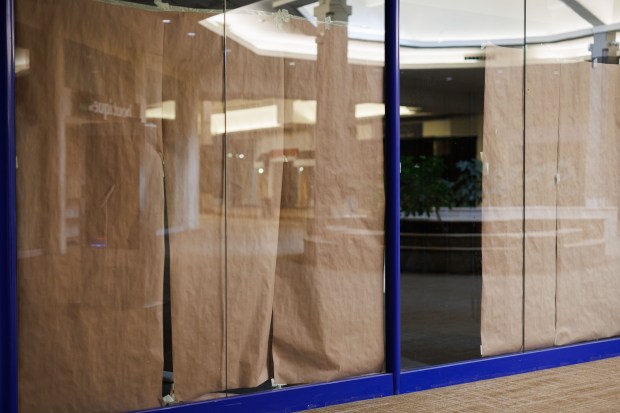
On the other side of the building, Ford City’s lone anchor store, JCPenney, is holding its going-out-of-business sale. Nearby, artifacts from recent history remain frozen in place.
At the now-closed clothing retailer Rainbow, bright “Face Masks Required” posters from the pandemic are still plastered to the glass doors. An operating license for a dilapidated Boba tea kiosk displays a 2024 expiration date. Pieces of trash, including an empty Pacifico beer can, gather dust on the floor behind the counter.
Despite the mall’s downfall, Francisco Salazar, 54, still enjoys walking the halls of Ford City — a hobby he’s held since before the turn of the millennium. Over the years, the mall has seen him evolve from a single man who recently immigrated from Mexico, to a husband and father of two.
Today, his kids are in their mid-20s, but he said it doesn’t feel like that long ago that he was taking them toy shopping there.

In all likelihood, he will soon be forced to find another place to walk.
On the heels of two years’ worth of failed attempts to fix a malfunctioning fire suppression system and prevent frequent flooding, the city reached a deal last month with property owner Namdar Realty Group to close the mall for good.
That same week, a Cook County judge agreed to postpone a hearing centered on Ford City’s closure until May 15 after some of the mall’s 16 remaining tenants complained.
With that hearing now less than a week away, the sights and sounds of the dying mall point to the fact that it could soon be laid to rest.
Will it close?
Walk beyond the dozens of people waiting for CTA buses outside Lincolnwood Town Center and you will find — despite social media rumors claiming otherwise — that the doors remain open. For now.
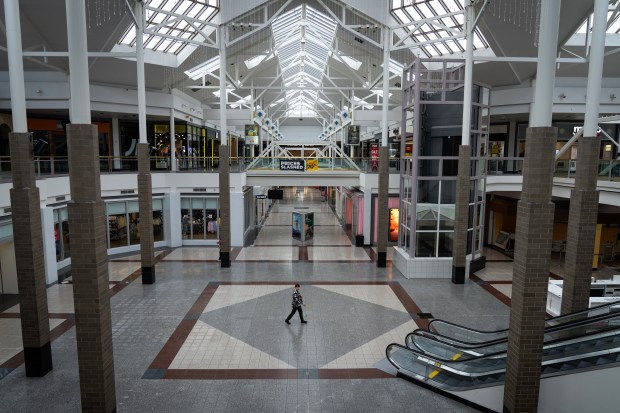
Inside, two security guards stand on a bridge connecting one side of the mall’s upper level to the other. Surveying the space they’re tasked with protecting, the two men grouse about the incessant noise of FedEx workers packing up storefronts on rolling large cardboard boxes toward the exits.
Almost every store in the mall is already closed. Large black curtains restrict access to the food court and, unlike Ford City, you can’t buy a soda, let alone a snack at Lincolnwood. All the Coca-Cola vending machines have already been ripped out of the walls.



According to Rati Akash, the village of Lincolnwood’s acting director of community development, the property owners and Village Board came to a “good-faith agreement” last month regarding a plan to demolish the mall in three phases, beginning with its unoccupied southwest wing.
Akash clarified that certain regulatory processes must take place before demolition commences, despite a news release announcing it could begin sometime this month.
In stark contrast to the teenage social scene once synonymous with malls, many of Lincolnwood’s shoppers seemed to come there alone, making beelines for the still-open Old Navy or Victoria’s Secret without ever removing their headphones.
These days, many of those visiting the mall are not shopping at all. They’re there to exercise or take photos to document the mall’s steep decline.
James Ozaki and Fawn Ndukwu, friends since high school and now in their early 30s, came to Lincolnwood assuming it was already closed. The two were getting ice cream together when Ozaki, who grew up in Chicago but now lives in New York, suggested they escape the breezy conditions for the mall they grew up going to.
When Ndukwu told him he heard it closed, the duo decided they needed to confirm for themselves.
“The colors have dulled, so walking into the space, it does feel kinda like you’re going into an apocalypse,” Ndukwu said after entering the mall for the first time in years.
Though he was shocked to see how much it changed, Ozaki said that even as a kid he felt acutely aware that Lincolnwood was never the “it” mall. Not like Schaumburg’s Woodfield Mall or Westfield Old Orchard in Skokie, anyway.

It’s a distinction Williams, the social media influencer, has made, too. In videos highlighting visits to shopping venues around the Midwest, he labels malls as either “dead” or “poppin.”
“I use ‘poppin’ if I go into a random mall in Indiana, and I see a mall I feel is trendy enough to be in Chicago,” said Williams, who has more than 100,000 TikTok followers.
So far, he’s posted nearly 60 videos on his “DYING MALLS” playlist on TikTok. He said the journey began because he “grew up on the bigger side” and always preferred shopping in person rather than online to ensure that his clothes fit properly.
Now, he views his role as more than a social media personality. He sees himself as a historian, perhaps the last person to document malls that once meant so much to those who shopped there.
Former mecca
Once regarded as a mecca for luxury shopping, drawing visitors from across Chicagoland to experience a level of polish few suburban malls could hope to surpass, Northbrook Court today is something akin to a retail wasteland.
The formerly high-end shopping destination, featured as a backdrop for a scene in a 1985 John Hughes movie, has more recently devolved into desolation. Escalators once connecting now-defunct stores like Sears to designer brands such as Louis Vuitton have been turned off. Now, navigating the mall is a convoluted endeavor.
Ralph Borkowicz, a 40-year Glenview resident, said he used to shop at Northbrook Court “quite a bit,” but now almost never goes, opting instead for Old Orchard, located just off the Edens Expressway.
“It seems that shopping centers that have apartments within them or on top of them seem to do very well and shopping centers that don’t have apartments are closing up,” he said.


At its peak the mall, which first opened its doors to the public in 1976, was home to more than a hundred retailers, boasting stores remembered as American classics. In 2025 alone, Northbrook Court lost its Apple store, Lululemon and Sephora, among others.
Today, a Neiman Marcus, Gap and a few other stores are still open, but for the most part, the building has become a hot spot for children’s birthday parties and a place for people to walk pets in the winter.
Robin Nasatir owns The Painted Penguin, which has locations in Northbrook Court, Hawthorn Mall and Water Tower Place, said businesses like hers help keep the mall alive. When birthday parties and other groups come in to paint ceramics or canvases, their parents often shop at Tommy Bahama or LensCrafters while their kids are at the party, she said.
“There’s still life left in the mall. We’ve got to dispel the rumor that there’s not,” she said.
Those coming to the mall these days are likely there to visit the movie theater, an AMC, which is accessible from the building’s exterior. Upstairs, a lone quick-service pizza parlor serves as the stomping grounds for young children and their parents. Together, they stop by for slices and homemade gelato after departing the small indoor playground on the mall’s lower level.
For now, Northbrook Court has no plans of closing its doors, but from the looks of it, it may soon be headed toward extinction.
“There’s a great emotional attachment for people that have been here and maybe grew up going to the mall and had that mall experience,” Northbrook Village Manager Cara Pavlicek said. “What happened over, just before the pandemic, pandemic, post pandemic, is it’s not the place that it was for people.”

In May 2023, the village of Northbrook entered into a predevelopment agreement with Brookfield Properties to add retail, dining and a mixed-used residential neighborhood to the more than 100-acre site. Later that same year, Northbrook approved a $98.5 million tax increment financing incentive package to subsidize the redevelopment project.
But so far, progress has been slow — if not nonexistent.
“And so while there’s a nostalgia, I think also people recognize it’s an amazing asset for the community and having the vision become the reality is incredibly important,” Northbrook Village Manager Cara Pavlicek said.
‘People need a mall’
The convenience of shipping everything to your front door was supposed to ultimately kill in-person shopping, especially the mall.
Throw in economic upheaval. The 2020 pandemic. Changing consumer habits. The death of mall shopping would seem all but certain.
And yet, experts say otherwise.
“The death of malls is vastly overrated,” said Jim Schrager, clinical professor of entrepreneurship and strategy at the University of Chicago Booth School of Business. Instead, he says a mall’s continuing success — or failure — is based on a tried-and-true real estate mantra.
“A mall is a piece of commercial real estate, and like every piece of commercial real estate, it’s all about location, location, location,” Schrager said.
Local competition, foot traffic, vacancies, and the merchandise that’s offered — these are the fundamentals of whether a mall will thrive or wither, he said. Malls struggle if they lose major anchor tenants, have poor foot traffic, don’t have the right goods on sale and have nearby retail competition.

Experts say there are many factors contributing to the decline of malls beyond just blaming juggernauts like Amazon.
“Some households still prefer to shop in brick-and-mortar, and many of them still do,” said Efraim Benmelech, a professor of finance and real estate at Northwestern University’s Kellogg School of Management.
For the “vast amount of things sold retail,” it’s very hard to make money selling online, Schrager said, simply because the economics don’t work out. Meanwhile, malls over long periods of time are “generally profitable.”
Benmelech believes the decline of some American shopping malls can be rooted in both the 2008 financial crisis and the rise of new technologies that have changed the way people shop and socialize. Most importantly though, COVID-19 accelerated existing trends, as shoppers became accustomed to purchasing items without leaving their homes.
He said malls can be categorized into three classes based on their occupancy levels and anchor tenant quality. Old Orchard, he said, is an example of a Class A mall because customers are drawn to premium tenants like Nordstrom and Apple. The abundance of dining options and the open-air experience certainly don’t hurt either, he added.
A few local malls, such as Old Orchard and Hawthorn in Vernon Hills, are adapting with the times. To avoid the same likely fates as Lincolnwood and Ford City, they’re making malls places people can both live and shop.
Old Orchard is currently in the first phase of a more than $100 million redevelopment project to add hundreds of mixed-use residential units directly onto the shopping center campus, some inside a former Bloomingdale’s, which downsized into a smaller store called Bloomie’s in 2022 and relocated within the mall.
Farther north in Lake County, Hawthorn had faced the loss of several major tenants in the years leading up to the pandemic. But now, it’s undergoing a massive, quarter-billion-dollar redevelopment effort that’s clearly visible to visitors; one parking lot is a giant dirt pile while construction is ongoing, fenced off with “pardon our dust” signs.


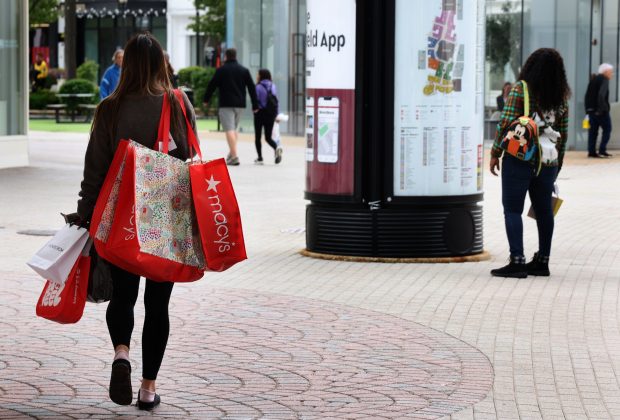

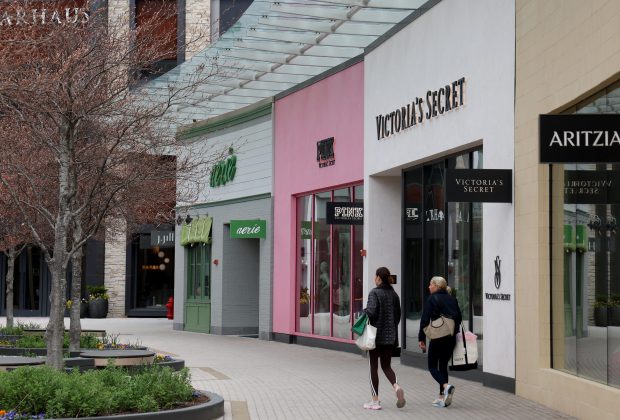
Downtown, where three of Water Tower Place’s eight retail floors sit nearly vacant on Michigan Avenue, the vertical mall recently announced a $170 million redevelopment project, which will transition Floors 4 through 8 into office space. The decision comes after years of financial struggle and the loss of several anchor stores.
But for malls like Lincolnwood and Northbrook Court, which have long promised redevelopment projects of their own but haven’t made significant progress, the future seems grim.
In Lincolnwood, Ritu Uppal, the 60-year-old owner of a knickknack and home decor store, wishes decisionmakers would prioritize people who depend on malls more, rather than treat closures as business transactions.
Uppal and her husband have operated their shop, called Gift Plaza, at Lincolnwood since 1993. Each day, they drive nearly an hour from Palatine to get to work.
“We make good friends here, people know us,” she said. “It was like a family here.”
The longtime tenants said they first found out a local development group purchased the property planned to demolish the mall via a letter late last year.
Though some larger tenants like Kohl’s and Old Navy are permitted to stay for the time being due to their lease agreements, Uppal said she and her husband will close their store for the final time this weekend.
Rather than opening a store elsewhere, which she said would be a major undertaking, she and her husband now plan to retire earlier than they’d expected. She’s disappointed that the impending closure is forcing her to leave, but above all else, she feels sorry for the community she has come to love over more than three decades.
“This area needs a mall,” she said. “More than apartments, more than a car dealership, the people need a mall.”
Pioneer Press reporters Joseph States and Claire Murphy contributed.