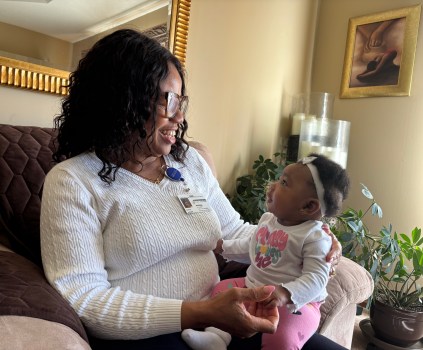

Three months after her daughter, Za’Mor Caldwell, was born, a county nurse came to Zaharia McLaurin’s home to make sure both mother and baby were healthy and well.
“She assessed the baby, just gave me tips on how handle her and what to do, especially with her growth and development, just making sure she’s healthy,” McLaurin said, holding Za’Mor on her lap.
McLaurin lives in Matteson, and Za’Mor is her first child.
“It’s helped a lot, because in a traditional setting you really don’t get the help like how they do it,” McLaurin said. “It’s been amazing for me, because I have another set of help.”
Her care was provided by Healthy Beginnings, a program run through the Cook County Department of Public Health intended to improve health outcomes by providing prenatal and postnatal care to suburban mothers.
“We want to prevent mortality, want to prevent morbidity and mortality,” said Maria Ajuzie, the nurse looking after McLaurin and her daughter.
The program also focuses on mothers’ mental health, McLaurin said.
“I think that’s important,” McLaurin said. “If I’m not in the right mental state, then I can’t take care of and provide for her.”
The program launched in January, said Michele Spikes-Cain, associate director of nursing at the Cook County Department of Public Health.
“If mother is uncomfortable meeting in the home, we can meet at the doctor’s office, library,” Spikes-Cain said. “We just want to meet them where they are so we can provide the resources, education and just wrap-around support they need during the critical part of pregnancy.”

Mothers are educated on topics including safe sleep and the importance of vaccinations, Ajuzie said.
“It’s extremely comprehensive,” Spikes-Cain said. “We try to touch on cardiovascular disease, any comorbidities the mother may be dealing with like diabetes, asthma.”
There are several ways expecting and new mothers get connected with the program, which generally provides support for a year after birth, with home visits once a quarter.
“(McLaurin) was referred to us from the hospital,” Ajuzie said. “Some of them, we see them before they have the baby. We educate them around prenatal, everything about prenatal.”

In addition to pure health concerns, the program also aims to help in other areas that can have negative effects on the mother and baby’s health, such as access to food, housing and transportation.
“Some of them don’t have housing, they don’t have transportation,” Ajuzie said. “Some need extra help, they don’t know how to go about it. But when we come in, we give them information on how to get the resources that they need at that point.”
Spikes-Cain referred to those factors as social determinants of health, nonmedical factors that can lead to worse health outcomes.
“We assess the mother for multiple screenings, for intimate partner violence, for food insecurity. We make sure mother has access to food,” Spikes-Cain said. “If she doesn’t, we refer and link to other services and other community partners, like WIC and food pantries.”
There is a wide discrepancy in pregnancy-related health outcomes for Black women, Spikes-Cain said, which makes resources such as those provided by Healthy Beginnings particularly important.
“Black mothers are three to four times more likely to die of pregnancy-related complications than white women,” Spikes-Cain said. “Almost 90% of those complications and deaths are preventable.”
Black women are more likely to deliver at hospitals with fewer resources, Spikes-Cain said.
“We know that structural racism and implicit bias in healthcare play a major role,” Spikes-Cain said. “This program was designed to meet that gap.”

The program is free, Spikes-Cain said, and mothers to not need to have insurance.
If a nurse notices more substantial issues during their home visit, they can recommend a pediatrician visit, Ajuzie said. And if it seems like a baby has medical issues that require specialist care, the program can connect them to a specialist.
“If they don’t have insurance, we advocate for them,” Ajuzie said.
Healthy Beginnings was started to replace a different program, High Risk Infant Follow-Up, that had been funded by a now-expired grant, Spikes-Cain said.
“We felt that just because the grant ended, that did not mean we had to stop what we were doing,” Spikes-Cain said. “The work must continue.”
Chicago is served by the Chicago Department of Public Health, she said, but for the suburbs, the task of filling gaps in public health programming falls to the county.
“South suburban families need coverage too,” Spikes-Cain said. “We know that just because you’re in the suburbs, it doesn’t always mean that you have access to quality care.”
elewis@chicagotribune.com