
The Lake County correctional officers union brought its concerns about stalled bargaining during contract negotiations, poor jail conditions, staffing shortages and inmate overcrowding to the Lake County Council Tuesday.
Naomi Frisch, the union’s attorney, said the Lake County Correctional Association Local #11’s most recent contract with the county expired Dec. 31, 2025. The agreement was signed by the Lake County Council, Frisch said.
“We are here today because we believe that the assigned representatives of Lake County, however they got assigned, are not bargaining in good faith in violation of Lake County ordinance,” Frisch said.
The union requested to begin bargaining in February 2025, Frisch said. Bargaining began over the summer, in June or July 2025, she said, when the warden announced his resignation.
“Since then, the chosen leadership of the sheriff’s department and the representatives that this county has sent to the table have caused delay and frustration and severely eroded the relationship between the correctional officers and their employer by their actions at the table and in the grievance arbitration process,” Frisch said.
During the union’s last bargaining session with the county Dec. 2, 2025, the only county representatives to attend the session were the county’s human resources director and county attorney, Frisch said, who knew nothing about the jail and had no authority to make decisions.
Lake County Council President Christine Cid, D-5th, said it’s the Board of Commissioners’ responsibility to address bargaining. Commissioner Michael Repay said the commissioners typically request that a representative from human resources and a county attorney attend.
The Lake County sheriff could also attend bargaining sessions that pertain to his departments, Repay said.
“We don’t have authority over the jail. They’re in a trick bag if they want someone with authority there,” Repay said.
After the warden left, the union proposed to maintain the current contract as is, with a 6% salary increase for both years of the contract, but was told by county officials there would be no salary raises, Frisch said
“We are here today to demand that the county as an employer acknowledge its obligation to bargain in good faith per the ordinances and to send representatives with authority to the table at the earliest possible opportunity,” Frisch said.
Citing county ordinances, which the council passes, Frisch said an unfair labor practice is defined as interfering with or restraining employees from collective bargaining, refusing to bargain in good faith, and disciplining employees for filing complaints. But Frisch said the ordinance doesn’t address enforcement, so she requested the council enforce the unfair labor practice ordinance.
“The sheriff’s department, as the designated representative of the county, has committed all of these unfair labor practices,” Frisch said. “Right now, the relationship between the Lake County Sheriff’s Department and its correctional employees is far from harmonious. We are here today because we believe this is a direct result of the sheriff’s unfair labor practices in violation of the Lake County code of ordinances.”
Lake County Sheriff Oscar Martinez said in a statement to the Post-Tribune that he supports the correctional officers’ union right to collective bargaining. But Martinez said there are “fiscal restraints” impacting correctional facilities across the country.
“I look forward to working with the correctional officers’ union and the Lake County Council under the current financial restraints to come to a fair and equitable resolution,” Martinez said.
Correctional officers sacrifice time with their families, their health and safety every day “to meet the bare minimum standards to keep the jail running,” Frisch said.
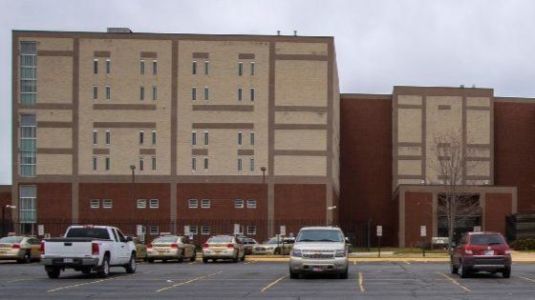
Currently, the Lake County Jail is understaffed by 70 officers, Frisch said. The correctional officers sign up for 12-hour shifts, Frisch said, but are often held over another four hours because of understaffing, she said.
On average, a correctional officer will work 40 hours of overtime every 28 days, Frisch said.
“This overtime is utilized not to maintain optimal conditions but to try, just to try, to maintain minimum safety standards,” Frisch said.
But the minimum safety standards aren’t always achieved, which has resulted in officers being assaulted and stabbed, Frisch said. The jail has been put on lockdown more than it should, she said.
The jail has been without a warden for seven months and the sheriff doesn’t enter the jail or help with day-to-day operational needs, Frisch said. The sergeants, lieutenants and officers, who work in the jail every day, have tried to approach the department administration with “clear ideas about how to fix these problems,” Frisch said.
The union, through the collective bargaining process, has raised concerns and made suggestions for how to improve staff utilization, safety and morale, which have been ignored, Frisch said.
“The administrative staff that works in the jail are trying. But without clear policies, strong leadership and directives from the leadership of Lake County, emotions are high, mistakes are being made and the safety of these officers is at risk,” Frisch said.
Martinez said staffing shortages in the jail “are nothing new,” and that when he took office, the jail also had a staffing shortage. During his tenure, Martinez said he has worked to change the hiring process, which resulted in an increase in the number of applicants, and expanded the jail’s hiring campaigns.
Further, Martinez said he has worked with the council to give correctional officers pay increases. When he started as sheriff, Martinez said correctional officers were paid about $31,000 a year and he increased the pay in three years to $54,000.
“The safety and security of our correctional professionals is a top priority. As sheriff, my office has always been open to correctional officers so that we can discuss and address any concerns,” Martinez said.
The council has worked to address the shortage by increasing pay, but the council has heard that many candidates who apply for the positions don’t pass the testing qualifications, Cid said.
The council has also tried to address overcrowding in the jail by working with judges and sheriff’s office administrators to come up with solutions to help reduce the number of inmates. Cid said she wasn’t aware of the conditions in the jail.
“This is the first I have heard about the violations in the jail. This is the first I have heard of it. I think the sheriff should answer to that. There’s always two sides, but I believe it needs to be addressed,” Cid said.
Councilman Ronald Brewer Sr., D-2nd, said the jail conditions were brought up in Lake County sheriff candidate debates during the 2026 primary election cycle.
There have been countless lawsuits and court cases that mentioned poor jail conditions, including a case where defense lawyer John Cantrell said the jail has been dealing with a “bunch of chaos,” including power outages, overflowing water, locks that didn’t work and inmates caught with shanks.
“I would like to dig a little more deeper into what’s going on over in the jail. There’s something serious going on over there. Whether we have the authority or not, I definitely know we have the influence,” Brewer said.
Councilman Randy Niemeyer, R-7th, asked Frisch why the union came to the council instead of the commissioners to raise its concerns.
“I would hope that the Lake County Council is concerned about the safety issues in the jail,” Frisch said. “The Lake County Council signed the collective bargaining agreement. There is involvement from the Lake County Council in this process, even if they are not the ones sitting at the table.”
Lake County Council attorney Tom O’Donnell said the council drafts and passes ordinances, but the commissioners enforce the ordinances.
Lake County Councilman Ted Bilski, D-6th, said the county recently paid millions of dollars to address the conditions in the jail.
The Lake County Jail had been under the U.S. Department of Justice oversight from 2010 to 2019 following a 2010 settlement agreement with the department stemming from a civil lawsuit filed in 2007 by inmates claiming inhumane conditions and inadequate health care while the jail was under the administration of former Sheriff Roy Dominguez.
The lawsuit resulted in a settlement agreement containing 92 “compliance targets” the jail had to achieve and maintain for one year to meet the conditions of the agreement, Martinez said previously.
Initially, the DOJ found 99 deficiencies in the jail, in particular unsanitary and unsafe living conditions, and systemic violations of the constitutional rights of inmates regarding medical and mental health care and suicide prevention.
Seven deficiencies, such as mold in the shower area, were taken care of within a few months, so Martinez was tasked with improving the remaining 92 deficiencies, officials said at the time.
“We don’t need any more issues … we don’t need any more issues,” Bilski said.
Repay said the commissioners filed a lawsuit to have more authority over the jail, including an independent auditor to walk through the jail, but the courts ruled against the commissioners.
Chris Akey, the president of the Lake County Correctional Association Local #11, who was one of five people to speak before the council, encouraged council members to spend an hour or two in the jail to see what the correctional officers experience and the conditions. Akey said when it rains, some elevators and different areas in the jail flood.
Christopher Rak, the local union’s vice president and correctional officer for 9 years, said the officers are drained from working 16-hour shifts. Officers are facing burnout, Rak said, which has led to safety concerns when officers interact with inmates.
The jail’s inmate population “is at an extreme level,” with overcrowding of inmates in most sections of the jail, Rak said. For example, a section of the jail on the third floor that has 32 beds but is currently housing 42 inmates, Rak said.
The officer shortage and the overcrowding have led to instances where two officers are responsible for monitoring 300 inmates, Rak said. The overcrowding has led to assaults on officers, Rak said, and recently an inmate stabbed an officer with a broken broomstick.
“It is essentially a powder keg just waiting to blow,” Rak said. “We are here to ask for council’s help. We ask that a contract can be negotiated with an increase in pay and other benefits so that it becomes easier to recruit people to work in the jail, as well as retain the officers who are there.”
akukulka@post-trib.com