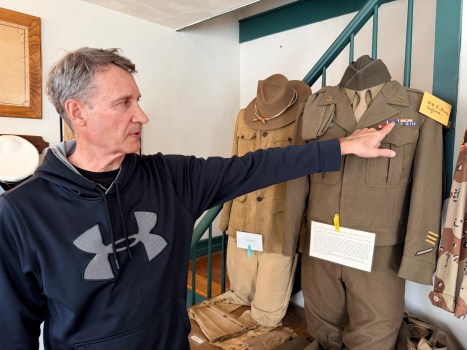

Visitors to Hebron’s Stagecoach Inn got a glimpse Saturday of when American troops fought fascism during World War II.
Living history interpreter Ian Baker brought some of his extensive collection of World War II artifacts to the museum for a pop-up exhibit sponsored by the Porter County Museum and Hebron Parks & Recreation.
“I’ve been putting this together for in excess of 25 years,” Baker said, buying items at flea markets, garage sales, estate sales and elsewhere.
Baker, of Michigan City, brought everything from boxer shorts to deactivated hand grenades to the museum.
Rather than replicas, the real but deactivated grenades allow visitors to feel the heft of the grenades lobbed by American troops. The troops would lob the grenades and dive for cover so they wouldn’t be hit by the shrapnel.
The weapons and the captured Nazi paraphernalia drew a lot of interest. American troops found tons of prizes to bring home, he said.
“The German flag down there was pilfered by a GI off a ship down there in Bremerhaven,” Baker said.

If Bremerhaven sounds familiar, it’s likely because that’s where Captain George Von Trapp, of “The Sound of Music” fame, was to have reported to duty before he escaped German-held Austria.
Zander Nikdoski, a Kouts High School junior, stopped by. “I just like learning about wars in general,” he said.
Baker showed him the pistol, which was a prop gun, not an authentic one, unlike the other artifacts on display.
Baker hears lots of stories from veterans as he collects and displays military artifacts from bygone wars.
Kent Kolodziej, of Crown Point, told of his father’s service in World War II.
His father, Peter, was drafted right out of high school in 1943. “He got out in June, and in July he was in boot camp.”
Peter didn’t talk about the war much, but Kent has pieced together details through military records and what Kent’s mom took notes about when Peter had to tell his story years after the war in order to get Veterans Administration benefits.

“He landed on Normandy a week or so after D-Day,” Kent said.
Before that, while in England, Peter was in the artillery. “He was shooting down planes or the buzz bombs they were dropping,” Kent said.
Peter was a member of the 110th Regiment of the Pennsylvania National Guard’s 28th Infantry Division, Kent said. “The Germans named it the Bloody Bucket.”
During the Battle of the Bulge, the Germans ran into Peter’s regiment. The regiment wasn’t expected to be attacked, but the Germans did anyway.
By that Dec. 16, Peter had been wounded and captured.
“He was transported in a railroad car like the Jews were to the gas chambers. He was transported to a POW camp,” Kent said.
Peter, with four bullet holes in him, spent a week or two at one POW camp before being put in another cattle car to go 250 miles inland to a larger POW camp.
Along the way, Peter and other captured POWs were marched through some German cities, being stoned by the German civilians.
“Not only was he wounded, but he was further injured with projectiles,” Kent said.
Peter also sustained frostbite inside the railcar, packed in so tight there was only room to stand, not lie down.

“I remember as a kid when we moved to Crown Point and for decades after, we would get Christmas cards,” Kent said. One was from a fellow prisoner in the same prison camp. “He was wounded in the jaw and couldn’t feed himself. Dad fed him.”
The food wasn’t much, just things like sawdust mixed with wheat, Kent said.
The POW camp was liberated by the British in April 1945. “He actually kept a notebook, from the day he was liberated until the day he was evacuated.”
When the British arrived, the Germans had just left, leaving the gates open for the enemy troops.
Some 15 years ago, Peter had already passed away when Kent was talking with a vendor in Illinois who sounded about Peter’s age. Kent figured by the man’s age that he might have served in World War II. He was right.
The man was a navigator on a B-17 bomber. “His plane gets shot down, shot out of the sky in Belgium,” and he was captured.
He was Jewish, Kent said, but didn’t wear a Star of David when flying for obvious reasons. The man was taken to the same prison camp as Peter, although the two men didn’t meet there.
When the German soldiers fled the POW camp, “basically, we all thought we were going to die, or nothing would happen,” the man told Kent.
The details he gave Kent checked out with what he had pieced together about his father’s experience there.
Kent doesn’t want stories like this to fade with time. He’s a volunteer with the Veterans Memorial Parkway Commission, working to raise funds for the World War 1, World War II and Holocaust memorial planned at Sauerman Woods in Crown Point.
The memorial will tell the story of World War I, underlying unresolved issues that led to World War II, and the Holocaust, Kent said. Fifteen chapters in that story are planned.
Crown Point’s Fourth of July parade, in honor of the nation’s semiquincentennial – the 250th birthday – will serve as a kickoff for fundraising for the memorial, Kent said.
The float for World War II will have information about Iwo Jima and D-Day, as well as a QR code to get more information about the planned memorial, Kent said.
Doug Ross is a freelance reporter for the Post-Tribune.