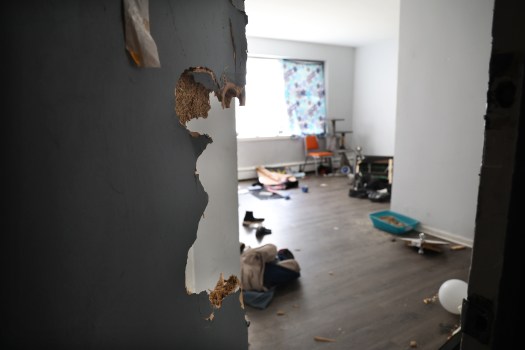


One man said he was awakened to the sound of helicopters outside his South Shore apartment building before four masked federal agents burst through the door and beat him with a rifle in front of his wife and three young daughters.
Another man claimed he was still in bed when a large black police dog clamped down on his leg and he was zip-tied by agents. Others said agents threatened to kill them, forced them outside into vans in their pajamas and underwear, and took them to detention facilities without due process.
No one ever saw a warrant, they said.
The harrowing stories were included in a series of federal tort claims filed Wednesday by immigration advocacy groups on behalf of 18 people who were allegedly arrested illegally and brutalized in a controversial overnight raid in a South Shore apartment building during Operation Midway Blitz last fall.
The tort claims, a prerequisite to a lawsuit against the federal government, foreshadow what would be the first litigation filed in connection with the military-style immigration enforcement raid at 7500 S. South Shore Dr. that unfolded in the middle of the night with helicopters, snipers and bright spotlights.
The filings allege federal agents stormed the U-shaped building in the dead of night on Sept. 30, broke down doors without warrants, and rounded up adults and children alike at gunpoint.
“Amidst the chaos, a DHS-hired camera crew and drones followed agents and filmed the operation inside and outside the building; footage was later released on DHS’ social media accounts as promotional content,” the plaintiffs’ attorneys said in a news release.
The claims, filed under the Federal Tort Claims Act, were made on behalf of 18 plaintiffs by the Mexican American Legal Defense and Education Fund, MacArthur Justice Center, the Immigration Clinic of University of Chicago, and the National Immigrant Justice Center.
“This raid is among the most abhorrent actions of Operation Midway Blitz, part of the current administration’s militarized campaign targeting communities of color in cities across the country,” said Susana Sandoval Vargas, MALDEF Midwest Regional Counsel. “We are pleased to represent courageous clients who have decided to stand up against this abuse of power and hold the federal government accountable for its actions.”
Officials with DHS did not immediately respond to a request for comment.
The filings document the first-hand experiences of many who were arrested that day.
One of them, Johandry Jose Andrades Jimenez, said he was asleep with his wife and three daughters aged 3, 1 1/2, and 6 months, when they were awakened by the sound of helicopters and he saw armed men dressed in military uniforms gathered outside.
“Within a few minutes, agents approached Mr. Andrades Jimenez’s door,” the declaration submitted on his behalf stated. “Agents were yelling aggressively, ‘Open the door! Get out! Get Out!’ Agents hit the door forcefully twice and breached the door. Four large men armed with guns then entered the apartment.”
Andrades Jimenez said one agent ordered him to get on the floor “or I’ll kill you.” He was then struck in the head with a rifle and thrown to the floor “in front of his wife and children, who were crying,” the declaration stated.
The agents allegedly zip-tied Andrades Jimenez and asked him if he was a member of the Venezuelan gang Tren de Aragua, which he denied, according to the declaration.
Battered and shirtless, Andrades Jimenez was marched out of the building and separated from his family. He was taken to the ICE detention facility in Broadview and eventually transferred to other jails in several states, where he was denied access to heart medication over more than two months in custody, according to his declaration.
Other declarations included in the filings indicate federal authorities had geared up for the raid weeks in advance.
One affiant, identified as J.M. Jimenez, said about a month before the raid, federal agents disguised as utility workers were going door to door marking the doors of Hispanic-occupied apartments with a big “X.”
The raid, which was led by then-Border Patrol Cmdr. Greg Bovino, was one of the most shocking episodes during the Trump administration’s Operation Midway Blitz, which resulted in the arrests of thousands of immigrants and numerous clashes with citizens on city and suburban streets throughout the fall and early winter.
During the events that happened overnight on Sept. 29 and Sept. 30, agents dressed for combat rappelled from helicopters onto the roof of the five-story brick building. They broke through windows and stormed inside, where they crashed through doors and placed residents in zip ties and on buses or in the back of box trucks. Many Venezuelan migrants lived in the building and were taken in the raid.
The assault on the building in a majority Black neighborhood on the city’s South Side was widely condemned, and the Illinois Department of Human Rights earlier this year launched an investigation into the owner’s role. The state has alleged that the owner prompted the September raid by telling the federal government there were Venezuelan immigrants living in the complex who were “unauthorized occupants and had threatened other tenants.”
Though the Trump administration often justified their deportation operation by claiming to pursue people who posed a safety risk to the public, no criminal charges were filed against anyone in connection with the raid, either in U.S. District Court or in Cook County.
DHS had previously said the raid was the result of federal criminal warrants, though none were made publicly available. Two immigrants who were detained in the raid had no felony criminal record or presented any risk to flee, yet were improperly subjected to “warrantless arrest,” according to a federal judge who reviewed allegations of warrantless arrests by agents.
Two days after the raid, DHS featured it in a video on social media with instrumental music, the sound of the helicopters and spotlights on the building.
Building residents continued to face problems in the weeks and months following the raid. They formed a tenant union after a Cook County judge appointed a third-party receiver to manage the property and ordered the building to be vacated.
Among the claims in the tort filings Wednesday were Norelly Eugenia Mejías Caceres and her partner, Daniel José Henriquez Rojas, who lived with her then-six-year-old son on the second floor of the building.
Twice before the taid, “”unfamiliar men in green vests knocked on” Caceres’s door. The first time they came, the men looked into her apartment, asked about the lights and left, the complaint alleged. She did not open the door the second time but suspects they were investigating who lives in the building.
On the night of the raid, Caceres and Rojas were awakened by the sounds of a helicopter and saw agents rappelling down onto the building. She tried not to awaken her child because she did not believe the agents would enter her apartment, the complaint said.
Suddenly, 20 agents smashed the front door, entered the bedroom, pointed military-style guns nad shouted “Get out!” and “Go downstairs” at the family. Agents told her not to record with her cellphone and did not produce a warrant, she said.
Caceres attempted to explain that they had pending asylum cases but were told to get out and prevented from showing their documents. The adults left barefoot and the child was shirtless in his underwear because they did not have time to get changed, the complaint said.
Rojas was ziptied in the hallway and Caceres fainted, according to the complaint. Caceres said the agents placed a hot metal object on her chest that left a bruise and the agents carried her by her wrists and ankles down the hallway, the complaint said. They used a large towel to carry her down the stairs.
As she sobbed, she asked the agents where her child was but was told to look into a camera, which agents used to identify her, the complaint said.
Caceres “complied with the agents’ commands, but she had been sobbing so intensely that the agents told her she needed to open her eyes wider for the smartphone camera,” the complaint said. “Once she complied, the agents took a photo of her face with the smartphone. The agents then called (Caceres) by her full name and identified her birthplace as Venezuela.”
After she confirmed this, the agents told her her child was with Rojas, she said. The child was wrapped in an aluminum blanket but not wearing a shirt or shoes, the complaint said.
Caceres, her son and Rojas were taken to a detention center where the adults were separated from each other. Caceres was taken to a detention facility in Texas where “the bathrooms were overcrowded and unsanitary, and (the child) once cut himself on a rusty bathroom door,” the complaint said.
Caceres and her child signed a form agreeing to be returned to Venezuela and was deported in late October. They did not reunite with Rojas until he was deported in late November, the complaint said.
Another woman, whose name is redacted, was living in the building and also described men coming by her apartment posing as repairmen, according to the complaint. On the night of the raid, she was also startled awake by the helicopter and drones, then watched as agents rappelled onto the roof and landed directly outside the open window of her living room.
She could hear agents breaking their way into other apartments and became “very afraid,” the complaint said.
She asked agents not to break down their door but they did it anyway, the complaint said. Her son had what she believes to have been an anxiety attack during the raid, she said, as agents searched through their apartment and pointed guns at her and her son. The agents forced her and her son out of the apartment into another on the second floor, where she witnessed agents “beat several detainees in the living room,” the complaint said.
One agent hit a man with what appeared to be the butt of a rifle and another man was kicked by agents in a circle, the complaint said. Some of the detainees said that another man, who was bloody, had been wounded by a dog, according to the complaint. The child hyperventilated and was put into a separate bedroom where he could still hear. Federal agents ziptied the woman and her son, according to the complaint.