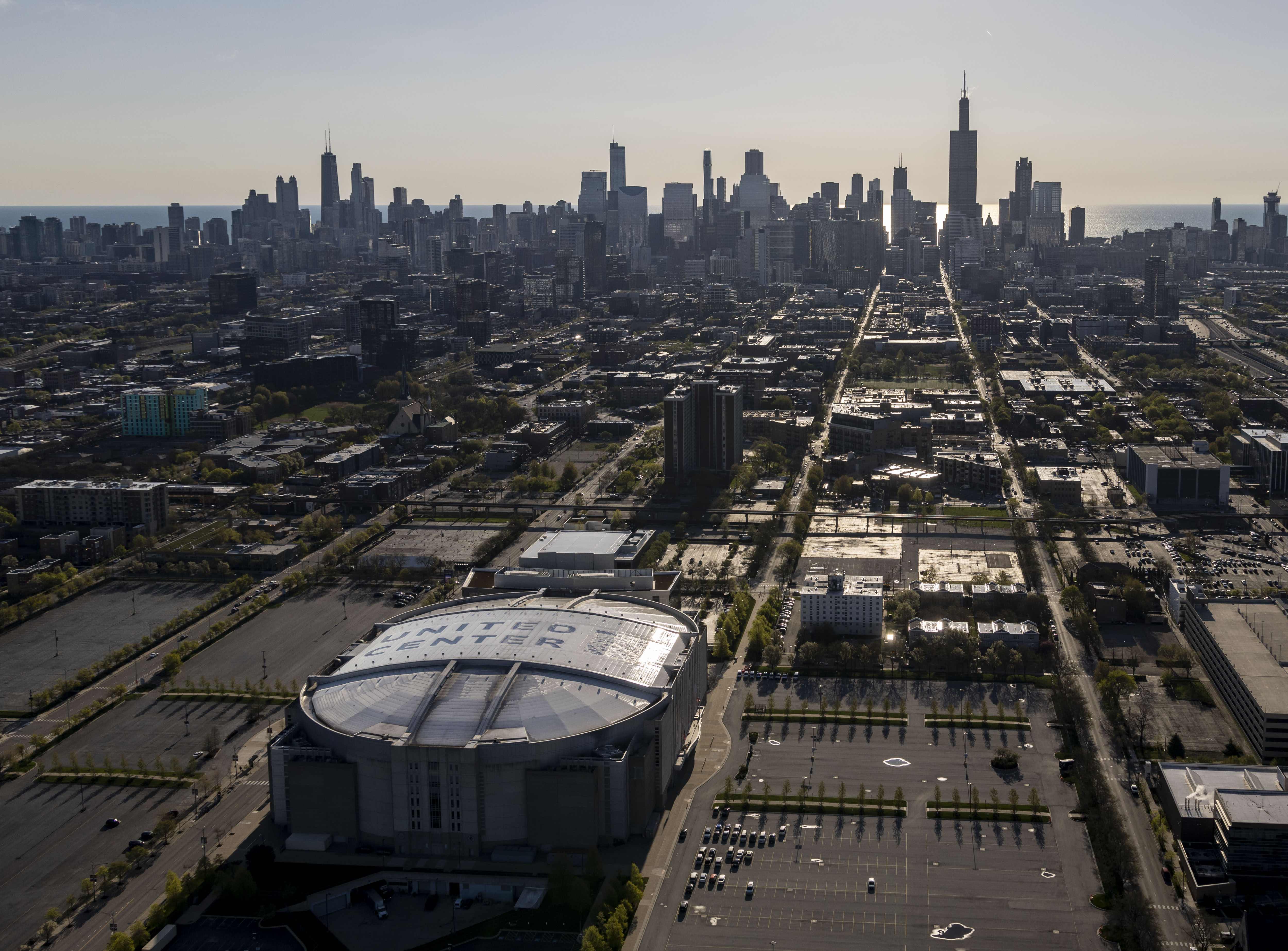

A City Council committee’s approval earlier this week of a property tax subsidy requested by the developers of the multibillion-dollar 1901 Project on Chicago’s West Side tees up the matter for full council approval next week.
Or does it?
Even as they advanced the plan, aldermen on the Economic Development Committee pressed representatives of the development team for answers to their worries about the diversity of construction subcontractors and opportunities for West Side residents to work on the project’s $500 million first phase. Those issues likely won’t be difficult to put to bed.
But there’s another lingering matter that has the potential to delay council approval well past next week. That’s the demand from United Here Local 1, the union that represents concessions workers at the United Center, that the developers require operators of future restaurants at the site to employ workers repped by the same local.
The Wirtz and Reinsdorf families, co-owners of the United Center and 1901 developers, have already signed on to United Here’s representation of workers at the 6,000-seat music venue and new hotel, the focal points of Phase I. But restaurants outside the concert hall and the hotel, which could include operators from the neighborhood as well as glitzier steakhouses and such, are a different matter. The developers understandably don’t want to limit the pool of potential operators by forcing them to negotiate with the union.
The restaurant industry by and large isn’t unionized; Unite Here has been trying to change that. It has had some success organizing Chicago eateries. There’s a list with more than 50 union restaurants in Chicago, some of them household names like Gibson’s and Harry Caray’s, all represented by United Here.
In other words, the union doesn’t need the City Council to put its institutional thumb on the scale. There’s nothing stopping United Here from attempting to organize whichever restaurants end up being part of 1901 once they’re established.
In the meantime, a stalemate between the developers and the union at City Hall has the potential to hold up the project.
We’ve already seen the City Council shoot itself in the foot by carrying water for local unions trying to organize private-sector workplaces whose owners prefer otherwise. We’ve noted before how one of the largest multifamily projects on the drawing boards in Chicago — Onni Group’s plan for 2,450 units in three high-rises at 700 W. Chicago Ave. — fell by the wayside when the Canadian developer wouldn’t agree to a union’s demand to help it organize other existing Onni-owned buildings in Chicago.
Onni now has leased an empty industrial building on the Chicago Avenue property to Universal for an elaborate haunted house called Universal Horror Unleashed. In the face of what all agree is a housing crisis, Onni’s residential plan will have to wait at least a decade for a more rational City Council.
In the bigger picture, here’s what else is for rent. Aldermen have effectively leased their authority to unions, which now routinely wield the council’s fealty to exert maximum leverage on Chicago businesses. Unions pay the rent every four years by contributing to aldermanic reelection campaigns.
In the case of the 1901 Project, here’s a development that council members and Mayor Brandon Johnson have celebrated as by far the largest private investment in Chicago’s West Side since … well, since the Wirtzes and Reinsdorfs built the United Center more than three decades ago.
Given Johnson’s status as Chicago’s most noteworthy West Sider, the location has much to do, we’re sure, with his support for a $55 million property tax break over the next 12 years that the developers say they need to finance the first phase.
This page has very mixed feelings about that subsidy, but is not similarly ambivalent about Chicago’s desperate need to get the wheels of development turning again. Clearly, the council has no major issues with granting the tax break and can justify its action by pointing to the estimated $46 million in additional property taxes the site will generate over the coming dozen years even after the subsidy.
So there’s no excuse not to finalize this deal promptly regardless of whether that induces a hissy fit from United Here and the Chicago Federation of Labor. The mayor, who has pointed repeatedly to 1901 as evidence of what he says is a thriving Chicago on his watch, ought to call on the council to do just that.
This practice of giving organized labor veto power over consequential private-sector developments in Chicago must stop. The 1901 Project — high-profile and centered in an economically deprived part of the city — is the ideal place to make a stand.
Submit a letter, of no more than 400 words, to the editor here or email letters@chicagotribune.com.