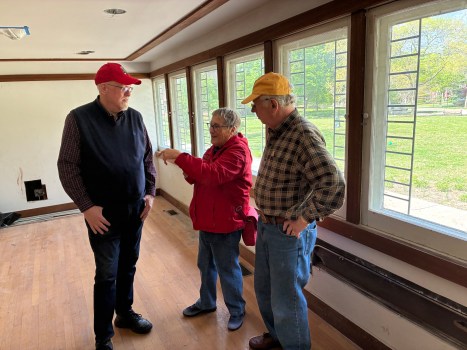

Starting Sunday, the public can get a rare look at a Frank Lloyd Wright cottage in Glencoe that was home to his attorney, a man who later became notorious for writing racist covenants that kept Blacks and Italians out of Glencoe.
The Glencoe Historical Society continues its ambitious fundraising for the costly restoration of Wright’s Ravine Bluffs cottage, as it is known now. After the cottage has sat idle for nearly six years, the society will open the cottage May 17 and 31 for hard hat tours, and could also open to the public with exhibits later this year.
Last month, an interior renovation started at the Wright-designed structure, built in 1913. The hard hat tours, at $25 per person, are part of a fundraising effort aimed at transforming the cottage into a museum, research facility and education center this fall.
“Our goal is to raise awareness and do the research and educate the community,” said historical society co-president Jeri Anne Darby.
Historical society officials envision the approximately 1,100-square-foot building as an homage to Wright. Glencoe is home to the third-highest number of Wright-designed structures in the world, trailing only Chicago and Oak Park.
“It is a celebration of America’s most preeminent architect,” said historical society Board member Ed Goodale, who is serving as the project manager.
“There is a concentration here of his projects unlike anything other than Oak Park or Chicago that you will find. This is something that needs to be celebrated.”
Spread over three galleries, the planned exhibition would focus on Wright’s development of affordable Usonian homes, his design of the nearby Ravine Bluffs subdivision and his role in developing Prairie-style architecture.
Historical society officials said another focus will be on Wright’s unbuilt designs both in the Ravine Bluffs subdivision and in downtown Glencoe.
The cottage will also highlight the efforts of Elizabeth Booth, owner Sherman Booth’s wife. She was a Glencoe suffragist prior to the 1920 ratification of the U.S. Constitution’s 19th Amendment, which granted women the right to vote.

However, the historical society also plans to acknowledge that the name of Sherman Booth was stripped from the cottage in 2024 after historical society Board members researching the exhibit “Blacks in Glencoe” discovered Sherman Booth had participated in a racist scheme to keep Blacks, Italians and Greeks out of Glencoe through racially restrictive real estate covenants.
The cottage was originally named for Booth, who was Wright’s friend and attorney, and the Booth family used it as a temporary home during construction of a larger estate nearby. Following the revelation of Booth’s racist plot, the historical society renamed the structure the Ravine Bluffs Cottage to more closely align it with the Wright-designed development.
Outside the cottage, there is a “council ring” recently maintained by the Friends of the Green Bay Trail, augmented by planted plugs of more than 1,000 native forbs and grasses.
“We have followed up with watering and weeding, which are ongoing, to give the young plants a good chance to fill in and provide the kind of landscape Wright homes often had,” Friends of the Green Bay Trail co-vice president Bryan Lammers explained in an email.
The interior renovation marks another chapter in the cottage’s tumultuous recent history. After an earlier relocation, the structure stood at 239 Franklin Road for more than a century. In 2019, the cottage’s future became uncertain as new owners considered demolition, drawing protests from preservationists.
Eventually, an agreement was reached in which the cottage was donated to the historical society and relocated about a quarter mile away to a small parcel owned by the Glencoe Park District. The historical society leases the land for $1 per year.
In July 2020, a large crowd watched as the cottage was hoisted onto a truck and moved about a quarter mile to its current location at 301 Maple Hill Road.
Following the relocation, the historical society completed an approximately $350,000 exterior rehabilitation of the cottage. But the building sat idle for several years, with society officials largely blaming the COVID-19 pandemic.
Last year, the historical society launched a fundraising campaign with a goal of raising $350,000. Officials said roughly $100,000 has been collected so far through donations from Board members and the community, allowing interior electrical work to begin.
Additional work remains, including finishing entryways, refinishing hardwood floors, restoring wall finishes, completing electrical work and installing new handrails.
Another major step will be restoring the cottage’s banded windows, though GHS officials said they are not yet certain how much the work will cost.
Goodale said the historical society also hopes to create an endowment to maintain the structure in the future. Officials estimate annual maintenance, operations and security costs will total between $10,000 and $15,000, in addition to the pending restoration of the banded windows.
“It’s like having a house and we are going to have to maintain it that way,” Goodale said.
If the cottage opens for ongoing public access, the historical society will be limited in its use of the building, as its lease with the Park District restricts hours of operation and the number of events allowed each year amid concerns from nearby residents.
“We are very mindful of the neighbors. We are not going to go overboard on this thing,” society Board member Ellen Shubart said.
With those parameters, the historical society is contemplating opening the building during separate tours of the nearby Ravine Bluffs subdivision. Officials have not yet decided whether to charge admission to the museum.
Historical society officials believe there will be ongoing interest in the facility, particularly among younger people drawn to Wright’s work.
Darby, the historical society co-president, said she hopes the remaining funding will be secured, allowing the cottage to become another showcase for Wright’s legacy.
“I am excited to share this with the local community and people who admire Frank Lloyd Wright’s work,” she said.