
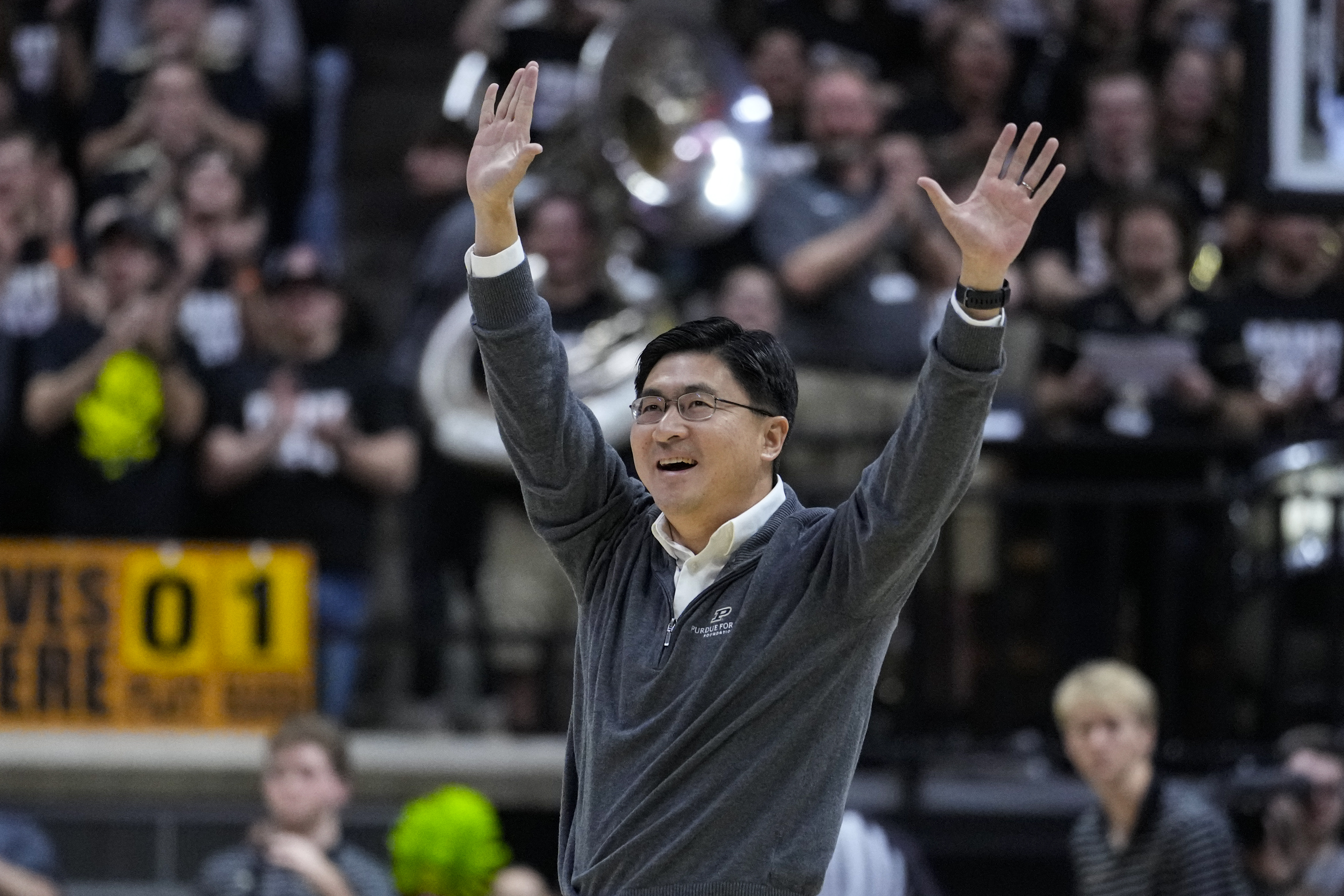

Northwestern University will have a new president come July, its Board of Trustees announced Monday, selecting current Purdue University President Mung Chiang as its pick to lead the school.
Chiang is set to take over the reins on July 1 and will be the university’s 18th president. The school’s last president, Michael Schill, resigned in September 2025 amid a federal funding freeze on the university.
“I am honored and thrilled to be Northwestern’s next president,” Chiang said in a news release. “I have long admired Northwestern for its dedication to interdisciplinary scholarship, artistic creation and impactful research, its tremendous healthcare system, and its palpable school spirit.”
Chiang became president of fellow Big Ten Conference school Purdue University in January 2023, leading a student body of around 58,000 on its West Lafayette campus. Before becoming the university’s president, he worked as Purdue’s dean of the College of Engineering and executive vice president for strategic initiatives. Prior to that, Chiang worked for 14 years at Princeton University.
Outside of academics, Chiang was appointed science and technology advisor to the U.S. Secretary of State in 2020. He currently chairs the board of the U.S. Foundation for Energy Security and Innovation, which he was appointed to in 2024.Chiang said in the news release that his first priority as president is to “listen to and learn about Northwestern’s distinct culture and this community of scholarly and creative minds, because what matters most is the ‘who’ before the ‘what.’”
“I plan to engage with as many members of our community as possible: students and parents, faculty and staff, alumni and donors, neighbors and partners, as well as all the trustees,” Chiang said in the news release. “I will listen to every one of the 12 colleges and schools, cheer every one of the 21 sports teams, visit Northwestern Medicine hospitals, and participate in every cherished campus tradition.”
According to the news release, Chiang’s presidency corresponded with Purdue’s most selective incoming class, highest graduation rate, most successful fundraising year, largest federal research grants and the largest industry research grant in the university’s history.
Beyond that, Purdue also saw athletic success. The university’s men’s basketball team reached the national championship game under Chiang’s tenure.
Some Northwestern faculty ‘alarmed’ by announcement
Northwestern’s American Association of University Professors chapter said Monday it was “alarmed” by the announcement, writing in a news release shared with the Tribune that the selection process “has taken the faculty and the chapter by surprise, in violation AAUP standards of academic governance.”
“The AAUP has long maintained that ‘[s]earches for presidents and other chief academic officers should have an open phase that allows individual faculty members as well as faculty bodies to review the credentials of finalists, ask questions, and share opinions before a final decision is made,'” the release reads.
The AAUP statement claimed Northwestern did not follow this process when selecting Chiang. The university said in a statement to the Tribune, however, that the presidential search “was executed in a way that is consistent with protocols of private institutions and in accordance with all University policies and standards.”
“The Presidential Search Committee that nominated the candidate for the Board’s election included faculty members, including the president of the Faculty Senate, as well as staff, student and alumni representatives. The search committee hosted listening sessions with a broad range of University community members, including the Faculty Senate, faculty leadership groups and faculty at large,” the statement read. “The University is thrilled to welcome Mung Chiang as its 18th president.”
Northwestern AAUP chapter President Jacqueline Stevens said in its the release that the organization looks forward to working with Chiang to “bring Northwestern into compliance with AAUP standards on academic freedom and shared governance.”
“It is imperative that the new administration embrace a faculty-inclusive process for future leadership selections and affirm the University’s commitment to its academic mission above all else,” she said.
At Purdue, Chiang draws praise, federal contention
Purdue’s Board of Trustees echoed praise for Chiang’s accomplishments in its own news release, describing his tenure as president as a period of “growth and academic excellence during a challenging time in higher education.”
“We are ever grateful for Mung’s leadership as Purdue continues to impact lives with outstanding teaching, research and engagement,” Purdue Board of Trustees Chair Gary Lehman said.
The school’s Board of Trustees voted in October 2025 to extend Chiang’s employment term by two years to June 30, 2031. Chiang called it an “incredible honor and joy” to work with the Purdue community in the news release, including its board, colleagues, students and alumni.” There truly is something special at Purdue: not just the projects and programs, but also the people, who time after time set the standard for excellence at scale,” Chiang said.
In a message to the Purdue community Monday, Chiang further wrote that this summer is once again the “right time to pass the baton to the next leader of our remarkable university.”“When I look back at the past four years along with the seniors, we again appreciate how blessed we are to be part of the Boilermaker team that worked each day to make Purdue the most sturdy and strategic institution of higher education in the country today,” Chiang wrote. “Thanks to you, Purdue is on a clear institutional trajectory upward and forward, beyond any single individual’s presence, with an even brighter future.”
Still, Chiang faced some obstacles while leading the public university.
The United States House Select Committee on the Chinese Communist Party sent a letter to Chiang in March 2025, which included their concerns over international students, students from China returning to the country after college, and what it described as the “displacement of American talent,” in secondary education.
“America’s student visa system has become a Trojan horse for Beijing, providing unrestricted access to our top research institutions and posing a direct threat to our national security,” Michigan Congressman and Chairman of the committee John Moolenaar wrote in the letter. “If left unaddressed, this trend will continue to displace American talent, compromise research integrity, and fuel China’s technological ambitions at our expense.”The letter also included a request for information about Chinese students at Purdue.
Provost Patrick Wolfe provided that information to the committee in a response letter less than two weeks later, according to the Lafayette Journal & Courier, sparking a wave of criticism from the school’s community and faculty, including the Purdue University Senate, which passed a vote of no-confidence for the provost in April.
Chiang’s initial hiring also faced backlash from faculty members in 2022, who were taken aback by the swift leadership shift that reportedly came from an internal search, Inside Higher Ed reported.


