
The south suburbs are not only steeped in history – they’re home to folks who excel at documenting it. So, it should be no surprise when the region’s skilled storytellers earn laurels for their efforts.
Three authors with ties to the south suburbs were among the recipients of Best of Illinois 2026 awards from the Illinois State Historical Society, announced last month. The honorees’ works include accounts of a rural community’s life during World War I, the evolution of a commuter suburb and how a Cook County election controversy led to a landmark Supreme Court decision.
SCOTUS focus
Mathias W. Delort, retired justice of the Illinois Appellate Court, received an award of Superior Achievement for his November 2025 article in The Journal of Supreme Court History, “Behind the Scenes of Norman v Reed with Justice Stevens: How a Local Chicago Political Battle Resulted in and Unlikely (and Rare) Supreme Court Case on the Rights of New Political Parties.”
Delort brought unique insight to the story since he worked on the case when he was an associate with Evergreen Park-based law firm Odelson & Sterk.
“The article was the end product of a colossal amount of work that began with a trip to the Library of Congress and ended up about two years later when I spent a full week or so writing the actual article, so it was very gratifying to see my work honored,” Delort said.
The article explores the 1991 United States Supreme Court case that involved the rights of new political parties following the death of Chicago Mayor Harold Washington. “I was one of the attorneys representing the Cook County election agency that was a party to the case,” recounted Delort, who was just five years out of law school at the time. “For a small suburban law firm to have a case at the U.S. Supreme Court was quite remarkable.”
Delort’s article explores how Justice John Paul Stevens, a native Chicagoan, took a leading role in urging the court to hear and rule on the case. “The case really didn’t develop any new legal doctrines but rather rested on principles that were well established by the high court’s earlier ballot access cases,” he explained.
The 35-year-old case is noteworthy, Delort said, because it was the last time the U.S. Supreme Court heard a case involving the rights of new political parties on their full merits.
“It wasn’t until I retired from full-time employment that I had the time to write the article,” he said. “Coincidentally, that was about the same time Justice Stevens’ papers were released by the Library of Congress.”
After presenting his findings at a meeting of the Chicago Bar Association Election Law Committee, Delort was urged to write the article by the editor of the prestigious Journal of Supreme Court History.

A native of Chicago’s Lincoln Park neighborhood, Delort lived in the south suburbs from 1991 to 1998, while working as an associate and later partner at Odelson & Sterk, which specialized in municipal, school district and election law. Delort was appointed as an associate judge of the Cook County Circuit Court in 2007 and served on the appellate court from 2012 to 2023. He currently lives in the north suburbs.
“When the case was over, I knew that it would be closest I would ever get to having a case in the U.S. Supreme Court,” Delort said. “I also knew that the case had an interesting backstory that should be told for history’s sake.”
New Lenox in wartime
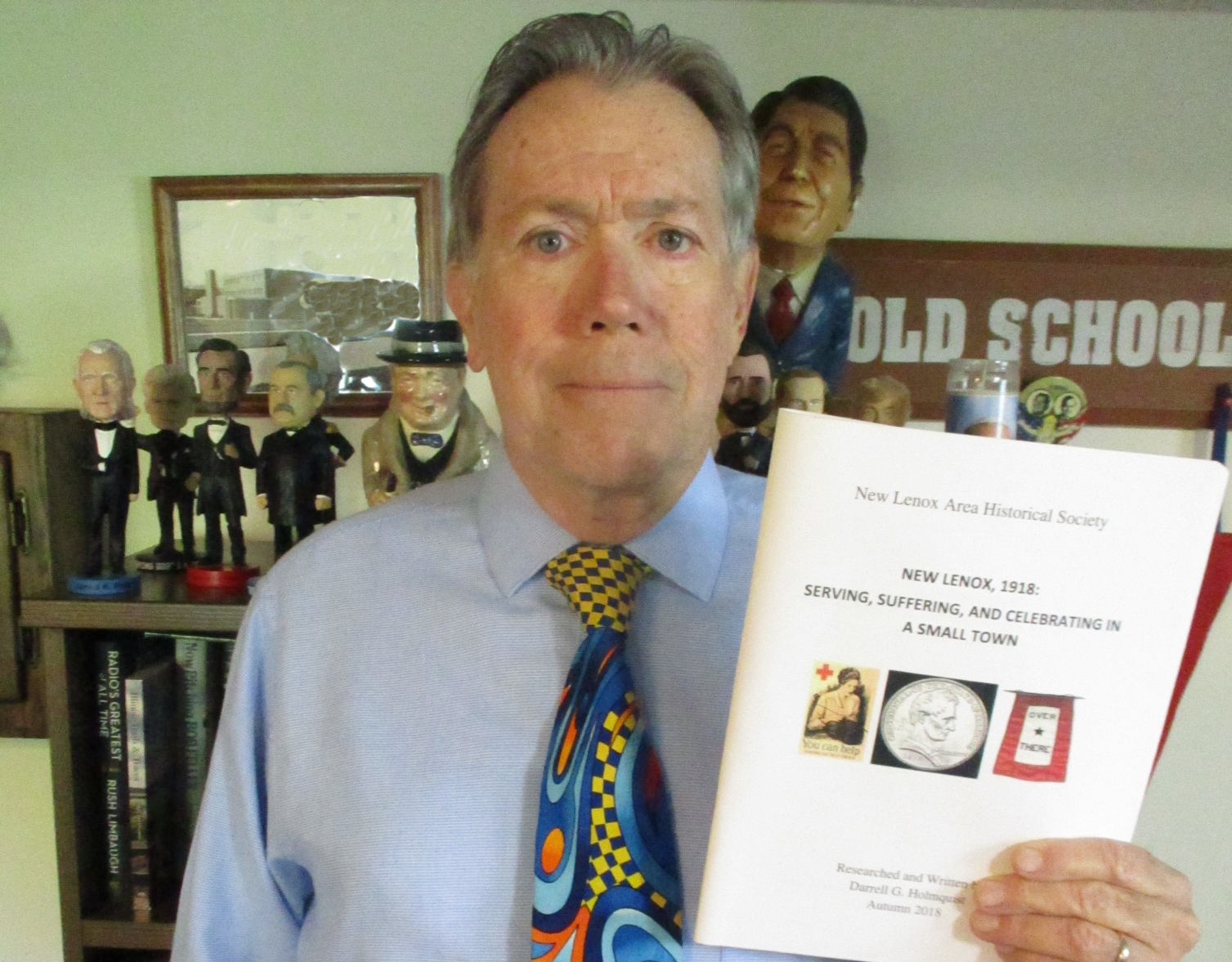
Darrell Holmquist, retired history teacher and Will County native, received an Award of Merit for his book, “New Lenox 1918: Serving, Suffering and Celebrating in a Small Town.” This account of life in the rural community during World War I includes key incidents and anecdotes that illustrate how the war affected daily life.
“I was grateful but did not expect this book to garner any kind of award,” said Holmquist, whose wife of 54 years, Suzanne – who also assisted with the design of the publication – nominated him for the award. “I was humbled.”
Holmquist retired in 2005 after more than three decades teaching U.S. history and western civilization, including stints at Joliet Central, Lincoln-Way East and Lincoln-Way Central high schools. While at Joliet Central, he started the district’s first class focusing on Illinois and Joliet history.
“I’ve spent all 76 of my years within six miles of where I was born on Joliet’s East Side,” Holmquist said. “I never thought that the history of people east of the Des Plaines River was very well represented. As such, all my side work during the high school history teaching days and in retirement has been devoted to helping ‘our’ story to be told.”
Holmquist made some interesting discoveries during the year and a half he spent working on the book, including how New Lenox dealt with the flu epidemic in 1918 and how lessons learned then applied to the recent pandemic more than a century later.
“We have a beautiful little cemetery – Maplewood – right in the heart of town, and I’ve walked through there many times and noticed family names that seem prominent among all the markers,” he said. “Researching the book, I came across many of those same monikers. Yes, history is alive with dead people.”
Holmquist’s own ancestors arrived in the 1840s from Ireland to help build the Illinois & Michigan Canal, in the 1880s from Sweden to work in area quarries, and in the 1920s from England to work in mines and mills. One of five siblings, he graduated from Joliet Central High School; MacMurray College, which operated in downstate Jacksonville from 1846 to 2020; and Northern Illinois University.
Once a part-time sports writer, Holmquist has written several other books, including a histories of the Lincoln Highway in New Lenox Township, Peace Lutheran Church in New Lenox and Good Shepherd Lutheran Church in Frankfort, as well as an unpublished history of the 100th anniversary of the arrival in the U.S. of his family’s English ancestors.
A lifetime member of the New Lenox Area Historical Society, Holmquist in the mid-1990s rallied support among the society, Lincoln-Way High School and the Illinois Department of Transportation to bring an original Lincoln Highway marker back to the front of Lincoln-Way Central, where it can be seen to this day along U.S. Route 30.

Holmquist traces his devotion to history back to age 7, when his parents bought him a set of encyclopedias.
“I couldn’t keep my nose out of the volumes. I looked up Lincoln one night and at the bottom of his page was a timeline. … From Honest Abe’s timeline, I saw Buchanan’s and then went the other direction to Andrew Johnson. I was hooked forever,” he said. “My mother made my memorization tasks a bit easier by typing a list of all the presidents, their parties, VPs, wives’ names, terms and when they died. When we had guests, my mother would trot me out to impress our families. Hope I didn’t disappoint.”
Flossmoor homage
Lifelong Flossmoor resident Tom Dobrez received a Certificate of Excellence for his book, “A More Perfect Place: The Story of Flossmoor,” which ISHS called “a personal but revealing tour of a place that he feels is a living testament to the American experiment, a … community that started as a playground for the wealthy before grappling with issues of race, class and identity.”
“I’m deeply humbled by this honor,” Dobrez said. “I respect all institutions dedicated to preserving history and the fact that they recognized my book as a Best of Illinois is remarkable.”
Published in November 2025, “A More Perfect Place” is intentionally sold through curated channels, which Dobrez said guarantees readers a quality product.

The book inspired the documentary film “Flossmoor: A More Perfect Place,” which Dobrez has screened at numerous fundraising events since its release last fall. More information about the book and film is at https://www.flossmoorhistorybook.com/.
This book is Dobrez’s latest backyard homage. The host of a historic podcast called “Flossmoor in Fifteen,” he previously authored “Root Root Root for the Home Teams: A Chicago Fan’s Odyssey to Find the Meaning of Life Through Sports.” Additionally, he’s president and co-founder of Flossmoor’s Future, the all-citizen-run nonprofit that serves as a civic backbone for the village. The group organizes Flossmoor’s annual Hidden Gem Half Marathon and hosts the 60422 Zip Code Day Party community celebration.
The Illinois State Historical Society announced the 2026 Best of Illinois History Awards winners during an April 25 luncheon in Springfield, recognizing more than two dozen authors, students, teachers, historical societies and museums from across the state. The event included an appearance and remarks by U.S. Sen. Richard Durbin.
“There is no greater recognition in Illinois for state and regional history,” said ISHS Executive Director William Furry. “The diversity and breadth of this year’s nominations reveal that Prairie State history continues to delight and engage audiences across all demographics.”
The ceremony included the presentation of two lifetime achievement awards, to former Illinois state historian Thomas F. Schwartz, now director of the Herbert Hoover Presidential Library in West Branch, Iowa; and Dr. James R. Barrett, emeritus professor of history at the University of Illinois Urbana-Champaign and the author of several award-winning books on Illinois labor history and working conditions in Chicago from 1880-1922.
A complete list of the winners and their specific awards is at http://www.historyillinois.org.
Jim Dudlicek is a freelance reporter for the Daily Southtown.