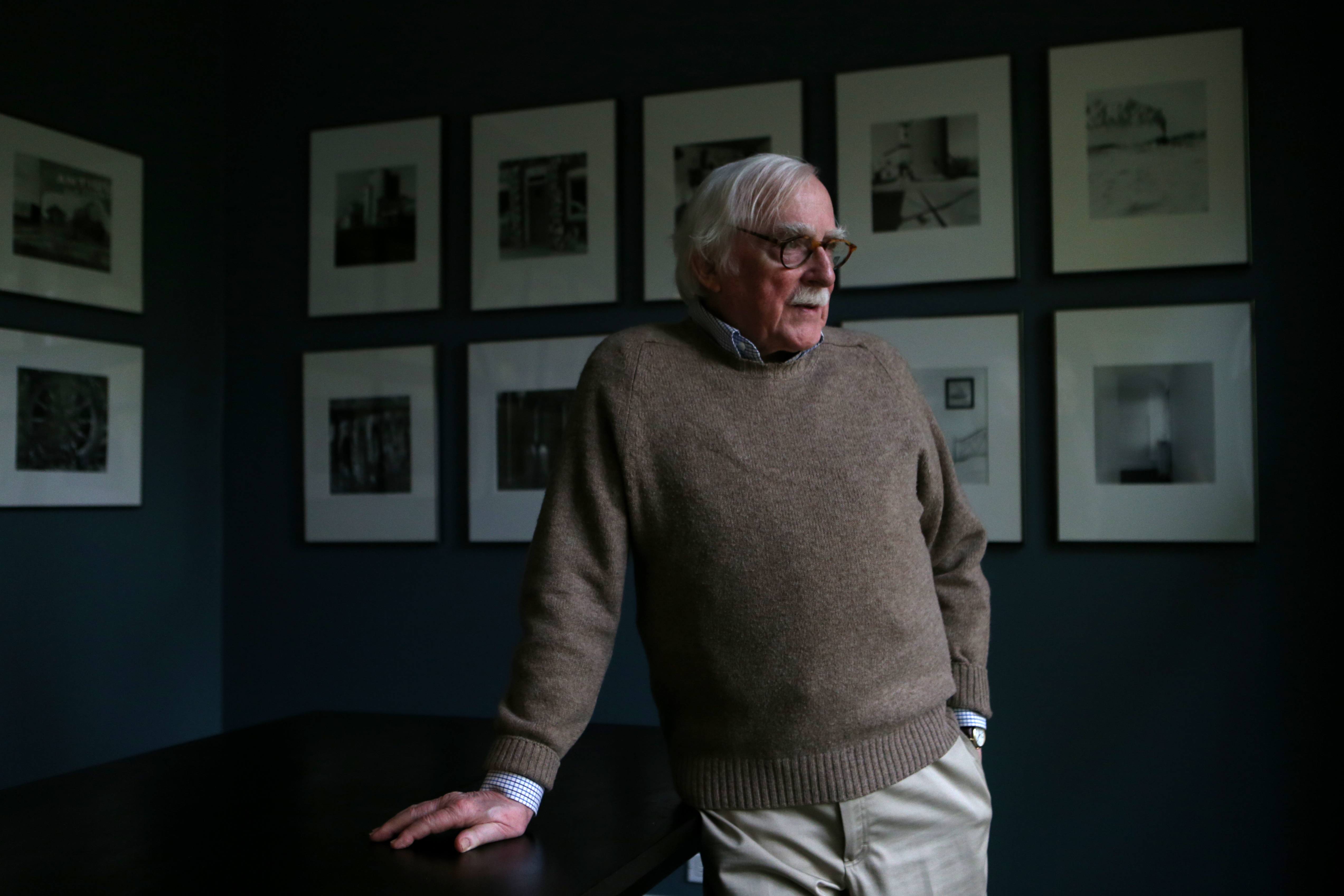

Photographer David Plowden started out chronicling American railroads in the postwar era before broadening his focus and hopscotching the country, using his camera to document the nation’s changing industrial and agrarian landscapes.
Plowden’s richly dimensional, black-and-white photographs, which appear in more than 20 books that he published, captured America’s vanishing steam locomotives, along with the deteriorating, rusty bridges, abandoned barns, decrepit farm silos and shuttered steel mills. Plowden’s area of focus made him as much an historian as he was a photographer.
“It became a cause,” he told the Tribune’s Don Terry in 2006, referring to his photography. “I felt we were losing part of our history, part of our identity.”
Plowden, 93, died of a heart attack on May 4 at the Westminster Place care facility in Evanston, said his wife of 48 years, Sandra Plowden. He had been a longtime Winnetka resident.
Born in 1932 in Boston, Plowden was the son of Roger Plowden, an English actor on the New York stage, and Mary Plowden, an accomplished pianist who had an influence on her son’s love of the arts. Plowden moved with his family to New York City when he was a child. While in elementary school, he lived in New York City during the school year and spent time on his family’s farm in Putney, Vermont, during the summer. He moved permanently to Putney in 1940 and graduated from the Putney School in 1951.
At age 11, Plowden began taking an interest in photography, shooting photos of the Central Vermont Railway’s 4:20 train as it approached Putney’s station.
After earning a bachelor’s degree in economics from Yale University in 1955, Plowden was hired by the Great Northern Railroad and was based in Willmar, Minnesota, where he worked on the railroad’s track gang and also photographed its trains. While working on the track gang, Plowden was struck by a beam, which landed him in the hospital. At that point, the railroad proposed promoting Plowden to a desk job, which did not interest him at all.
“I had a ball” riding with the engine crew, Plowden told the Tribune in 2006. “When I got promoted to a desk job, I quit.”
In 1958, Plowden went to work as an assistant to famed rail photographer O. Winston Link, who was known for chronicling steam locomotives at night. The following year, he studied with another noted photographer, Minor White, at the Rochester Institute of Technology in Rochester, New York. He then worked for yet another photographer, George Meluso, in New York City from 1960 until 1962.
Plowden struck off on his own in 1962, working both as a photographer and as a writer, providing elegiac descriptions of the industrial and agrarian declines that he observed. A frequent visitor to his Brooklyn, New York apartment during the first half of the 1960s was famed photographer Walker Evans, to whose photos Plowden’s work often has been compared.
Throughout the 1960s, Plowden’s photographs often were published in Trains magazine. He published his first book, “Farewell to Steam,” in 1968.
One of Plowden’s most famous photographs, a 1967 photo that he shot from a derelict patch of land in New Jersey that depicts electrical poles with the Statue of Liberty in the background, left such an impression on the members of the rock band Counting Crows that they gained his permission to use it for the cover of a live album, “Across a Wire: Live in New York City,” that they released in 1998. In 1968, Plowden was awarded a Guggenheim Fellowship to complete a book on bridges, which he published in 1974.
As his career as a photographer continued, Plowden published more books, including one containing his photographs of tugboats, published in 1976.
Plowden eschewed the title of railroad photographer, colleagues said, finding it too narrow a description of his work.

“David sought the dignity in whatever was before him,” said Scott Lothes, president and executive director of the Center for Railroad Photography & Art. “Whether photographing a soot-covered locomotive fireman, a smoke-belching steel mill or a humble and ubiquitous barn, he only released the shutter after ensuring that everything about the composition presented his subject with truth and dignity. He approached human relationships with similar intent and thoughtfulness. Even though he expanded his oeuvre far beyond railroads (starting) around 1960, he was beloved by railroad photographers of the 21st century for not only the enduring strength of his work, but also for the warmth of his character. His passion — which he maintained well into his 90s — for the American landscape and images of it was infectious.”
In 1977, Plowden was hired to teach photography at the Illinois Institute of Technology’s Institute of Design, where he taught until 1986. He subsequently taught at the University of Iowa’s journalism school for three years, and later was a faculty member at Grand Valley State University from 1988 until 2007. Across those appointments, Plowden remained based in Winnetka.
“I want to pass on all that I know,” he told the Tribune in 2006, referring to his teaching career. “I learned from the best. I believe in the continuity of life.”
Retired College of DuPage professor Glenn Hansen was one of Plowden’s IIT students. After taking several courses with him and later — while working as a freelance photographer — Hansen worked closely with Plowden as his darkroom assistant until 1991, when he started teaching at the College of DuPage. The duo had a “good symbiotic relationship,” Hansen said, learning from one another.
“He was really an excellent black-and-white printer. What really stands out to me is the quality of his black-and-white images and how he saw the world,” Hansen said. “We worked on seven or eight book projects and numerous magazine articles together, with me handling a lot of the darkroom and print work. I later taught him Photoshop, which he became really good at.”
As an instructor, Hansen said, Plowden placed a heavy emphasis on having his students gain experience in the field, shooting photos and then bringing them back to class to dissect in group critiques. Throughout his many years as a professor, however, Plowden continued documenting America’s changing landscapes, along with people.
“He had a gift for making connections and getting access,” Hansen said. “For example, he documented (the state of) Iowa extensively and made a lot of good friends there. It was more than just the photographs of the artifacts — it was the American culture. The photographs are representative of more than just the physical objects that they depict — it’s a connection to what that part of the world was like, the people, the places and the life but particularly the people. While his work may not reveal a lot of social values, he really cut through the surface and made strong connections.”
The late historian David McCullough, who knew Plowden since their days together at Yale in the 1950s, told the Tribune in 2006 that Plowden “sees America as no one has, except in paintings and literature. You see it in (Edward) Hopper and (Willa) Cather. He’s in that spirit. He’s a poet.”
Plowden’s own professional idiosyncrasies included never using a flash — instead favoring available light — and in particular shooting with his Hasselblad camera during the waning light of day. During that time of day, the light is “as rich as chocolate mousse,” he told the Tribune in 2006.
Plowden’s home base offered him plenty of material. In 1985, the Chicago Historical Society — now the Chicago History Museum — hosted an exhibit devoted to 148 of his photographs that was titled “The Industrial Landscape of Chicago.” The exhibit was the result of a financial partnership with the museum, which sponsored the idea of photographing industrial change between Gary and Elk Grove Village.
“These shapes, these oil refineries and steel mills are on a scale almost as vast as the Grand Canyon,” he told the Tribune in 1985. “These are awesome creations, symbolic of the energy of this country, symbolic of the kinds of things we do. Our industrial forms, our railroads, our airplanes are among our most American forms.”
Even though Plowden shot his final photograph in 2011, his work has been exhibited frequently since then, including at the Milwaukee School of Engineering Grohmann Museum, the Middlebury College of Art and the Brattleboro Museum & Art Center in Vermont. An exhibit of his photos of Iowa over four decades opened at the Sioux City Art Center in Iowa on May 4 — the day of his death.
Plowden’s work, including his notes, negatives and prints, will be preserved at Yale University’s Beinecke Rare Book and Manuscript Library. However, even Plowden had his limits when it came to his photography. He told the Tribune in 2006 that he and his wife agreed that he would not take his cameras on family trips.
“I’m never at rest when I have the camera,” he told the Tribune. “Sometimes I think I’ve never been at rest.”
Outside of work, Plowden enjoyed gardening, fishing, conducting research and classical music, his wife said.
A first marriage to Pleasance Coggeshall ended in divorce in 1976. In addition to his second wife, Plowden is survived by three sons, John, Daniel and Philip; a daughter, Karen; 10 grandchildren; five great-grandchildren; and a sister, Jean Younce.
A celebration of life service is being planned.
Bob Goldsborough is a freelance reporter.