

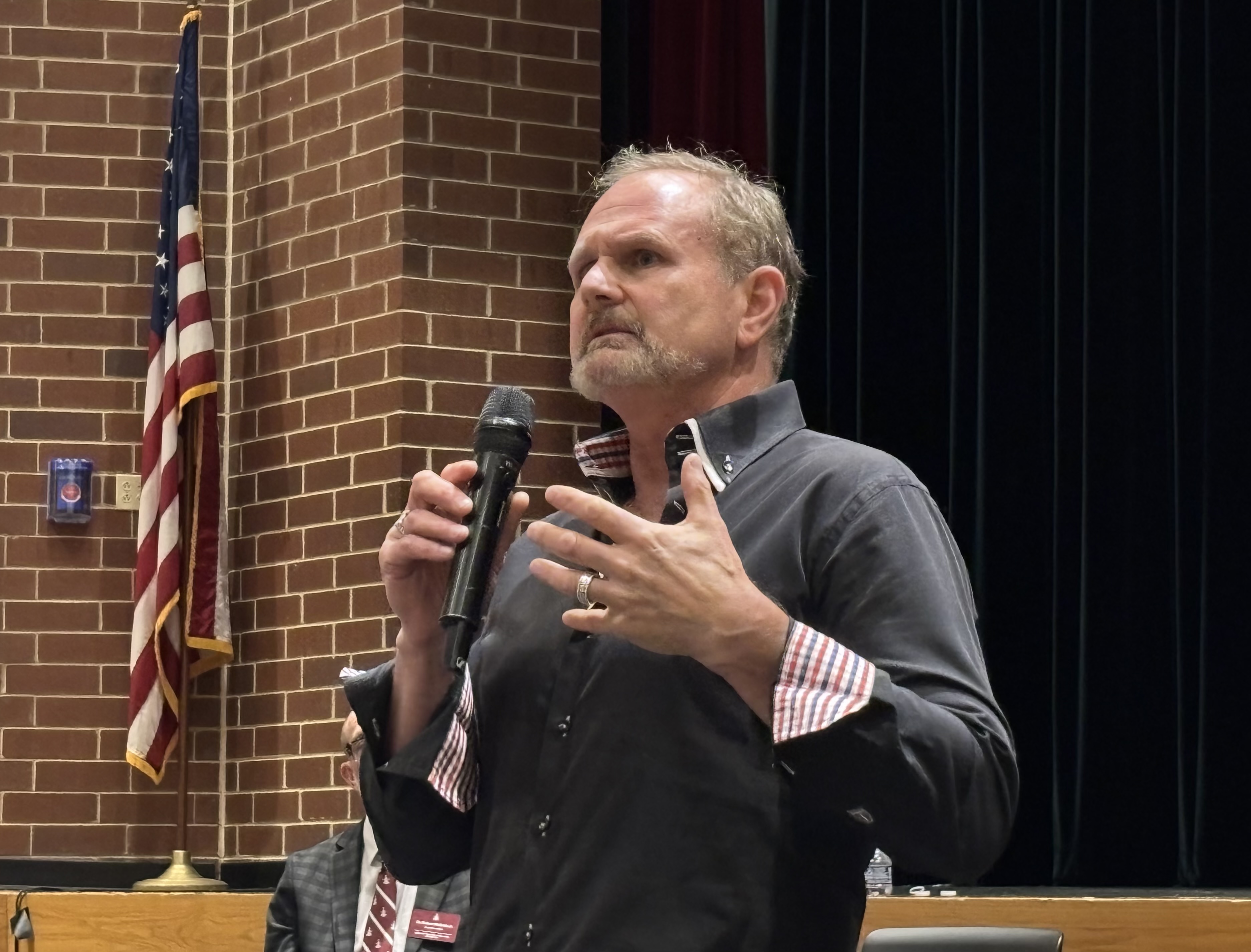

The city of Lockport suspended discussions on the possibility of data center construction Thursday, two days after a public meeting where residents voiced strong opposition.
“Many residents expressed concern that even strong local protections may prove insufficient without broader state and federal oversight addressing the cumulative impacts of the rapidly expanding compute industry and large-scale data center development,” the city said in a news release.
Lockport Mayor Steven Streit emphasized Tuesday the opportunity the city had to impose stringent restrictions on any potential data center, because the parcel of land up for development is owned by the city.
“You can demand full mitigation,” Streit said. “We can demand that they use effluent from our wastewater treatment and not our potable water. We can demand that they make reusable, adaptable buildings if the industry dries up and moves on. We can make a lot of demands that we can’t normally make, because it’s our property.”
However, many residents considered this insufficient, and voiced total opposition to any data center project, regardless of what restrictions the city imposed.
“It doesn’t belong in downtown Lockport,” said resident Barb Guschwan.
The potential development would be located on a city-owned parcel of land close to downtown Lockport referred to as the Star Innovation District, formerly part of a shuttered Texaco oil refinery.
The city initially announced three workshops to explore the possibility of a data center on the property, but only one took place before the city announced Thursday iscussions were suspended.
The city’s news release acknowledged that data centers are largely unregulated, and lack any regional or national protections for power, water and the environment.
“In recognition of those concerns, and until clearer regulatory frameworks are established at the state and federal levels, the City Council will suspend discussions regarding future data center development proposals within the City of Lockport,” the release said.
The lack of regulation and oversight was brought up multiple times by concerned residents Tuesday, some of whom worried the city wouldn’t have the power to enforce the restrictions.
“Let’s talk about regulatory agencies. There are none in Illinois,” said Brent Porfilio. “So who’s watching the henhouse? Who’s watching their water consumption? Who’s watching their energy demand? Who’s watching upgrades for when they expand this thing?”
Proposed legislation known as the POWER Act was introduced in the state legislature in February with the goal of creating a more comprehensive regulatory framework for data centers, including introducing water and power reporting requirements and incentivizing data centers to use renewable energy sources.
Sarah Moskowitz, executive director of the Citizens Utility Board, a consumer protection organization, said Tuesday the bill was unlikely to pass in its current form.
“The POWER Act is a very ambitious piece of proposed legislation,” Moskowitz said. “Important to me is, it would require these facilities to cover their own energy and capacity needs.”
A similar turnabout regarding data center development took place recently in Merrillville, Indiana. After the first of two planned public informational meetings there, Merrillville’s Town Council voted unanimously Tuesday to impose a one-year moratorium on approving any data center projects in town.
elewis@chicagotribune.com


