


A 1970s vintage building that was formerly a plumbing warehouse might not seem like an obvious candidate for renovation, but Catholic Charities’ new Summit Community Center in southwest suburban Summit demonstrates that thoughtful design can create value in less than obvious places.
The project began as a replacement for the food pantry program at nearby St. Blase Church that has been run for many years by Catholic Charities in partnership with the Congregation of Albertine Sisters Serving the Poor (CSAPU). The program occupied cramped and shared space in the school basement that provided far from optimal operations. But when a donor purchased the nondescript brick-clad two-story building at the western entrance to Summit on Archer Avenue, Catholic Charities CEO Sally Blount saw an opportunity to think bigger.



As recently completed, the facility has been designed as a prototype for future Catholic Charities community centers. “The Catholic Church should be doing this because we design sanctuaries,” Blount said. “It’s a sanctuary when we invite someone inside who’s hungry or homeless or traumatized.”
The project was designed by locally based Wheeler Kearns Architects, an 18-person firm with an impressive track record of providing nonprofits with economical but distinguished public-facing facilities through the Chicago area.
That experience led the firm to embrace the existing building’s unassuming presence on the street. “Too often people push for something new, bright and shiny, and then it ends up being rejected by the community because it’s not something that they’re familiar with,” Wheeler Kearns principal Calli Verkamp said. “We’ve found that the community tends to accept these institutions if it feels more familiar to them in the context of their neighborhood.”
The highly visible site greets motorists as they exit Interstate 55 to enter Summit. The exterior has been subtly updated — some new windows and an entrance canopy are the singular additions. The canopy greets visitors with the warm scent of its wood soffit while a rain chain drains the addition’s roof with aplomb. On the opposite side of the building, what was previously the parking lot is now a protected patio space, dubbed the peace garden by the architects.
Wheeler Kearns suggested incorporating the principles of “trauma-informed design” — a relatively new idea that seeks to create spaces that are calm, clear and easy to navigate. Blount was unfamiliar with the term. “Think of a DMV and think about the exact opposite of a DMV,” Wheeler Kearns project architect Emmanuel Garcia told her. “That’s what we’re here for.”
Adaptive reuse almost always comes with unforeseen surprises. In this case, it turned out that the entire second floor structure had been shoddily constructed and did not meet code, necessitating its demolition and the provision of code-compliant construction. Still, retaining the overall masonry shell and roof structure was cost-effective and less carbon-intensive than an entirely new structure.
The original L-shaped structure had two double-height spaces; Wheeler Kearns retained this organization and developed its new floor plans around these spaces. The reception area is anchored by a low table in keeping with trauma-informed design principles — a more typical 42-inch-tall counter could be seen as unapproachable.
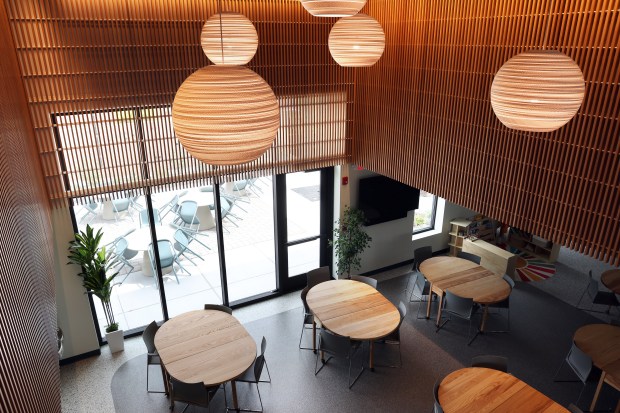
The old loading bay has been recast as the gathering room with tall windows and doors replacing large garage doors. Immediately adjacent to the new entrance on the west side of the building, this space forms the literal and metaphoric heart of the center. Vertical wood slats wrap the upper half of the room and conceal acoustical panels that dampen the sounds in the space. An industrial kitchen is open to the space via a large pass-through that encourages communication between the staff and patrons — much like a neighborhood coffee shop.
The gathering room is typically populated by custom moveable wood tables that were built by Garfield Park-based Revolution Workshop. Garcia described the design as an “heirloom furniture piece” that can be used for dining and conversation in the upright position, but can be a countertop when the leaves are dropped. These varied configurations give the staff options that don’t require the tables to be stored away in space that can be better used for other purposes.
The pantry is the second of the double-height spaces and is organized around three aisles. Mimicking the organization of a supermarket, frozen and refrigerated items are located along a feature wall where they can be restocked from behind the shelves. Clients are chaperoned through the daylit space, although each has a cart and chooses items as you would in a typical grocery store. A basic-needs room evolves the pantry function to provide necessary non-food items for the clientele.
The color palette throughout the building is relatively restrained, with a dark blue used to define the stairs and elevator as well as the refrigerator and freezer sections of the pantry. “The palette on the interior, our goal was to deinstitutionalize the space,” Verkamp said. Blount cited the warmth of the wood and the muted colors as critical interior elements. “I’m so tired of Catholic Charities beige,” she said.
Subtle details add to the experience. The reception area and the lower portion of the gathering room sport a gypsum board ceiling with a grid of tiny perforations that gives texture to the surface while improving the acoustics. The floor — a no-nonsense epoxy surface such as you’d find in a health club — is varied and defines subareas within the larger space.
Offices, classrooms, counseling rooms and training spaces are on the second floor and can be used by partner agencies that supplement the services provided directly by Catholic Charities. A reflection room will eventually provide a chapel-like atmosphere for prayer and quiet contemplation.
And the Summit Community Center promises to be just the first chapter as the partnership between Catholic Charities and Wheeler Kearns Architects continues with four additional projects now underway.
The late Pope Francis spoke of the need to “to encounter people where and as they are,” a charge that Catholic Charities embraces every day as part of its mission. But by rejecting the wanton destruction of old buildings that is the unfortunate norm in Chicago, Wheeler Kearns’ new Summit Community Center demonstrates that we can approach buildings in a similarly generous manner and encourage both human and architectural flourishing through thoughtful design.
Edward Keegan writes, broadcasts and teaches on architectural subjects. Keegan’s biweekly architecture column is supported by a grant from former Tribune critic Blair Kamin, as administered by the not-for-profit Journalism Funding Partners. The Tribune maintains editorial control over assignments and content.
Submit a letter, of no more than 400 words, to the editor here or email letters@chicagotribune.com.


