
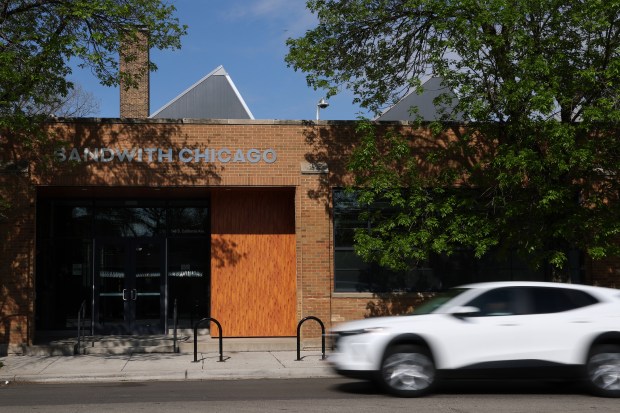

Until now, BandWith Chicago is probably best known for its drumline that has performed at Bears games and Lollapalooza. But BandWith’s new home in East Garfield Park, designed by Chicago-based Lamar Johnson Collective (LJC), provides the organization with architecturally notable facilities that bolster its mission as a neighborhood performing arts center.
Executive Director Annie Palomino started the nonprofit organization in 2013 to provide free music education as Chicago Public Schools cut funding for such programs. For 13 years, BandWith occupied cramped and shared spaces at nearby Marillac St. Vincent Family Services. The earlier home created strong ties with the East Garfield Park neighborhood that the organization hoped to continue.
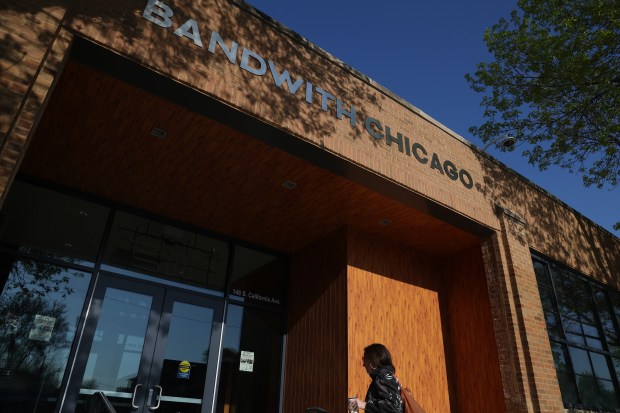
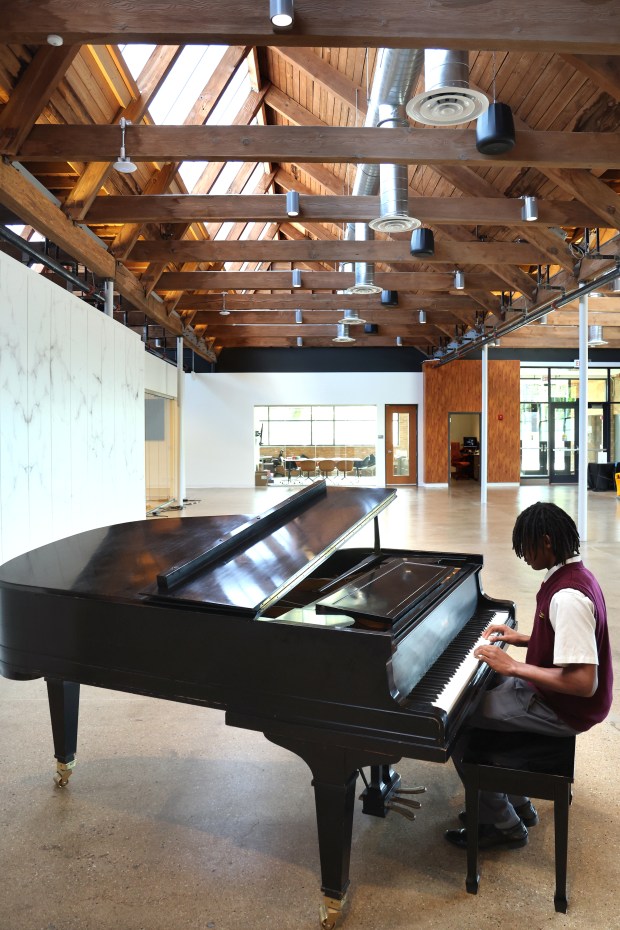
So it was fortuitous when BandWith found a vacant single-story structure only a block away, at South California Avenue, between West Wilcox and West Adams streets. The 25,000-square-foot building was completed in 1925 and once housed J.D. Wallace’s manufacturing facilities for the building’s first few decades. More recently, the building was a casket factory. LJC associate principal Nicholas Moen recalls there was no running water in the building when the design team first visited the site. But “you walked in and you could see the skylights and the heavy timber structure,” he noted. “We just said, this space is awesome, we can handle going through the pain of figuring out how to repair it.”

The recently completed renovation is modern, minimal and Miesian, although the old industrial structure provides more warmth than those terms might suggest. LJC’s design often seems effortless, almost inevitable, although that was hardly the case. Preserving the original character of the structure was paramount. While it’s sometimes hard to tell, masonry repairs were extensive, including new steel lintels above the window openings and the complete reconstruction of several masonry walls. The wood roof deck required patching, which can readily be seen on the interior. New roofing and insulation were provided throughout. The skylights were reframed and glazed.
The original organization of the structure proved helpful. “There’s a structural bay around the whole thing that’s got a flat roof,” Moen said. “All the rooms that needed to be acoustically isolated are under the flat roof, leaving the skylights for the big community room.”
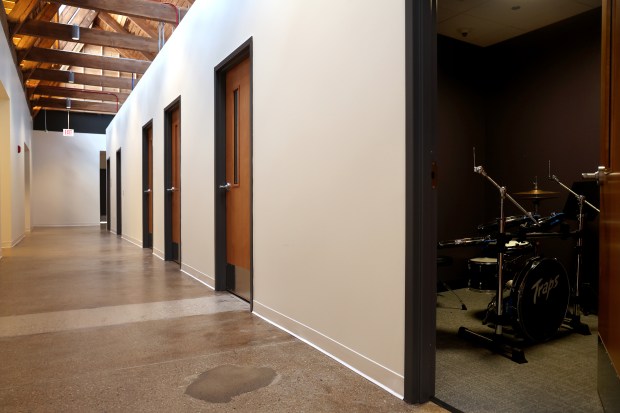
The minimalist impulse extends to the new mechanical and electrical systems. “We worked really hard to make sure that there weren’t ducts running down the middle of the hallway,” Moen said. Likewise, electrical conduits are hidden on the top of the beams and centered down the skylight to leave the focus on the old structure and new walls.

The highlight of the project is seen immediately upon entry — the large open community space under the heavy timber-framed skylights. It features a polished concrete floor and comfortable seating area that supports flexible uses. The timber roof structure is exposed throughout, supported by a 25-feet by 25-feet grid of slight steel columns that punctuate the new spaces in sometimes unusual ways.
“But we arranged everything in a way that we hope that you come in and walk right around it,” Moen said.
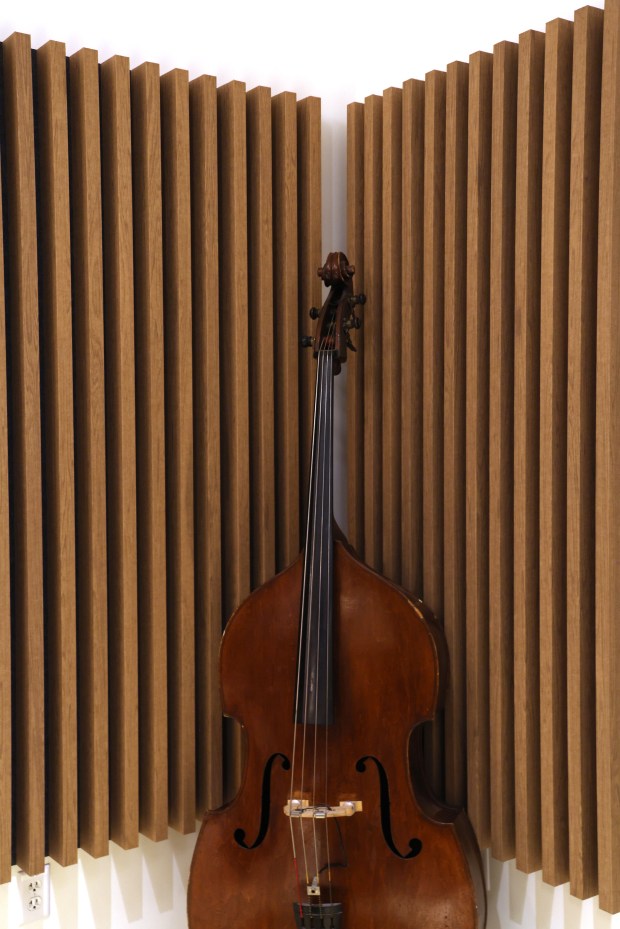
In an environment with lots of hard reflective surfaces, acoustical concerns required the deployment of fabric wrapped acoustical panels throughout. The designers sourced many of these elements from a local vendor who donated panels initially used in their displays at the Merchandise Mart. These were supplemented by custom-designed panels with a marble pattern that lend the community gathering space a more refined tone.

Immediately adjacent to the community room is a dance studio with large floor-to-ceiling windows. Rendered as a box within a box, it becomes a focal point that can act as an extension of the community space. “It’s got a lid on it,” Moen said. “So, they can have a dance rehearsal in there without overwhelming the rest of the space with sound.”
“It’s become (the) centerpiece,” Palomino said. “It’s really fun to sit in here on Saturday morning on one of these couches and there’s various dance classes happening in there.”
A box office — clad in vertical wood siding — greets visitors at the entrance. Once inside, the building’s organization is immediately apparent. “When you walk in the door, everybody sees the skylights, and then you go into the various rooms around the perimeter,” Moen said . These perimeter spaces under the flat roof include a music library, a recording studio, a variety of practice spaces and offices. Most have natural light through newly installed windows.

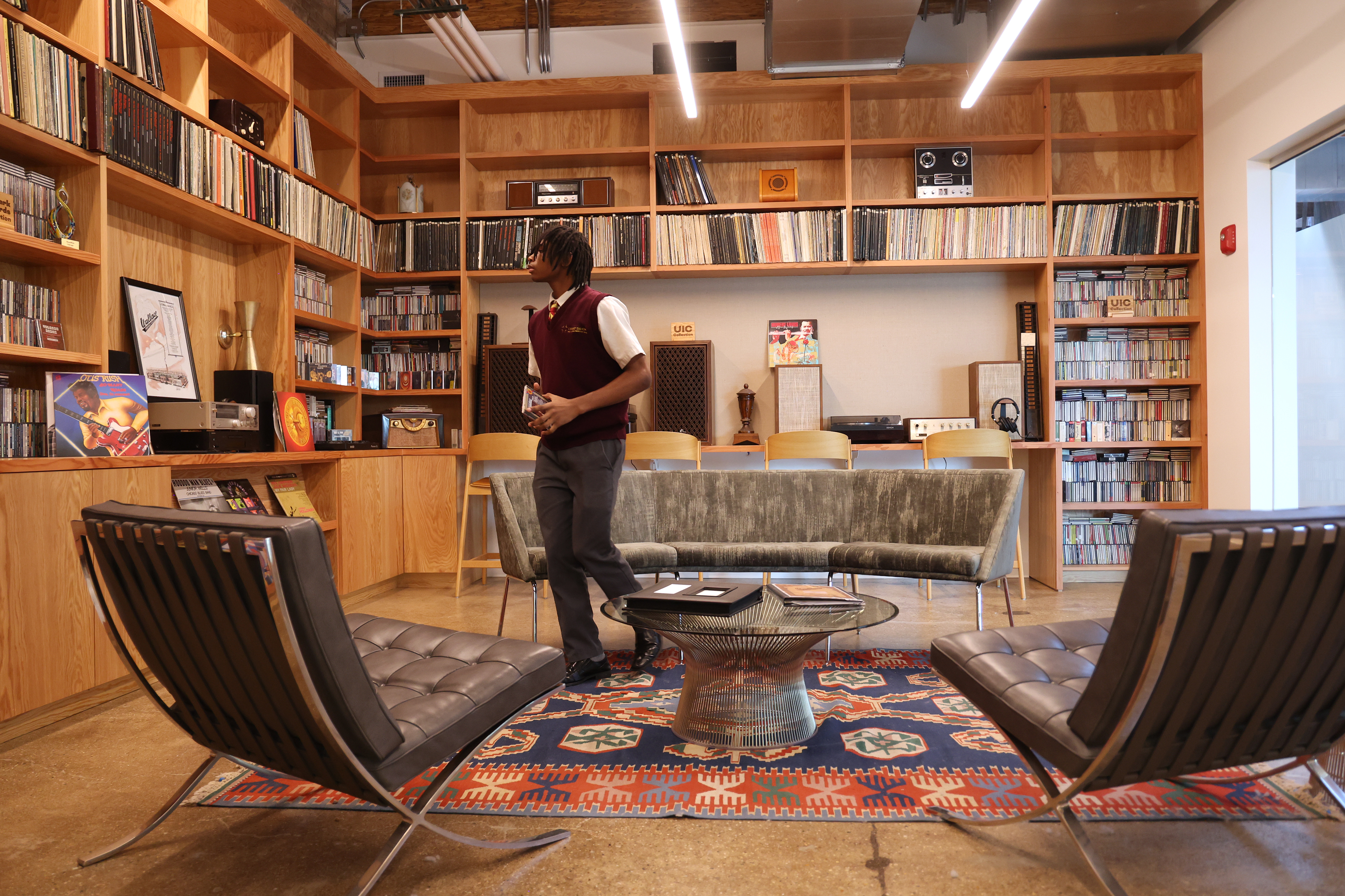
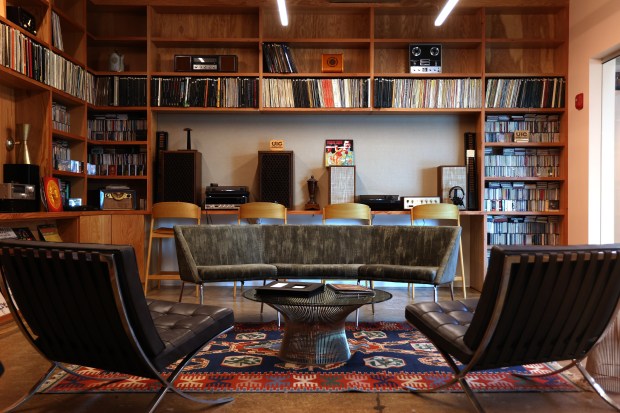
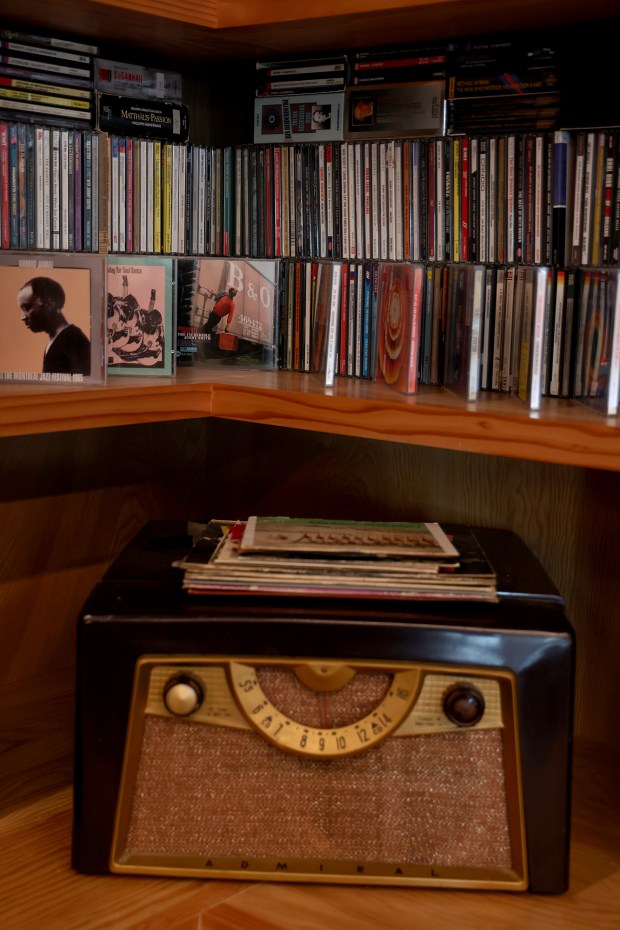
The music library is immediately off the community space and visible upon entering the building. Moen recalls one of Palomino’s first asks was to create a music library where visitors could pull something off the shelf and discover something inspiring that they never knew existed.
BandWith’s reach has grown in the months since occupying the new space, Palomino said. While the group’s ties to its previous home at Marillac remain strong, it is now drawing students from more than 10 grade schools and 35 high schools on the West Side. “We’re much more accessible,” she said.
A recent week’s offerings included an adult step class, a choir workshop, a New Orleans brass workshop, an Afro-Cuban band with music and dance, step dance instruction, and a classical music concert and conversation.
“We want it to be a hub, and we want it to be multigenerational,” Palomino said.
There was a time when a minimalist approach to architecture was virtually required in Chicago, thanks to the dominant influence of Ludwig Mies van der Rohe and the acolytes he trained at the Illinois Institute of Technology. Thankfully, that’s no longer the case.
But BandWith Chicago’s new home in East Garfield Park displays a more contemporary approach to minimalism, one that richly layers old and new elements in a compelling solution that is modest and straightforward while equally elegant and nuanced.
East Garfield Park and Chicago are richer for it.
Edward Keegan writes, broadcasts and teaches on architectural subjects. Keegan’s biweekly architecture column is supported by a grant from former Tribune critic Blair Kamin, as administered by the not-for-profit Journalism Funding Partners. The Tribune maintains editorial control over assignments and content.
Submit a letter, of no more than 400 words, to the editor here or email letters@chicagotribune.com.