
He was the killer of big blond spiders, the fixer of household things, an occasional Santa’s helper. Among his many acts of service, my father volunteered with Chicago’s Christmas Ship, bringing Christmas trees to disadvantaged families in the area.
My father was also a refugee.
Dad was 6 years old when his homeland of Germany attacked Poland and started World War II. My grandmother boarded him on a farm outside Berlin to keep him safe. He remembered running through a field toward the farmhouse as Allied forces strafed it. I always wondered what it must have been like for him, being separated from his mother, who stayed in Berlin, and his father, who was conscripted, and living with strangers far from what was familiar. But he didn’t often recount the past.
Although my father fiercely defended border control, he was outraged by Present Donald Trump’s family separation policies during his first term, which separated more than 5,000 children from their parents at the U.S.-Mexico border. Since Trump’s return to office in 2025, more than 145,000 children have had a parent detained in deportation campaigns, according to a recent Brookings Institution report.
My father did not stay at the farm. When Allied bombing campaigns intensified, my grandmother worried that the railroad tracks would be obliterated, so she brought my father back to Berlin. In an apartment building there, my father and grandmother would listen for the telltale tap of the Gestapo’s hobnail boots and scurry up stairs to the attic to cross over and come down into another section of the building, where my grandmother’s Catholic friend lived, so they could hide.
That haunting piece of family history resurfaced for me when the “Broadview Six” and others protested outside a suburban immigration detention facility. Chicagoans blew whistles and filmed detainments while immigration agents patrolled neighborhoods with military-grade weapons as part of Operation Midway Blitz.
Once, toward the end of WWII, when my father and grandmother were in an air raid shelter, a few Russian soldiers came in, sat in the middle of the room and started cleaning their rifles. Dad told me: “They would aim the weapon at one of us, but not fire it. They seemed to have fun with it. I thought for sure I was going to die that day.” He was only 12. I heard his words again when I read about federal immigration agents descending from a Black Hawk helicopter, breaking down doors, and zip-tying U.S. citizens and immigrants in Chicago’s South Shore neighborhood last September.
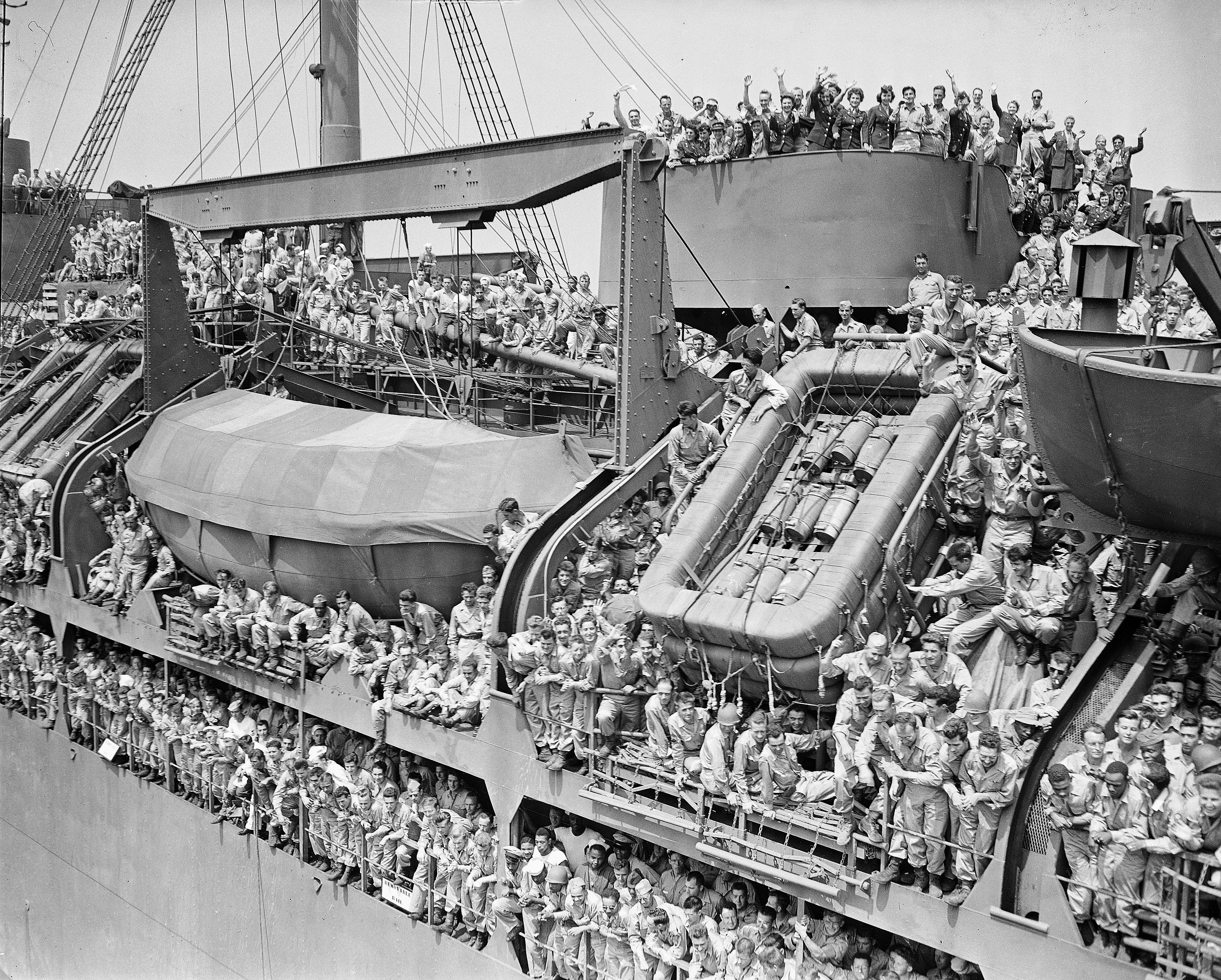
With support from the organization that was the precursor to the United Nations High Commissioner for Refugees, my father and grandmother immigrated to the United States aboard the General Henry Taylor. The ship sailed past the Statue of Liberty into New York Harbor. I imagine my father’s dread and excitement, his sense of loss and hope, as he took his first steps on U.S. soil at age 16.
My father and grandmother were met by an affiliate of the refugee group, who arranged a place for them to sleep and then brought them to Penn Station. They caught a train to Chicago, where my grandmother had some friends, and they were on their own.
If they were seeking safety in the U.S. today, they might need to fly to Mexico as Ukrainians did after Russia’s 2022 invasion. Or they might have to travel on foot across multiple countries, taking only what they could carry; cross the Darién Gap, with its extortioners, traffickers, sexual violators, thieves, flash floods and wild animals; and travel north through Mexico atop a train, eating instant coffee so they wouldn’t fall asleep and roll off. They would arrive at the U.S. border having not bathed in days.
Immigration officials would look at them but not see the people they had been or who they were going to become.
My father and grandmother first settled in Englewood. Dad went to night school to learn English and was attending Englewood High School when he got drafted into the Army. He passed the GED test while completing his military service, earned a bachelor’s degree in business from Northwestern University and built a comfortable middle-class living for himself.
Despite Executive Order 13269, signed by Republican President George W. Bush, which grants expedited citizenship to noncitizens serving honorably in the armed forces, approximately 94,000 noncitizen veterans were at risk of detainment or deportation as of 2024. Over the past year, 248 relatives of former military members have been put into deportation proceedings, 125 former service members have been arrested for immigration violations and 34 former military members have been put into deportation proceedings.
Dad often credited the U.S. for saving his life. He was fiercely proud to be an American, but I am not sure he would recognize his beloved country today.

When the president lets immigration officers operate with expanded authority and limited accountability, threatens to send the military into U.S. cities, strips people of due process and tries to implement indefinite detention without bond hearings, the U.S. resembles the authoritarian country Dad and my grandmother fought so hard to escape.
The life my father built for himself in Chicago would have been impossible in postwar Berlin. In midlife, he taught himself how to sail and eventually served as the commodore of the Burnham Park Yacht Club. He once told me he couldn’t believe someone like him was allowed to belong to a yacht club, let alone lead it.
Dad believed in the promise of the U.S. — that those seeking safety and opportunity would find them here — because he had lived it. That U.S. promise has enabled a pluralistic society that reflects the best of our country’s values: hope and goodwill between peoples, care, concern and understanding. The ruptures in our nation, exemplified by family separation, indefinite detention, mass deportation and an absence of refugee resettlement for most everyone except white South Afrikaners, will destroy the essence of the U.S.
Alex Poppe is an award-winning author of four books of literary fiction and the bestselling “Breakfast Wine,” a memoir-in-essays about her wild ride through Iraq. She has worked in conflict zones such as Iraq, the West Bank and Ukraine.
Submit a letter, of no more than 400 words, to the editor here or email letters@chicagotribune.com.