



Most Chicagoans know Division Street as one of the city’s truly prominent arterial roadways. With its famous designation as “1200 North” in the municipal grid system, it runs from its eastern origin at Lake Shore Drive and the water’s edge to a western terminus at Thatcher Woods in River Forest.
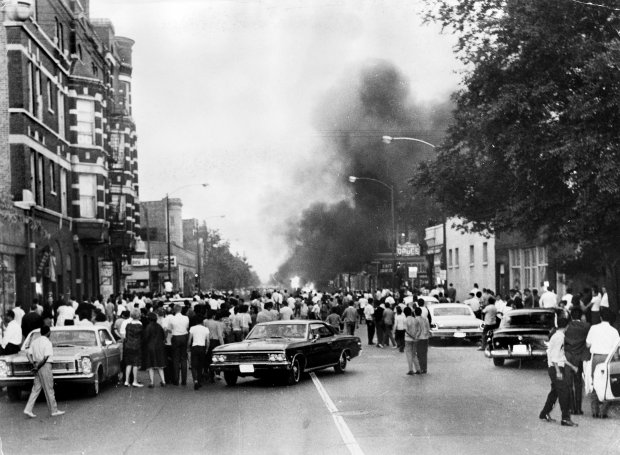
Far fewer Chicagoans know it as the site of one of the most significant of the city’s many violent 1960s social conflicts. Sixty years ago, from June 12 to June 14, 1966, the intersection of Division Street and Damen Avenue was the epicenter of the first recognized uprising of a Puerto Rican community in an American city. It led to a significant, if gradual, change in the social and political standing of Chicago’s Puerto Rican community.
The first major migration of Puerto Ricans to Chicago began in the 1950s, with large numbers settling in Lincoln Park. Many found employment as low-paid laborers in service industries and factories. But the area’s subsequent gentrification prompted the Puerto Rican community to move west to the more affordable neighborhoods of West Town, Wicker Park and Humboldt Park. It was within this forced relocation that the seeds of the 1966 conflict were likely sown.
Life in the Division Street corridor presented new hardships for the Puerto Rican community, including housing discrimination, poor neighborhood schools, restricted access to decent-paying jobs, limited interaction with city services and difficulty in finding church homes. From this grew a sense of isolation that would later manifest itself in a deeply problematic relationship with the Chicago Police Department and its controversial efforts to reduce area crime. Many of the same hardships simultaneously confronted the city’s Black community.
In 1966, Mayor Richard J. Daley pronounced the first week of June as “Puerto Rican Week,” highlighted by neighborhood celebrations and a large State Street parade on June 11. But by the evening of June 12, the tone markedly changed, as police and celebrants clashed at Damen and Division. A young Puerto Rican, alleged to have been carrying a gun, was shot and wounded by police. A crowd of several thousand gathered; police dogs were called in, and the crowd responded with assaults on the police. The angry crowd grew at nightfall, instigated by word of mouth and local radio broadcasts.
The riot surged again on June 13, following a large, peaceful rally organized by area religious and community leaders. Rioters again attacked police with rocks, bottles and other objects, and looted and burned local buildings. On the evening of June 14, over 500 police officers surged into the Division and Damen area in an ultimately successful effort to stifle the rioting, but not before many injuries, arrests and widespread property damage had occurred.
In the riot’s aftermath came several positive developments. A 5-mile protest march from the Division Street neighborhood to City Hall took place, without violence. And the Chicago Commission on Human Relations held a series of hearings on the plight of the city’s Latino residents, which included discussions of the grievances of the Puerto Rican community and the formulation of several policy recommendations. In addition, new Puerto Rican cultural and support organizations began to form, several of which continue to operate to this day. The Chicago Police Department began to hire more Puerto Rican officers. And the development of the Paseo Boricua district on Division, between California and Western, increased community pride.
But with the benefit of 60 years of hindsight, it’s fair to ask: Has lasting progress truly been made since those three hot summer nights in Humboldt Park?
Certainly some. Through the Latino Caucus in Chicago’s City Council and leadership positions in government agencies and institutions, there are measurable indications of Puerto Rican political and commercial influence. But whether it is enough progress, considering that Latinos as a whole represent almost 30% of the city’s population, is debatable. Furthermore, the famous diversity of the city’s broad Latino coalition suggests that the fruits of such influence might not be shared evenly among its constituents.
And any lasting progress must also be measured against other disturbing events. Memories of Operation Midway Blitz remain raw. The plight of the “Broadview Six” should be shocking. U.S. Immigration and Customs Enforcement continues to fund deportation operations and build mass detention facilities. So maybe not so much progress, after all.
The roughly 12 miles of Division Street, from the lakefront to the forest preserve, are lined with many great neighborhoods, each with its own unique stories to tell. Stories of vitality and decline; of abundance and deficit; of community and tension; of tolerance and intolerance. Stories that tell us much about our city, our neighbors and the challenges they continue to face. And as we drive down Division Street, we would do well to acknowledge those challenges and what must be done to redress them.
Michael Peregrine is a retired Chicago lawyer who grew up near Division Street’s River Forest terminus.
Submit a letter, of no more than 400 words, to the editor here or email letters@chicagotribune.com.