

And so Michael Miles was telling me, “Both of them, Bach and Stevie Wonder, are musical geniuses. They create music that makes this often cruel world tolerable.”
Like much of what this musician, teacher, producer and performer has told me over the decades that I have known him, it is intriguing, provocative and interesting. Most of it is also delivered with passion. Or, as former Tribune critic Howard Reich once put it, “The man clearly does not dream small.”
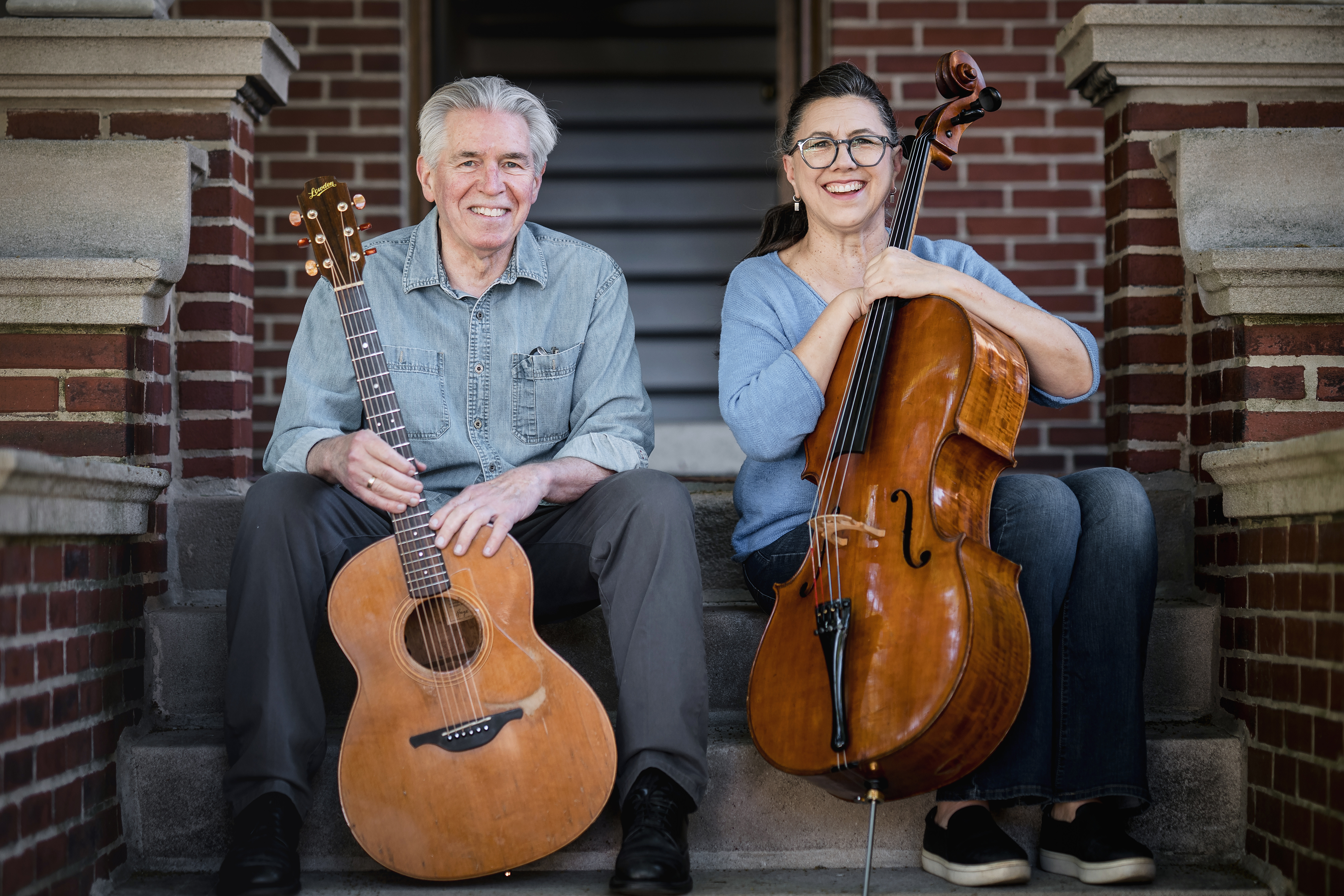
His latest project in his busy musical life is manifested in an album with 11 songs, played on Miles’ guitar and on the cello of his frequent collaborator, Jill Kaeding. They have played Bach together, notably on “American Bach Revisited.” They have played Stevie Wonder, too. And now plenty of others.
Their new album is titled “Great American Jukebox,” and they have been giving a series of concerts where those songs are performed, including June 13 at the Old Town School of Folk Music, with which Miles has long been associated and which in 2019 named him musician and educator of the year.
Among the 11 songs are Stevie Wonder’s “As”; three Lennon-McCartney songs, including “A Day in the Life”; “Madman Across the Water” by Elton John and Bernie Taupin; Peter Green’s “Black Magic Woman”; and, perhaps surprisingly, Stephen Sondheim’s “Send in the Clowns.”
You would not be alone if you think that the “Great American Jukebox” echoes the Great American Songbook, that more familiar phrase used to describe the enduring hits that are the 20th century’s American popular music and jazz standards, focused on the tunes of Tin Pan Alley, Broadway theater and movies.
The precise origin of that phrase cannot be attributed to a single person. But Miles can, if so inclined, claim the “Jukebox” as his own, and he is very energetically spreading the word and the sounds. Not only is there the new album and the concerts, but a new YouTube channel and a website with more than 50 arrangements of these songs and others available as individual sheet music through Hal Leonard.
“It came to me, as do many ideas, at four in the morning,” he says. “I got out of bed, went downstairs, turned on the computer and there it was — Great American Jukebox — and it was quite available. I bought it for $12.”
The timing was perfect. There are many who associate Miles with the banjo, and he is so good with that, that in 1990, banjo master Pete Seeger, hearing Miles play, said, “This is enough to make me want to learn to play the banjo all over again.”
“But I have always played guitar,” Miles tells me. “I have a master’s degree in guitar performance from Northeastern University and have been teaching, too. And playing both the banjo and guitar, it’s kind of given me a more balanced musical diet. And with this new CD being able to, in a sense, step inside Carole King and figure out how she was feeling when composing. That’s the thing about arranging. It’s riddle solving.”
For me, and I have to assume for many of you of the same vintage, the familiarity of the songs enriches the listening. Without words, we supply the lyrics, but also listen more intently and the music soars.
Miles describes the album as a gathering of songs “reimagined for solo fingerstyle guitar and for the chamber‑like interplay of guitar and cello.”

I describe it as ambitious, and that is what I have come to expect from Miles. I got to experience him firsthand when we collaborated a few years ago on a series of productions under the “Panorama” title, combining music, spoken word, film and other entertainments on stage at the Hideout. Kaeding often shared the stage.
He is well-organized, thoughtful and lively. Like me, and I assume like many of you reading this, he is of a certain age at which a jukebox is a good memory. You’ll still see one every once in a while, but it’s easy to forget what an important role this city played in jukebox history. For decades, this was the center of jukebox manufacturing, with Seeburg, Wurlitzer, Rock-Ola and AMI dominating the market.
Only Rock-Ola survives. Founded in Chicago in 1927, it built gumball and pinball machines before getting into the jukebox biz in 1935. It moved to Southern California in 1992. I was pleased to learn that the company name has nothing to do with rock ‘n’ roll. It was named after its founder, David Rockola.
Miles did not know that but was thrilled to learn. He then told me how he believes that we all have an inner jukebox in our heads and then said, “Composers are like painters, using notes to color chords, like an artist’s palette. In exploring these songs, I am solving the riddle and understanding the songs more deeply.”
After talking, I went back and re-listened to the album. Better the third time around, and I expect the next time will be better still. On Miles’ website, I also noticed this: “William Blake said: ‘Mine is to create, not to compare.’ Me, I want to create and share. Deeply. That’s what my performances are all about.”
If you go
Album release concert 8 p.m. June 13 at Old Town School of Folk Music, 4544 N. Lincoln Ave.; $39, 773-728-6000 and www.oldtownschool.org
rkogan@chicagotribune.com


