
Salah Sarsour’s journey since he emigrated to the Midwest had been what his attorneys describe as “the embodiment of the American Dream.”
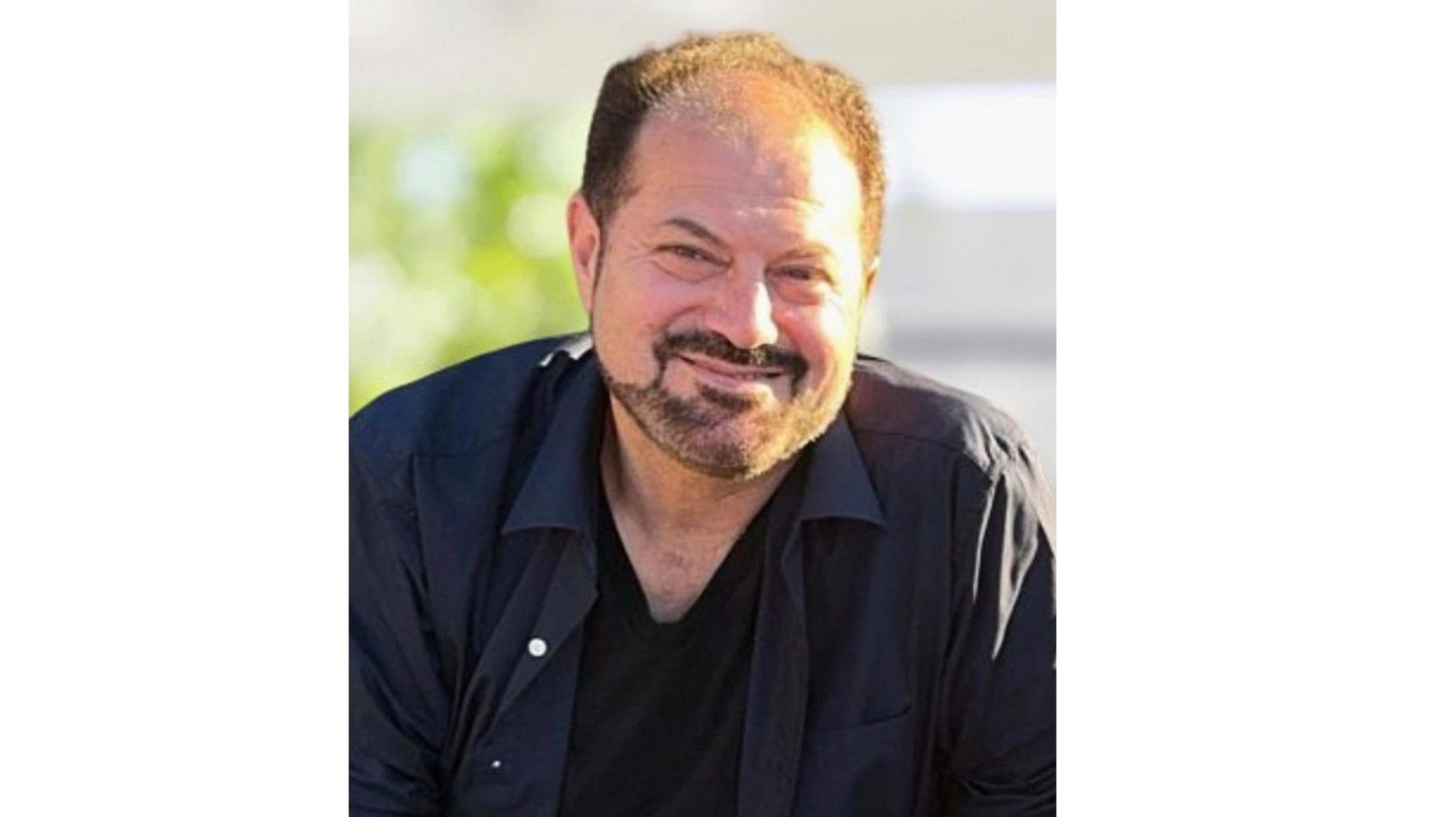
Sarsour, a Palestinian-born man who settled in Milwaukee more than three decades ago after a stint behind bars as a teenager in Israel, became a business owner and, per a motion for his release, “a vital thread in the social and spiritual fabric” of the city’s Muslim community.
By 2026, the 53-year-old was in his fifth year as the board president of the largest mosque in Wisconsin and looking forward to the arrival of a tenth grandchild.
But in March, federal immigration agents arrested Sarsour, a legal permanent resident, setting off court battles over differing narratives of his time in the Middle East and the conditions he faces in detention, with lawyers from the American Civil Liberties Union of Illinois among those fighting for his release as his health declines.
Though the case is rooted in neighboring Wisconsin, it has touched U.S. district and immigration courts across the Midwest as Sarsour’s legal team and federal attorneys go back in forth in court filings over his detention and the conditions he faces while jailed.
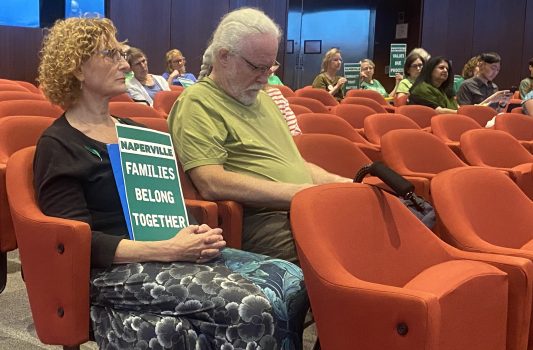
And in Chicago, a trio of progressive aldermen are pushing for a resolution that would formally call on U.S. Department of Homeland Security and U.S. Immigration and Customs Enforcement for Sarsour’s release. That resolution, introduced in April, passed out of the City Council Committee on Health and Human Relations but was referred back to the committee May 20, city clerk records show.
Sarsour’s attorneys have drawn comparisons between his case and other high-profile examples of the Trump administration’s alleged political targeting of pro-Palestinian student activists like Mahmoud Khalil and Mohsen Mahdawi.
Samuel Cole, an immigration attorney with the ACLU of Illinois, said Sarsour had “clearly been targeted” for his activism for the Palestinian cause and said other pro-Palestinian advocates who were watching the case unfold should remember “you have the right to express your beliefs.”
“This administration cannot silence you,” he said. “The Constitution gives you the right to support Palestinian rights and you should not be intimidated.”
‘He’s being silenced’
On the morning of March 30, Sarsour was picking up his mail on his way to work when an unmarked car sped toward him and a man with a gun got out, pointed the weapon at him and demanded he identify himself, according to an April 13 petition for his release. Nearly a dozen cars carrying plainclothes federal officers arrived moments later.
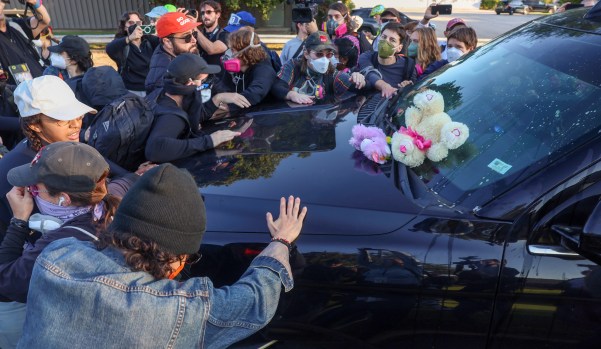
The officers were U.S. Immigration and Customs Enforcement officers, court records state, and they took a “terrified” Sarsour from Milwaukee, where he spent 33 years, to the notorious Immigration and Customs Enforcement processing center in west suburban Broadview.
According to a petition for his release, Sarsour was only at Broadview for a few hours, before he was transferred to a jail in Clay County, Indiana. Like other reports from detainees in federal custody in Broadview, Sarsour’s lawyers said in the motion to support his petition that he was told that his best option would be to agree to deportation.
Clay County is a common landing spot for people arrested in the upper Midwest, and detainees there typically have their cases heard in either the Indianapolis or Chicago immigration court, where Sarsour was originally told to appear.
But according to court records, federal authorities made the unusual move to transfer Sarsour’s case from immigration court in Chicago to Kansas City about a week after his arrest. They also assigned it to one of two Regional Deputy Chief Immigration Judges, who are two levels more senior than the standard “line” immigration judge who handles the vast majority of removal proceedings.
A representative with the Executive Office for Immigration Review, which runs the country’s immigration court system, said the agency didn’t comment on cases.
Representatives from the U.S. Department of Homeland Security doubled down on statements made in an April press release, which alleged that he was suspected of funding an unspecified terrorist group. In a statement, a spokesperson called Sarsour “a terrorist who was convicted of throwing Molotov cocktails at the homes of Israeli armed forces” and alleged that he lied on his green card application, which was granted in full in 1998.
Court filings on Sarsour’s behalf tell a different story: Sarsour emigrated to the U.S. seeking “freedoms of speech and association, equal protection and due process” after two years of imprisonment for “throwing stones” at Israeli military members.
On a visit back to the West Bank in 1995, the motion for Sarsour’s release alleges that he was held in solitary confinement for 78 days and tortured before signing what was described in his court filings as a “coerced statement” as he tried to reunite with his family.
Per the motion, Sarsour at one point spoke to FBI agents about his arrests, which the U.S. government evaluated four times between 2000 and 2019 while they determined Sarsour’s eligibility for naturalization.
“The charges against him are things that the government has known about,” said Cole, the ACLU immigration attorney. “It’s not new.”
Cole chalked his arrest after decades in the U.S. up to one of “many other examples of the Trump administration’s unlawful efforts to silence Palestinian activists.”
Sarsour shares a lawyer with Madawi, a pro-Palestinian Columbia University graduate student activist who was arrested last year at a citizenship interview.
Court filings on Sarsour’s behalf draw extensive parallels between Sarsour and other high-profile cases like that of Madawi and Khalil, the former Columbia university graduate student who was one of the most visible faces of the school’s encampment protesting Israel’s war in Gaza.
Rather than being part of routine immigration enforcement, the attorneys wrote, Sarsour’s detention is “an extraordinary abuse of his constitutional rights and part of an extraordinary policy attacking First Amendment freedoms” and “the product of a documented, coordinated multi-agency campaign being waged by the government against Palestinians and advocates for Palestinian human rights.”
Besides serving as the president of Wisconsin’s largest mosque, the Islamic Society of Milwaukee, Sarsour is also a board member of the nonprofit group American Muslims for Palestine.
His legal team has pointed out in court filings that Trump administration officials had pledged to go after organizations like American Muslims for Palestine in the weeks before Sarsour was arrested.
And they’ve said in court filings that Secretary of State Marco Rubio last summer issued an internal memorandum that determined Sarsour was eligible for deportation under the same provision of a rarely-used statute to justify the detentions of Mahdawi and Khalil.
That law, the Immigration and Nationality Act, allows officials to expel people who pose “potentially serious adverse foreign policy consequences for the United States.”
Luna Droubi, the attorney who represents both Mahdawi and Sarsour, said there was “no reason” for Sarsour to remain jailed.
“He’s being silenced,” she said. “It’s what the government wants.”
Worsening health
Sarsour passed the two-month mark in federal detention on May 30. But his attorneys say the time in custody is taking a severe toll on his health.
In a Friday letter to Indiana District Judge James Patrick Hanlon, Sarsour’s lawyers said the 53-year-old, who is diabetic, has developed severe abdominal pain and that his blood sugar levels are not being checked consistently. Jail guards are also discriminating against him, his attorneys allege, trying to confiscate his Quran and interrupting his prayers.
U.S. Department of Homeland Security representatives, reached by email, wrote that “any accusation of discrimination by ICE agents is FALSE” and that “all illegal aliens in ICE custody receive three meals a day and proper medical treatment.” Department of Justice lawyers also filed their own letter to Hanlon Monday calling the allegations “unfounded” and arguing that his lawyers’ claims about the conditions in jail had no bearing on whether he should be released.
Federal lawyers also provided a list of purchases Sarsour had made from the jail’s commissary — mostly snack packages and coffee — and a written declaration from an Assistant Field Office Director Douglas Thompson, who supervises the Clay County Jail. In the declaration, Thompson testified that Sarsour had been given his diabetes medication every day he had been in custody except for two. Thompson also denied that Sarsour did not have access to a Quran and said he’d reviewed surveillance footage both of jail guards handing him the book and of Sarsour holding it from two separate days while he was in custody.
Cole, in a written statement to the Tribune, said it was “appalling” that the government would refer to a list of snacks purchased that included pork to make a case that Sarsour was being treated fairly while in custody.
“After seizing (Sarsour) at gun point and holding him for over 60 days in a cell, the government responds to our request for religious and medical accommodations by suggesting that a devout Muslim eat (barbecued) pork rinds as a snack and that they only check (Sarsour’s) blood-sugar levels once a month,” Cole wrote. “The government is required to provide him with adequate medical and religious accommodations.”
Sen. Tammy Baldwin, D-Wisconsin, called for Sarsour’s release last month, echoing lawyers and citizens’ assertions that he is a “a respected leader in the Milwaukee community” who has “spoken out passionately against the war in Gaza and on issues impacting the Islamic community.”
In the letter, also signed by Democratic Sens. Bernie Sanders of Vermont and Chris Van Hollen of Maryland, Baldwin raised concerns about Sarsour’s treatment and religious freedom while in detention and questioned why the government would detain someone with legal permanent residency.
“Any attempt by the government to punish an individual for espousing political views it disagrees with is wrong and unconstitutional,” the letter read.
Hanlon is expected to have a status hearing on Sarsour’s case Monday, his legal team said.