
When architect Daniel Burnham created the 1909 Plan of Chicago, his “make no little plans” vision shaped the development of the city, its parks system and its open lakefront for more than a century.
World Business Chicago, which hosted the “Horizon Lines” open design contest this spring, is hoping it may have found the next big idea to transform the city’s future.
Some 200 would-be Burnhams submitted their own bold visions for what Chicago could look like circa 2050, with proposals ranging from building islands out into Lake Michigan to creating themed public toilets across the city. Six concepts emerged as finalists Wednesday, vying for a $5,000 prize and a potential pathway to development.
“We asked Chicagoans to help us do something ambitious — to imagine the future of our city in ways that are both visionary and grounded in real opportunity — and these finalists deliver exactly that,” Phil Clement, CEO of World Business Chicago, the city’s economic development arm, said in a news release.
Clement was part of a 10-member jury that selected the six finalists, whose work will be on display — along with the best of the rest — throughout the summer at the Chicago Cultural Center, with the public invited to visit and weigh in on their favorites.
Here are the six big ideas in the running to become the next Millennium Park or Riverwalk, potentially transforming Chicago’s cityscape, with some color commentary by Elle Rampel, chief of staff at World Business Chicago, who headed up the initiative.
Green City Rising: Chicago’s Living Network of Neighborhood Arboreta

The Morton Arboretum is seeking to help Chicago live up to its official motto since incorporating in 1837, “Urbs in Horto,” which means city in a garden. The plan, put simply, is more trees. Chicago’s urban landscape has transformed dramatically as the birthplace of the skyscraper, but the city has retained significant native splendor, thanks to the design ideas of early urban planners. The Morton Arboretum is proposing a return to Chicago’s roots by creating a network of mini-forests across city neighborhoods.
“We are missing forest canopy in our city, we have a lot of concrete buildings, and this would really help to kind of bring it back to what Chicago used to look like,” Rampel said. “People love trees.”
The Third Frontage Initiative

The initiative envisions transforming the city’s 1,900-mile alley network, long the domain of hulking garbage trucks and foraging rats, into a new neighborhood streetscape with housing, green infrastructure and strolling pedestrians. Submitted by colleagues at Chicago architecture firms Gensler and Adrian Smith + Gordon Gill, the plan would retain the functionality of alleys but add civic life by converting unused garages into housing, planting vegetation and rolling out the welcome wagon block-by-block to reposition the city’s expansive backyard corridors into a residential zone.
“Chicago’s next great public realm may already exist, hidden in plain sight,” wrote plan authors Tian Ouyang and Yibin Yang.
Repairing the Scars of the Interstate Highway Era

The proposal by the Metropolitan Planning Council seeks to essentially cover below-grade stretches of the Dan Ryan and Eisenhower expressways with green civic spaces, turning the interstates into de facto tunnels and their roofs into pedestrian-friendly parkways connecting previously divided neighborhoods. The concept is not dissimilar to the Big Dig, a $15 billion, 16-year project completed in 2007 that buried a Boston highway underground, creating 300 acres of open land and reconnecting downtown to the waterfront.
“These highways cut through our cities, but they could still serve as a passageway underneath,” Rampel said. “On top, you have land that could be built, it could be taxed, it could be leveraged, it could be used for parks.”
Wonderways: Reimagining Chicago’s Boulevards as a Network of Climate Commons

Listed on the National Register of Historic Places, Chicago’s century-old Boulevard system is a 26-mile “emerald necklace” around the city, featuring grand streets with wide parkways and expansive green space stretching from Jackson Park to Lincoln Park. The Midway Plaisance was the city’s first designed boulevard, constructed for the Columbian Exposition of 1893. Chicago design firm MKSK reimagines the boulevard system as “a network of ecological and social landscapes” connecting the parks ringing the city. The plan would expand the tree canopy, restore prairies and micro-forests and turn trails into active recreational spaces across neighborhoods.
“This is a concept to really capitalize on the boulevards that have made Chicago famous — these wide, leafy and green spaces — but the idea is to incorporate more nature,” Rampel said. “Even areas that incorporate wildlife.”
AgriFlats

A proposal from Chicago-based Wheeler Kearns Architects would turn the city’s food deserts into urban agricultural zones, where growers live and work in interconnected greenhouses. The creation of Chicago’s first food district would provide 13 aspiring growers with 1-acre greenhouses and attached living quarters for year-round produce cultivation. AgriFlats would create 230 permanent jobs and a farm-to-table, pesticide-free supplier of homegrown vegetables to residents and the city’s top restaurants.
The idea of urban farming has been pioneered by companies such as Brooklyn-based Gotham Greens, which has opened two massive commercial agricultural greenhouses in the Pullman neighborhood on Chicago’s Far South Side. The AgriFlats proposal would locate its greenhouses in the same neighborhood.
“AgriFlats doesn’t just grow food,” the proposal states. “It grows community.”
Re-Loop, The Living Mile

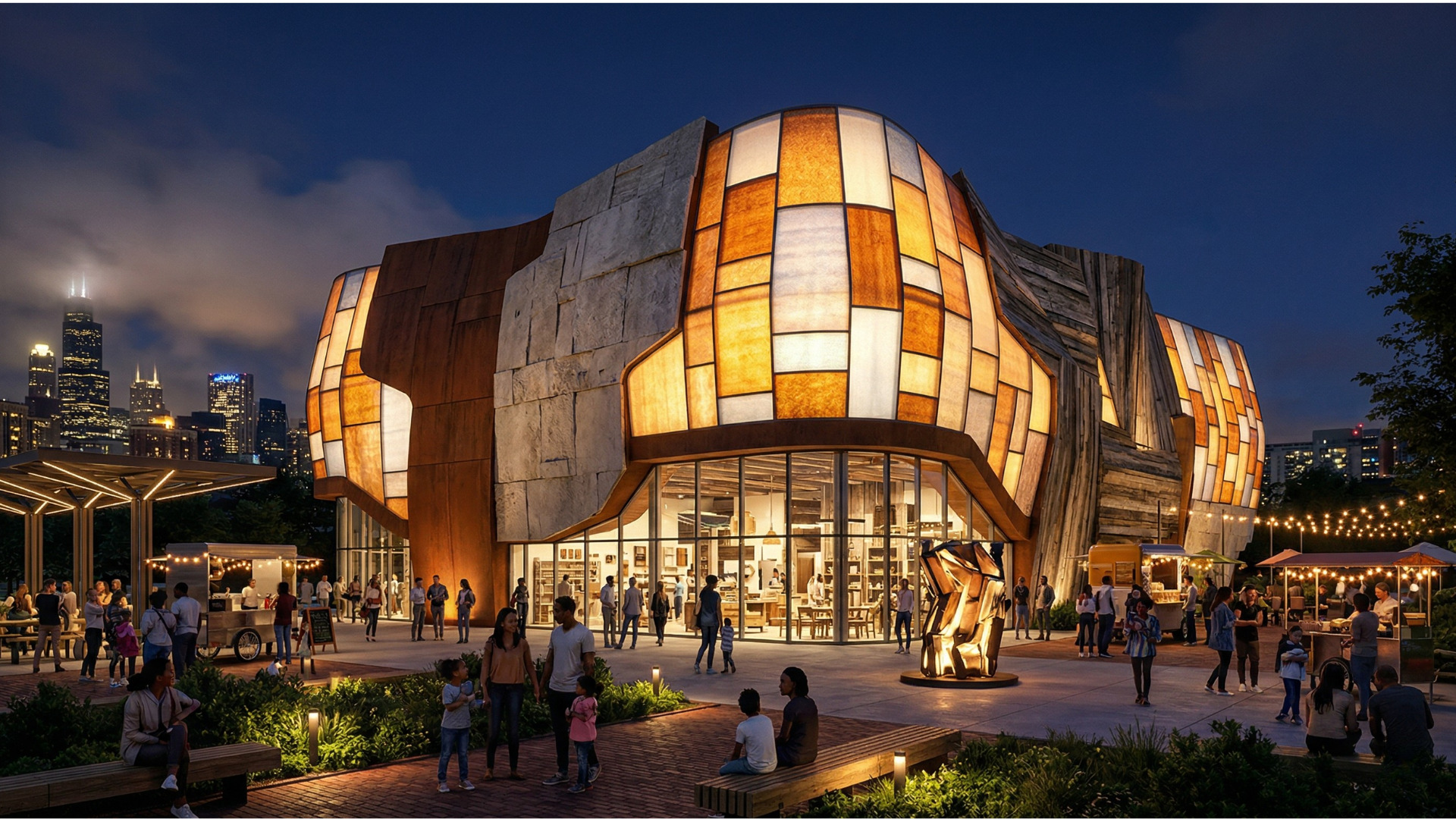
Imagine a South Side tourist attraction built from Chicago’s refuse. That’s what a coalition of recycling advocates did with a walkable “experience district” featuring “80-foot sculptures forged from crushed CTA rail steel,” food stalls and a permanent home for salvage businesses, makers and fabrication programs already doing such work on the South and West sides. Re-Loop would be located on undeveloped land near Rate Field, perhaps becoming an international attraction rivaling The Bean, its backers contend. With the White Sox contemplating a move to a new stadium, a walkable recycling district might help salvage the area’s tourism appeal.
World Business Chicago will award a $5,000 prize to the winning concept and $1,000 each to the five other “Horizon Lines” finalists. Selected teams will also receive “early engagement opportunities” to discuss their projects with city planning officials, according to the news release.
Visitors to the free Cultural Center exhibit will be able to offer feedback on the proposals through July 24. The winner will be announced Sept. 15. The exhibit runs through Sept. 20
In addition to the six finalists, the best of the other submissions — from longtime Chicago residents to lofty international design firms — will also be on display, reflecting the “no small plans” of the city’s design heritage. Those include everything from an elevated Buckingham Fountain rivaling the Eiffel Tower to a series of manmade islands extending into Lake Michigan.
Another notable submission came from a group of global architects organized by Chicago-based Perkins & Will, who created a series of artistic public toilets designed to reflect their prominent locations around the city.
Despite not making the final cut, Rampel said the idea could be both a tourist attraction and a functional addition to the city streetscape.
“Maybe this is something that we really need to think about as a city,” Rampel said.
rchannick@chicagotribune.com