
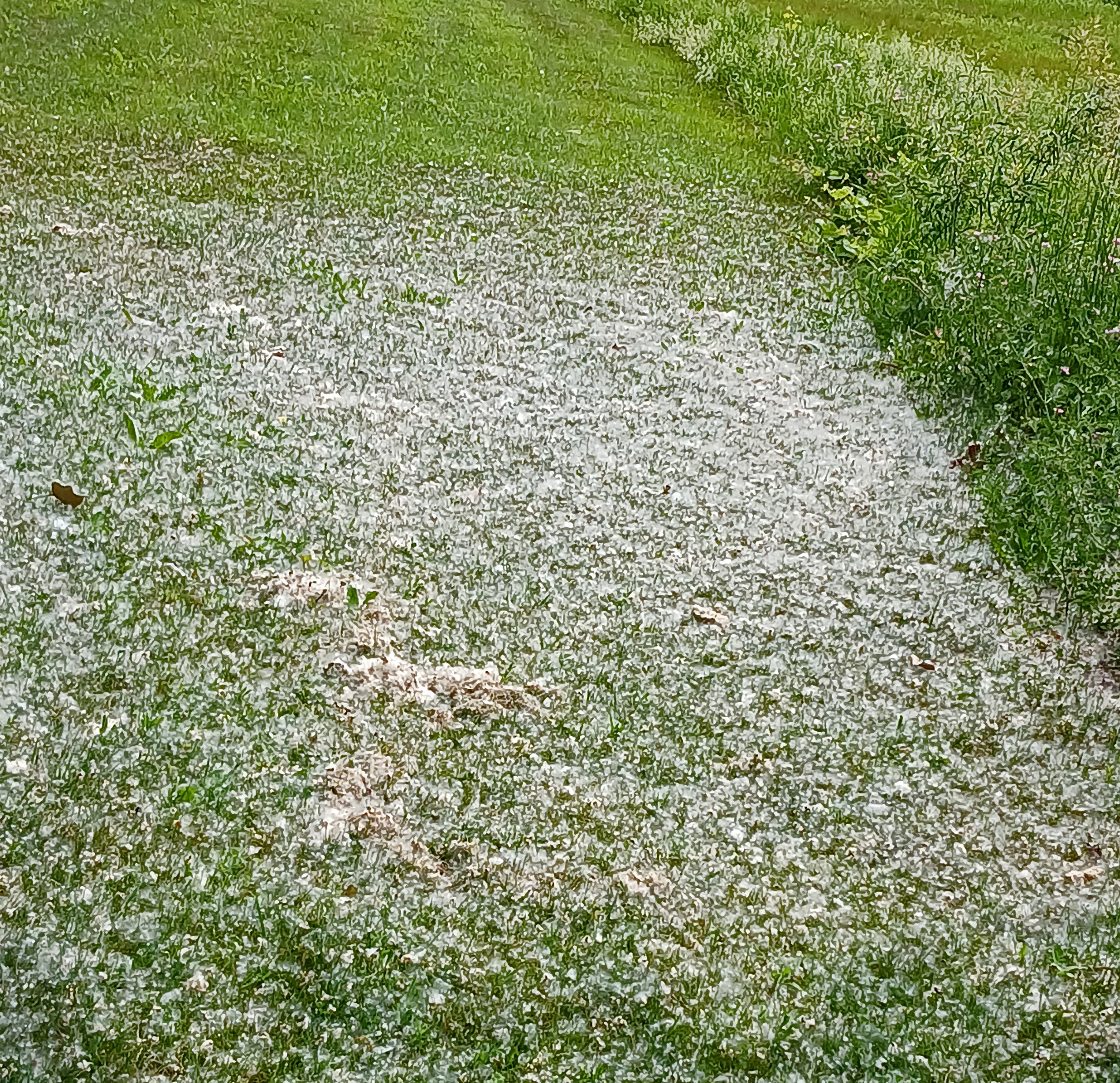

When growing up, I often noticed tiny cotton fluffs floating on the wind in June. I’m not sure when it finally dawned on me that these fluffs were dispersing the seeds of the eastern cottonwood tree. As a child, it’s more fun to think that it’s snowing in June when the white stuff sails to the ground sometimes gathering in large quantities along the sidewalk. It’s possible I even believed that’s where all those cotton balls in the medicine cabinet came from.
It’s “snowing” again in June in my neighborhood. The other day, like a child, I tried to catch some of the snow as it fell. I also visited two Lake County forest preserves to look for more signs of the eastern cottonwood. They’re easy to identify by noticing the 3- to 7-inch-long, triangularly shaped leaves with tiny, rounded teeth and a point on the end.

A member of the poplar family, the fast-growing eastern cottonwood can reach 100 feet or taller and live 100 years or more. The largest eastern cottonwood in Illinois, located in Ogle County, is 122 feet tall and is likely 200 years old.
A second species of cottonwood in Illinois, the swamp cottonwood, is much smaller with much larger leaves and only found in the southern third of the state.
Cottonwoods prefer moist areas, often growing along rivers and lakes. Young eastern cottonwoods have greenish gray bark; mature trees have a furrowed, gray bark and trunk. As with other members of the poplar family such as quaking aspen, the part of the tree that attaches the leaf to the branch is several inches long, causing leaves to flap rapidly from side to side when the wind blows.
The cottonwood won’t produce its seeds until it’s roughly 10 years old, and its most prolific seed-bearing time occurs when it’s 30 years old.
Only female trees produce the cotton. It starts early in spring when flowers on the trees form on short hanging stems called catkins. Male catkins develop pollen which drifts on the wind to pollinate female flowers. The flowers ripen into seeds attached to white hairs called pappi that allow them to float hundreds of feet in the air as well as on the water, traveling downstream.
Some folks, including Bill Richmond of Palatine, love what cottonwood trees symbolize. He recently wrote on a Facebook page that the floating seeds “signify the end of the school year and beginning of summer in northeastern Illinois.”
Others bemoan the mess they make and the sneezes they produce. Botanists say the floating cotton masses from the cottonwood trees likely do not cause allergies. If you’re sneezing when the “cottony snow” is falling, it’s from wind-borne pollen from some other tree such as an oak.
Cottonwoods can be messy. Large, shallow-growing roots sometimes cause problems with septic systems and underground pipes. Brittle limbs easily break and fall during strong winds and storms, potentially causing damage in residential areas. Some towns, such as the village of Glencoe, forbid the planting of cottonwood trees on any public property or right-of-way. The village of Glenview lists the cottonwood tree as a “lesser quality tree” compared with other native trees.
The Lake County Forest Preserves removes what it calls “aggressive native cottonwoods” from some of its properties to encourage growth of other native plants leading to a more diverse, robust ecosystem. The Forest Preserves of Cook County follow a similar practice.

Long before the ecosystems in Illinois were altered by settlers, Native Americans used cottonwood bark for food and medicine, and the roots to create ceremonial items.
Today, cottonwood tree bark is harvested for pulpwood, wooden kitchen utensils and sometimes, the sticks that hold summertime treats like popsicles.
Out in the wild, Baltimore orioles, the bright orange and black birds that sing in neighborhoods in spring and summer, build their pendulous hanging nests on cottonwood trees. Great blue herons, which breed in our region, make platform nests on the upper branches of dead and live cottonwoods. Bald eagles nest in cottonwood trees as well. In fact, two baby eagles hatched this year in April in a large cottonwood tree in Chicago.
Rose-breasted grosbeaks eat the seeds, while cedar waxwings munch on the flowers in early spring. Beavers eat the bark and leaves. In addition, the tree’s roots help curb streambank erosion.
There’s much to love about cottonwood trees and their rightful place in our natural environment, such as along the Des Plaines River at Ryerson, Wright and Half Day Woods in Lake County. Eastern cottonwoods can be just as magical as the revered mighty oak.
Sheryl DeVore has worked as a full-time and freelance reporter, editor and photographer for the Chicago Tribune and its subsidiaries. She’s the author of several books on nature and the environment and co-author of a coming book on “Birds of the Midwest,” to be published by Timber Press. Send story ideas and thoughts to sheryldevorewriter@gmail.com.


